
7 Days Masai Mara Safari: 2027 Prices, Itinerary & Guide
7 Days Masai Mara Safari | Written by David Njunge, TRA Licensed Safari Guide (10+ years)
7 days Masai Mara safari rates for 2027, by road with two sharing, run from KES 185,500 for Kenyan citizens, KES 208,000 for residents and USD 2,690 for non-residents, or KES 115,500 each for six. You get six nights full board in or right beside the reserve, eleven game drives and every corner of the Mara covered.
Why Spend a Whole Week in the Masai Mara?
Most people never see more than the corner of the Mara nearest their camp. In a week you work through all of it: the Musiara Marsh in the north, the Talek and the central plains, the Triangle across the river and the open south down to the Sand River. By the second half of the week you are coming back to animals you already know, so a cheetah you found on Tuesday is one you can track down again on Friday and watch her hunt.
It is not for everyone. If you are new to Kenya and keen on seeing several parks, a shorter stay in the Mara paired with another park may suit you better. We already have full itineraries and prices for those trips: Lake Nakuru for rhinos, Lake Naivasha for a boat ride and a walk on Crescent Island, Amboseli for elephants under Kilimanjaro, or a three-park route with Amboseli and Nakuru. Our comparisons of the Mara with Amboseli and Samburu help if you are torn. If what you want is depth, though, the Mara has more than enough for seven days, and the rest of this page is about doing exactly that.
| Who It Suits | Why a Full Week Works |
|---|---|
| Photographers | Time to wait for the light, the right behaviour and the second and third attempt at the same scene |
| Repeat visitors | You already like the Mara and want to see the parts a short trip never reaches |
| Migration chasers | Several river mornings in July to October, which is what it takes to see a crossing |
| Families and slow travellers | Afternoons off without feeling you are missing anything |
2027 Prices
Each figure is what one person pays for the week when two share a room and have the Land Cruiser to themselves. Low season is January to June and peak is July to December. Three camps sit in each tier, and the figure is set by the most expensive of them for that season, which means you can pick any of the three without the price changing. Over Easter, Christmas and New Year the camps also charge a festive surcharge of their own.
Jump to: Kenyan Citizens | Non-Residents | Kenya and East African Residents | Four or Six People
Travelling with children? Children aged 8 and under go into the Mara free. From 9 to 17 they pay the child park fee: KES 300 in low season and KES 500 in peak for citizens, KES 1,000 and KES 2,000 for residents, and USD 50 all year for non-residents. Most camps also charge less for a child sharing with parents, and each camp sets its own age bands, so we price children on your quote.
Kenyan Citizens
| Tier | Low Season | Peak Season | Camps |
|---|---|---|---|
| Budget | KES 185,500 | KES 213,500 | Oldarpoi Mara Camp, Olailepo Mara Camp, Masai Mara Manyatta Camp |
| Mid-Range | KES 250,500 | KES 351,000 | Sentrim Mara, Mara Sopa Lodge, Mtito Safari Camp |
| Luxury | KES 504,500 | KES 532,500 | Mara Major Camp, Matira Bushcamp, Mara Maisha Camp |
| Luxury Plus | KES 860,500 | KES 1,068,500 | Sand River Masai Mara, Emboo Camp, Governors’ Camp |
Non-Residents
| Tier | Low Season | Peak Season | Camps |
|---|---|---|---|
| Budget | USD 2,690 | USD 3,565 | Oldarpoi Mara Camp, Olailepo Mara Camp, Masai Mara Manyatta Camp |
| Mid-Range | USD 2,960 | USD 4,395 | Sentrim Mara, Mara Sopa Lodge, Mtito Safari Camp |
| Luxury | USD 4,920 | USD 5,795 | Mara Major Camp, Matira Bushcamp, Mara Maisha Camp |
| Luxury Plus | USD 7,655 | USD 9,915 | Sand River Masai Mara, Emboo Camp, Governors’ Camp |
Kenya and East African Residents
| Tier | Low Season | Peak Season | Camps |
|---|---|---|---|
| Budget | KES 208,000 | KES 250,000 | Oldarpoi Mara Camp, Olailepo Mara Camp, Masai Mara Manyatta Camp |
| Mid-Range | KES 273,000 | KES 387,500 | Sentrim Mara, Mara Sopa Lodge, Mtito Safari Camp |
| Luxury | KES 527,000 | KES 569,000 | Mara Major Camp, Matira Bushcamp, Mara Maisha Camp |
| Luxury Plus | KES 883,000 | KES 1,105,000 | Sand River Masai Mara, Emboo Camp, Governors’ Camp |
Residents show a permit or an East African passport at the gate to get these rates. Where a top camp bills residents in dollars, the shilling price may shift slightly with the exchange rate.
On a week-long stay the season matters more in some tiers than others. Budget camps keep one rate all year, so peak season adds KES 28,000 per citizen on that tier. Mid-Range camps raise their rates for the migration, so a citizen on Mid-Range pays KES 100,500 more for the same week in August than in February.
Sharing the Vehicle: Four or Six People
When there are more of you, the Land Cruiser and guide are shared between more people, but each of you still pays your own half of a room and your own entry fees. That is why a group saves a lot on Budget and only a little on Luxury Plus. For six Kenyan citizens on the Budget tier between January and June, the week comes to KES 115,500 each, against KES 185,500 for a couple.
Kenyan citizens, per person:
| Tier | 4 People, Low | 4 People, Peak | 6 People, Low | 6 People, Peak |
|---|---|---|---|---|
| Budget | KES 133,000 | KES 152,500 | KES 115,500 | KES 132,000 |
| Mid-Range | KES 198,000 | KES 290,000 | KES 180,500 | KES 269,500 |
| Luxury | KES 452,000 | KES 471,500 | KES 434,500 | KES 451,000 |
| Luxury Plus | KES 808,000 | KES 1,007,500 | KES 790,500 | KES 987,000 |
Non-residents, per person:
| Tier | 4 People, Low | 4 People, Peak | 6 People, Low | 6 People, Peak |
|---|---|---|---|---|
| Budget | USD 2,165 | USD 2,955 | USD 1,990 | USD 2,750 |
| Mid-Range | USD 2,435 | USD 3,785 | USD 2,260 | USD 3,580 |
| Luxury | USD 4,395 | USD 5,180 | USD 4,220 | USD 4,975 |
| Luxury Plus | USD 7,130 | USD 9,305 | USD 6,955 | USD 9,100 |
Kenya and East African residents, per person:
| Tier | 4 People, Low | 4 People, Peak | 6 People, Low | 6 People, Peak |
|---|---|---|---|---|
| Budget | KES 150,500 | KES 180,000 | KES 131,000 | KES 157,000 |
| Mid-Range | KES 215,000 | KES 317,500 | KES 196,000 | KES 294,500 |
| Luxury | KES 469,500 | KES 499,000 | KES 450,000 | KES 476,000 |
| Luxury Plus | KES 825,500 | KES 1,035,000 | KES 806,000 | KES 1,012,000 |
Note: a group of seven or more needs a second vehicle, and we quote both together.
Found your rate? Send us your dates, your tier and how many of you are travelling, and we’ll hold the camp and reply with a full quote.
If you are travelling alone, the price covers the whole vehicle and a single room, which we work out for your dates. All of the above is by road. Flying in and out of a reserve airstrip adds about USD 600 per person with the Nairobi transfers, and you will find that version among our Masai Mara flying packages.
What the Week Includes
- Collection in Nairobi on the first morning and drop-off on the last afternoon
- Six nights full board at your chosen camp, inside the reserve or just outside a gate depending on tier
- A private pop-top Land Cruiser and one guide for all seven days
- Meals from lunch on Day 1 through breakfast on Day 7
- Mara entry fees for each day you game drive, the Triangle day included
- Eleven game drives, with the full Triangle day counted as a morning and an afternoon
- Drinking water on every drive
Paid Separately
- The guide’s tip. Kenyan and resident guests normally give him around KES 3,000 per day, so around KES 21,000 for the week, and visitors usually give USD 20 to 30 a day. There is a separate box at camp for the staff
- Sodas, beer and wine, except at camps whose rate already covers house drinks
- Laundry, at camps that charge for it
- Travel insurance
- An entry fee for Day 7, needed only if you want a drive on the way out
- The holiday surcharge some camps add at Easter, Christmas and New Year
- Add-ons: a balloon flight at KES 58,000 for Kenyans and residents or USD 500 for non-residents, a bush breakfast at KES 5,000 or USD 60, and a Maasai village visit at KES 1,000 or USD 20
The Photographer’s Approach
If photography is the reason for the trip, a week in the Mara gives you time to wait for the shot. It works best split between the main reserve and one of the private conservancies on its edge.
The main reserve has the open plains, the river crossings and the views everyone recognises. It also has the traffic. On a popular lion sighting in August you can count thirty or forty vehicles, and once they have parked there is nowhere left for your guide to move to for a better angle.
Private conservancies such as Olare Motorogi, Naboisho and Mara North work differently. Most cap a sighting at around five vehicles and allow guided off-road driving, night drives and walks. The camps cost more, but there you can actually wait for the light. Our conservancy versus national reserve guide covers the rules on each side.
What I usually suggest is three nights in the reserve and three in a conservancy, so you get both.
What That Costs
The prices above are for six nights in the main reserve. Moving three of them to a conservancy means a different set of camps plus conservancy fees, so we price that version separately for your dates, along with any horse riding or walking safari you want to add. Expect it to cost more than the same tier in the reserve, because conservancy camps are small and their fees go to the Maasai landowners.
A Few Things I’ve Learned
Fog at Musiara. On some mornings, especially early in the year, mist sits thick over Musiara Marsh and the Mara River and you can’t see the car in front. Driving out at 6 am into that usually means forty minutes of seeing nothing. Waiting half an hour, until the sun starts to burn through, often means arriving on the plains in soft, diffused light, which is the best light of the week for lions. It doesn’t always pay off. Sometimes the mist clears early and you have lost the time for nothing, so it’s your call on the morning.
The midday plains. The routine is back to camp for lunch, and most people want exactly that. If you take a packed lunch and stay out instead, though, the plains between about noon and 2 pm are nearly empty of vehicles. The cats are mostly asleep, but giraffes, zebras and elephants move to water, and you have them to yourselves. Over a week it is worth doing once.
The same guide all week. Ask for it, and check that you get it. By Day 3 a good guide knows who in the car wants birds and who only wants cats, who gets carsick and who wants to stay out until 6 pm. Swapping guides halfway through means starting that over again.
Sample 7-Day Itinerary (Masai Mara Only)
Day 1. Pickup in Nairobi at 7:30 am, the Southern Bypass and down the escarpment at Mai Mahiu, then tarmac through Narok to the gate. Lunch at camp, a rest, and a first drive from 3:30 pm to 6:00 pm.
Day 2. The Talek and the central plains. A gentle first full day where most guests see their first lions, along with plenty of topi, zebra and gazelle on the short grass, and cheetahs using the termite mounds as lookouts.
Day 3. West over the river into the Mara Triangle with a packed lunch. The Mara Conservancy keeps vehicle numbers low, the Oloololo Escarpment fills the western skyline, and it is the best part of the reserve for black rhino. Your package entry fees cover the Triangle as well.
Day 4. Down to the Keekorok plains and the Sand River, open country where the first migration herds arrive from Tanzania in July and where far fewer cars go.
Day 5. The north: Musiara Marsh, Bila Shaka and the woodland along the Mara River. This is the morning I give to leopards, because the riverine figs and sausage trees here are where they lie up.
Day 6. Your day. Go back to whatever you liked best, give the whole day to a crossing point in migration season, fly in a balloon at dawn, or take the afternoon off at camp. Most people pick by Day 4 or 5.
Day 7. After breakfast we head for Nairobi. From a camp inside the reserve we drive straight out and clear the gate by 10:00 am, which keeps you well ahead of the extra-day cutoff, so no seventh-day fee is due. From a camp outside the gate there is no gate to clear at all, and you go straight onto the Narok road. Either way you are back in Nairobi in the afternoon.
Practical Notes

| Travel Factor | Expert Guide Tip (David’s Insider Advice) |
|---|---|
| Park Ticketing | A Mara ticket covers one calendar day, 6 am to 6 pm, not 24 hours from when you enter. Arrive at 4 pm and you have paid a full day for two hours of light, so plan to be in early on Day 1. |
| Nairobi Traffic | Take the Southern Bypass out of the city and be heading down the escarpment towards Mai Mahiu before the lorries fill the road. |
| Emergency Cash | Carry around KES 20,000 in cash. Online payment portals and card terminals go down when the network does. |
| Road Conditions | Tarmac all the way from Nairobi to the Mara gates. Inside the reserve it is murram and black cotton soil. |
How the fee clock works. Because the Mara charges by calendar day, a late arrival uses a whole day’s ticket however little of it you spend inside. If your camp is inside the reserve, you may drive straight to the gate on the last morning without buying another day, and we aim to clear it by 10:00 am so you stay well ahead of the extra-day cutoff. Camps just outside a gate don’t have this problem, because the ticket you used for the last drive ended at 6 pm the evening before. That is why every one of our itineraries arrives for lunch and leaves after breakfast.
Silent drives. Emboo Camp runs electric game-drive vehicles, and cheetahs in particular let a quiet car closer than a diesel one. If you are staying there, it is worth asking the camp to book you onto one.
Two fee systems inside one reserve. Narok County runs the main reserve, where the gate accepts card or cash, or you can settle it beforehand through KATO in Nairobi. The Mara Conservancy runs the Triangle, which is cashless and sells its tickets through the KAPS Float Management System. We pay both for you ahead of your trip.
Driving vs Flying
By road, the week has two travel days, about five to six hours each way between Nairobi and the gate. Everything in between is game driving, so for a Mara-only week the road costs you far less than on a multi-park trip.
A return flight between Wilson and an airstrip inside the reserve adds about USD 600 per person with transfers. It gives you most of Day 1 and Day 7 in the bush instead of on the road, which over a week works out at roughly two extra game drives. It is worth it for older travellers, small children and anyone with a bad back.
Whichever you choose, dress for the dawn drives. In an open-roof car at 6 am the wind chill is colder than the weather app tells you, and every season I see guests shivering in a thin fleece they thought would be enough. A beanie and a pair of light gloves cost very little and make a big difference.
When to Go
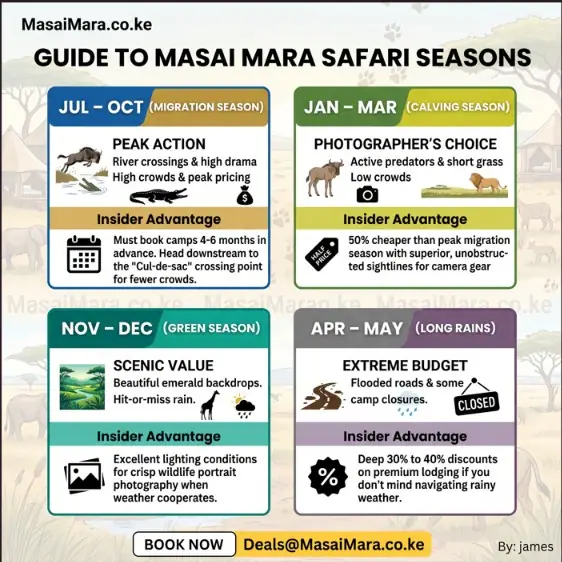
| Season / Months | Travel Experience | Insider Advantage |
|---|---|---|
| Jul-Oct (Migration Season) | River crossings and high drama, the most vehicles and peak prices | Book camps four to six months ahead. Quieter crossing points such as the Cul-de-Sac draw fewer cars than the busy ones near Mara Serena |
| Jan-Mar (Short-Grass Season) | Dry, short grass, resident herds and busy predators, few vehicles | Low season fees and rates, clear sightlines for long lenses |
| Nov-Dec (Short Rains) | Green, fresh landscapes and afternoon showers | Lovely light between storms, though peak pricing still applies |
| Apr-May (Long Rains) | Flooded low tracks and some camps closed | Some camps cut their rates, the cheapest weeks of the year |
July to October is what most people picture: the herds on the river and the crossings. It is also peak price, and the best-known crossing points near Mara Serena get crowded, so we often work the quieter ones. With seven days you can give two or three mornings to the river and still see the rest of the reserve.
January to March is when photographers who know the Mara come. The grass is short, the resident game and the predators are on the open plains, and you are paying low-season rates. A Mid-Range week for two citizens is KES 250,500 in February against KES 351,000 in August.
April and May is the long rains. Tracks flood and a few camps close for the season. Those that stay open often drop their rates.
November and December depends on the weather. When the short rains hold off, the country is green and the light is excellent for portraits, but camps and park fees are still on peak rates.
For the weather and game month by month, read when to visit the Masai Mara.
Things That Go Wrong
Dust in the camera. In the dry months the Mara’s fine dust gets into SD card slots and battery doors. Bring a blower and a soft cloth, and keep the body in a sealed bag between sightings.
A camp that is too far out. Some lodges outside Sekenani are half an hour or more from the good game areas, which over a week adds up to most of a day spent commuting. Ask how far the camp is from where you will actually be driving, not just how far it is from the gate.
A guide who pushes in. When a sighting is crowded, a good guide waits for cars to leave, moves round for the light or goes looking for something else. A poor one squeezes into the scrum and makes it worse for everyone. Ask an operator how their guides handle a crowded sighting before you book.
Questions
How much does a 7-day Masai Mara safari cost?
A week in the Mara by road, two sharing, is KES 185,500 to KES 1,068,500 for citizens, KES 208,000 to KES 1,105,000 for residents and USD 2,690 to USD 9,915 for non-residents, with tier and month deciding where you fall. With six in the vehicle it starts at KES 115,500, KES 131,000 or USD 1,990 each.
Is a whole week in the Mara too much?
Not for most people who book it. Whether you spell it Masai Mara or Maasai Mara, the reserve is big enough that seven days never runs out of ground. For photographers, migration visitors and anyone who has been before, no. A week lets you cover the north, the south, the Triangle and the rivers properly, with a spare day left over. If you get restless staying in one place, the 5 or 6-day trips are a better fit.
What does the seventh day add over six?
Another night and two more drives, which on our plan becomes the free day: back to your favourite sighting, a full day at a crossing, or a balloon flight. Compared with the 6 days Masai Mara safari, a Budget citizen sharing a room pays KES 26,500 more.
Will I see the Big Five?
Buffalo, elephants and lions are easy. A leopard is likely with a week of mornings along the rivers, though never guaranteed. Black rhino is the hard one. You have a real chance on the Triangle day but it is rare elsewhere in the Mara, so anyone set on rhino should add a Lake Nakuru night.
Book Through Masaimara.co.ke
Give us your travel dates, your group size and a tier, and tell us what matters most this week, whether that’s cats, crossings, photography or simply rest. We’ll send back the week laid out day by day, with every cost shown.
Related Reading
- 6 Days Masai Mara Safari
- 5 Days Masai Mara Safari
- Masai Mara Flying Packages
- Budget Masai Mara Safari
- Masai Mara Camps
- Masai Mara Conservancies
- Wildlife in the Masai Mara
- Mara River Crossings
About the Experts Behind This Safari
Written by: David Njunge, TRA-Licensed Safari Guide (10+ years of on-the-ground experience in the Masai Mara).
Edited by: Cecilia Wambui, Lead Travel Consultant & Logistics Expert.
✅ Verified for the 2027 travel season.
Welcome to Masaimara.co.ke
Thank you for visiting us! We're excited to help you plan an unforgettable safari adventure across Kenya.