
5-Day Masai Mara Safari From Nairobi (2026 Prices)
Edited by David Njunge, TRA Licensed Safari Guide with 10+ years in the Mara ecosystem
A 5 days Masai Mara safari costs KES 168,000 to KES 665,000 for Kenyan citizens, or USD 1,680 to USD 6,650 for non-residents. You get 4 nights and 7 game drives. This is the duration where leopard sightings shift from “lucky” to “likely” and where river crossings during migration become a realistic target rather than a gamble.
What’s Covered
Standard package includes:
- Return Nairobi transport (private 4×4 Land Cruiser)
- 4 nights full board accommodation
- All meals from lunch Day 1 to lunch Day 5
- Park fees (4 days inside reserve)
- 7 game drives total
- Bottled water throughout
- English-speaking driver-guide
You’ll pay extra for:
- Drinks (alcoholic and soft drinks beyond water)
- Tips (KES 4,000-6,000 recommended for guide)
- Travel insurance
- Optional activities below
Add-ons:
Activity | Cost |
KES 58,500 | |
KES 3,900 | |
Bush breakfast | KES 6,500 |
Night drive (conservancies only) | KES 9,100 |
Walking safari | KES 7,800 |
Park Fees (2026)
Masai Mara fees set by Narok County Government. Paid at the gate via cash or card. Your guide handles this.
Category | Low Season (Jan-Jun) | Peak Season (Jul-Dec) |
Kenyan Citizen (Adult) | KES 1,500/day | KES 3,000/day |
Kenyan Citizen (Child 9-17) | KES 300/day | KES 1,000/day |
Non-Resident (Adult) | USD 100/day | USD 200/day |
Non-Resident (Child 9-17) | USD 50/day | USD 50/day |
Children below 9: Free.
For a typical 5-day trip (4 days inside reserve): KES 6,000 to KES 12,000 for citizens. USD 400 to USD 800 for non-residents.
2026 Packages
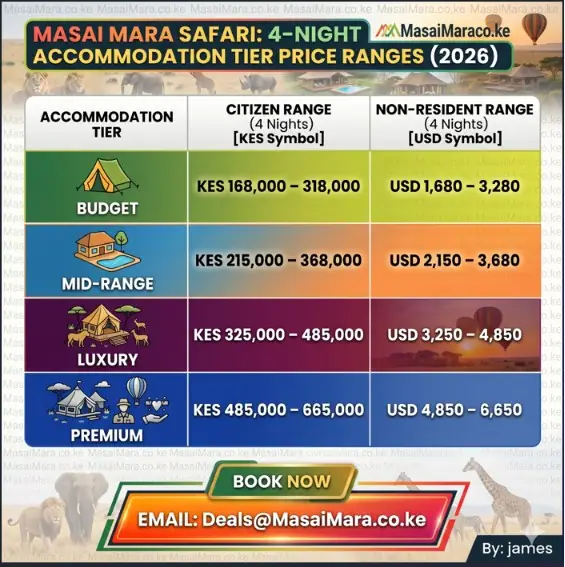
Per person sharing. Based on two travelers. Private vehicle throughout.
Kenyan Citizens
Tier | Low Season | Peak Season | Camps |
Budget | KES 168,000 | KES 318,000 | Rhino Tourist Camp, Mara Crossing Camp, Crocodile Camp |
Mid-Range | KES 215,000 | KES 368,000 | Mtito Safari Camp, Tipilikwani Mara Camp, Basecamp Masai Mara |
Luxury | KES 325,000 | KES 485,000 | Mara Simba Lodge, Fairmont Mara Safari Club, Olare Mara Kempinski |
Premium | KES 485,000 | KES 665,000 | Mahali Mzuri, &Beyond Bateleur Camp, Sala’s Camp |
Non-Residents
Tier | Low Season | Peak Season | Camps |
Budget | USD 1,680 | USD 3,280 | Rhino Tourist Camp, Mara Crossing Camp, Crocodile Camp |
Mid-Range | USD 2,150 | USD 3,680 | Mtito Safari Camp, Tipilikwani Mara Camp, Basecamp Masai Mara |
Luxury | USD 3,250 | USD 4,850 | Mara Simba Lodge, Fairmont Mara Safari Club, Olare Mara Kempinski |
Premium | USD 4,850 | USD 6,650 | Mahali Mzuri, &Beyond Bateleur Camp, Sala’s Camp |
What Happens on Day 4
I used to think more game drives meant better safaris. Pack in as many as possible. Keep moving. I was wrong.
Day 4 is when most guests finally stop trying so hard. The first three days? Everyone’s scanning every bush, jumping at radio static, shooting 400 photos of the same zebra because what if it does something interesting. By Day 4, the checklist mentality fades. You’ve seen lions. Elephants. The pressure’s off.
That’s when you actually start seeing.
The dung beetle nobody photographed on Day 1. The lilac-breasted roller that’s been following your vehicle for twenty minutes. A jackal hunting mice in the grass.
The 5:30am wake-up is miserable. I won’t pretend otherwise. Highland cold cuts through fleece. The “hot” coffee they bring to your tent? Cold in three minutes. Your nose runs. Your fingers ache on the camera. But then a lion calls somewhere in the dark—not a roar, more like a low vibration you feel in your ribs before your ears catch up. Wild sage smell hits when the vehicle crushes it. Sharp. Almost minty.
You don’t notice any of this on Day 1. Too overwhelmed.
Skip the Day 3 afternoon drive. I know that sounds like less value. Do a bush walk instead. Rest. Your eyes need a break to see properly again. Most operators won’t suggest this. I’m telling you anyway.
German couple last February. Day 4, we found nothing spectacular. Zebras. Distant elephants. They called it their favorite drive of the whole trip.
The Leopard Question
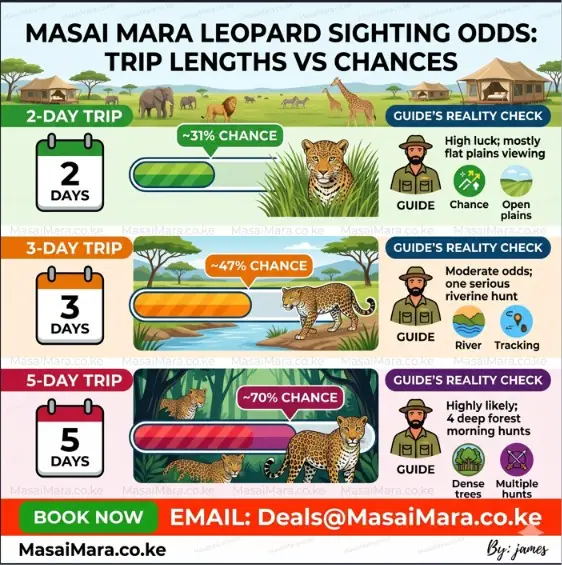
Safari Duration | Leopard Sight Rate | Guide’s Reality Check |
2-Day Trip | ~31% Chance | High luck; mostly flat plains viewing |
3-Day Trip | ~47% Chance | Moderate odds; one serious riverine hunt |
5-Day Trip | ~70% Chance | Highly likely; 4 deep forest morning hunts |
Everyone asks about leopards. So here’s what my notebook actually shows.
I started keeping rough tallies in 2024. Not scientific. Just tick marks after each trip. Out of 38 five-day safaris that year, we got proper leopard sightings on 27. That’s around 70%, give or take. “Proper” meaning the cat was visible for at least half a minute within shouting distance—not a tail vanishing into bushes.
Compare that to my 3-day trips: closer to half. Two-day trips? Maybe a third.
The difference isn’t magic. It’s math. More days means more morning drives. More morning drives means more time in the riverine forest where leopards actually live. On a 3-day trip, you get one serious leopard hunt. On five days, you can spend entire mornings on it.
I used to tell guests that the central plains were the best bet for everything. Wrong. Leopards want fig trees along the Talek and Mara rivers. Sausage trees with dense canopy. You find them by driving slowly through shaded corridors, stopping for every suspicious shape. Most turn out to be nothing. Then one doesn’t.
If leopard is what you came for, five days is the minimum I’d honestly recommend. Shorter trips leave too much to luck.
Zone Rotation Strategy
Don’t stay in one place all five days. I know it’s easier. I know packing mid-trip is annoying. But the Mara is 1,500 square kilometers and driving the same roads gets old fast.
2026 Road Update
Everyone still warns about the “African massage” from Narok. They’re out of date. The C12 is smooth tarmac all the way to Sekenani Gate now.
The real massage starts when you cross into the reserve. 2025’s rains tore up the internal tracks. Black cotton soil. Ruts deep enough to swallow a wheel. A Land Cruiser isn’t for looks anymore—it’s survival.
If C12 has construction delays (and it often does), ask about the Ewaso Ng’iro route. Longer. Usually smoother.
The Split-Stay Advantage
Two nights east near Sekenani. Two nights west near the Triangle or Oloololo. You save hours of daily commuting and the scenery actually changes.
Days 1-2, eastern sector. Marsh Pride territory. Highest lion numbers.
Day 3, cross to the Mara Triangle. Different management. Better vehicle limits. Feels like a different park.
Days 4-5, Sand River area. I used to send everyone to the main Mara River crossing points for migration. Crowded. Dusty. Fifty vehicles jockeying for position. Last August we sat at Sand River for four hours. Total silence. No other vehicles. The crossing there was more raw than anything I’ve seen at the main points. Light hit the water better for photos too.
One more thing. Don’t wear blue or black near Talek River thickets. Tsetse flies. I’ve watched guests get bitten twenty times in an hour because nobody warned them.
If your guide wants to stay in Musiara the whole trip, push back. That’s lazy.
Multi-Destination Options

Safari Route Option | Primary Advantage | Expert Warning / Hidden Cost |
4 Nights Mara Only | Maximizes predator tracking time | Inner road tracks are rough/demanding |
3N Mara + 1N Nakuru | 95%+ Rhino sighting success | Loses one key morning drive in Mara |
3N Mara + 1N Naivasha | Ideal for active cycling/boat rides | Sacrifices deep wilderness tracking time |
Option A: 4 Nights Mara (Standard)
All time in the Mara. This is what I recommend for 90% of clients. Our packages above assume this.
Option B: 3 Nights Mara + 1 Night Lake Nakuru
Add Lake Nakuru National Park for rhinos (95%+ odds versus ~8% in Mara). Nakuru fees via eCitizen: KES 4,635 citizens, USD 60 non-residents. Adds KES 25,000-40,000 total.
The downside: you lose a Mara morning drive. Hurts leopard odds.
Option C: 3 Nights Mara + 1 Night Naivasha
Lake Naivasha for boat rides, Crescent Island walking safari, Hell’s Gate cycling. Only recommend if traveling with non-safari enthusiasts.
My advice: First-timers should spend all five days in the Mara. Save combinations for your second trip.
When Things Go Wrong
The flat tire is the one everyone worries about. It’s not the real problem.
October last year, we got a puncture near Musiara. Changed it. Fine. Next day—another puncture. Same tire. The spare was already on the vehicle. Three hours we sat there. Mara heat. Flies circling. No shade anywhere. Camp finally sent a replacement vehicle but by then we’d missed the morning light entirely.
What actually ruins safaris more often? Rain.
German family, November. Rain started on their second day and just… kept going. Thirty-six hours. Black cotton soil turned to thick grey soup. We couldn’t reach any of the good spots. Spent Day 3 watching zebras through windshield wipers, stuck on the only passable road. They were frustrated. I was frustrated. Nothing to do but wait.
Day 4 the sun came back. Found a leopard within two hours. They ended up calling it the best trip they’d ever taken. But if that had been a 3-day safari? They’d have gone home with nothing but wet zebra photos.
The one that still bothers me: couple who booked five days specifically for a river crossing. August. Peak migration. We checked every crossing point, every single day. The herds were there. They’d approach the water. Stand at the edge. Then turn around. Five times this happened. On Day 5, thirty minutes before we absolutely had to leave for Nairobi, a small group finally crossed.
They got their photos. Barely.
Five days gives you buffer. But the wildebeest don’t owe you anything.
Insider Knowledge for 5-Day Trips
Electric Vehicles
Some camps—Emboo, Mara Bush Camp—have switched to electric safari vehicles. Not a gimmick. Diesel engines make cheetahs bolt. EVs let you get maybe 30% closer because animals don’t associate silence with threats. No vibration means sharper photos too.
Ask specifically when booking. Not every camp has them.
What Your Guide is Really Saying
Guides talk to each other in Swahili codes. Partly habit, partly to avoid tipping off guests in other vehicles.
“Kijana” means they’ve spotted a male leopard. “Kijana anaenda chini”—the leopard’s climbing down from a tree. Get your camera ready now, not in thirty seconds.
“Safari Moja” is the one you want to hear. Means someone found something rare and doesn’t want forty vehicles swarming yet. Your guide will suddenly announce we’re “going this way” without much explanation.
“Mambo ni mengi”—the sighting is already crowded. We’ll hang back and wait for a better angle rather than join the scrum.
By Day 3 you’ll start recognizing the urgency in their voice before you catch the actual words.
Reading the Sky
Vultures in a tree? Predator’s still at the kill. Vultures on the ground? Predator left. Vultures circling low? Kill happened in the last ten or fifteen minutes.
Most people stare at the grass looking for lions. Guides look up first.
The Dust Seat
Sit behind the driver. Least bounce on rough roads. You hear the radio chatter. You see where the guide is looking.
Front passenger seat is the worst for photography. You hit the dust clouds first. Fesh-fesh—that fine volcanic powder—gets into everything. Camera battery doors. SD card slots. Lungs.
Take your shoes off before standing on the seats for the pop-top roof. It’s not a rule anyone will tell you. But guides notice. And they remember who respects their vehicle.
2026 Connectivity
For the work-from-anywhere crowd or photographers uploading raw files daily: Emboo and Oldarpoi have Starlink now. Reliable enough for video calls most of the time. Ask when booking—not everyone’s upgraded.
Safaricom 5G reaches Sekenani sector. Deeper in the reserve, you’re back to patchy 3G or nothing at all. Download offline maps before you leave Nairobi.
Get your e-SIM at JKIA Terminal 1A. Saves hunting for a shop in town.
The Migration Factor
July through October. That’s when everyone wants to come.
The herds move constantly. Monday morning they’re at the main Mara crossing points. Monday afternoon, twenty kilometers south. I’ve had 3-day guests drive past empty crossing points for three straight days, then hear on the radio that a massive crossing happened the morning after they left.
Five days lets you wait. Check Sand River one morning. Main Mara crossings the next. Talek confluence after that. Something usually happens.
But here’s the thing nobody mentions: peak season prices are brutal. Park fees double. Vehicle rates more than double. A budget 5-day trip in January costs around KES 168,000. Same trip in August? KES 318,000.
That’s not a typo.
If budget matters more than migration drama, come January through March. Same wildlife density. Grass is shorter so you see more. No river crossings, but no crowds either. And you’re paying half.
What Your Itinerary Might Be Hiding
Day 1 Optimization
Most itineraries say “depart Nairobi 8am, arrive 2pm.” That’s lazy planning.
Leave at 6am instead. You clear Mai Mahiu before the truck traffic builds. Arrive by noon. Get a proper 3pm game drive instead of a rushed 4pm start.
Ask before you book: does Day 1 include an afternoon drive, or just “arrival and dinner”? Big difference.
The 10 AM Exit Rule
If you’re driving out on Day 5, you need to clear the gate by 10am. Otherwise they charge another full day—USD 200 in peak season. Which means your “morning drive” is really just the exit drive.
The workaround: Book a fly-out from Ol Kiombo or Musiara airstrip. You can game-drive until 11:30am because the airstrip counts as your exit, not the road gate. Costs more. Worth it if photography matters.
Camp Location
Outside camps—the ones clustered near Sekenani or Talek gates—add 30 to 45 minutes of gate queue each way. Every day. On a 5-day trip, you lose three or four hours to paperwork.
Park Fees
Confirm how many days your quote covers. Some packages only include three days of fees even though you’re there for five. That missing day shows up at the gate as a surprise bill. KES 3,000-6,000 for citizens. More for non-residents. You see more. You just don’t get the river crossings.
Best Months for 5 Days
January through March. My recommendation for most people. Dry. Clear. Calving season means predators are active. Prices at their lowest. Fewer tourists.
July through October. Migration. Highest prices. Most crowded. Possible crossings. Book months ahead—good camps sell out.
April and May. Long rains. Roads flood. Skip it unless you specifically want green season rates.
November and December. Short rains. Unpredictable. Can be excellent value if weather cooperates.
More details: Best time to visit Masai Mara
Comparing Durations

Frequently Asked Questions
How much does a 5 days Masai Mara safari cost?
Kenyan citizens pay somewhere between KES 168,000 and KES 665,000 depending on camp choice and season. Non-residents, USD 1,680 to USD 6,650. Peak season is nearly double low season.
Is 5 days too long?
No. The reserve is massive—1,500 square kilometers. By Day 4 you’re seeing it differently than the Day 1 tourists rushing past.
Will I see the Big 5?
Lions, elephants, buffalo—almost certainly. Leopards, around 70% chance based on my logs. Rhinos are rare in the Mara no matter how long you stay. Add Lake Nakuru if rhinos matter.
Can I combine with other parks?
You can. Lake Nakuru for rhinos is the common add-on. But honestly, first-timers should just do the Mara. You won’t run out of things to see.
Start Planning
Tell us your dates and preferences. We’ll build your 5-day itinerary.
Related Safaris
- 3 Days Masai Mara Safari
- 4 Days Masai Mara Safari
- 7 Days Kenya Safari
- Masai Mara Flying Packages
- Budget Masai Mara Safari
Prices verified August 2026 via direct camp inquiries. Park fees per Narok County and Kenya Wildlife Service. Leopard statistics from personal guide logs (2024, 38 five-day trips). We earn commission on bookings.
Welcome to Masaimara.co.ke
Thank you for visiting us! We're excited to help you plan an unforgettable safari adventure across Kenya.