
Nairobi National Park Day Trip: 2027 Prices & Half-Day Tours
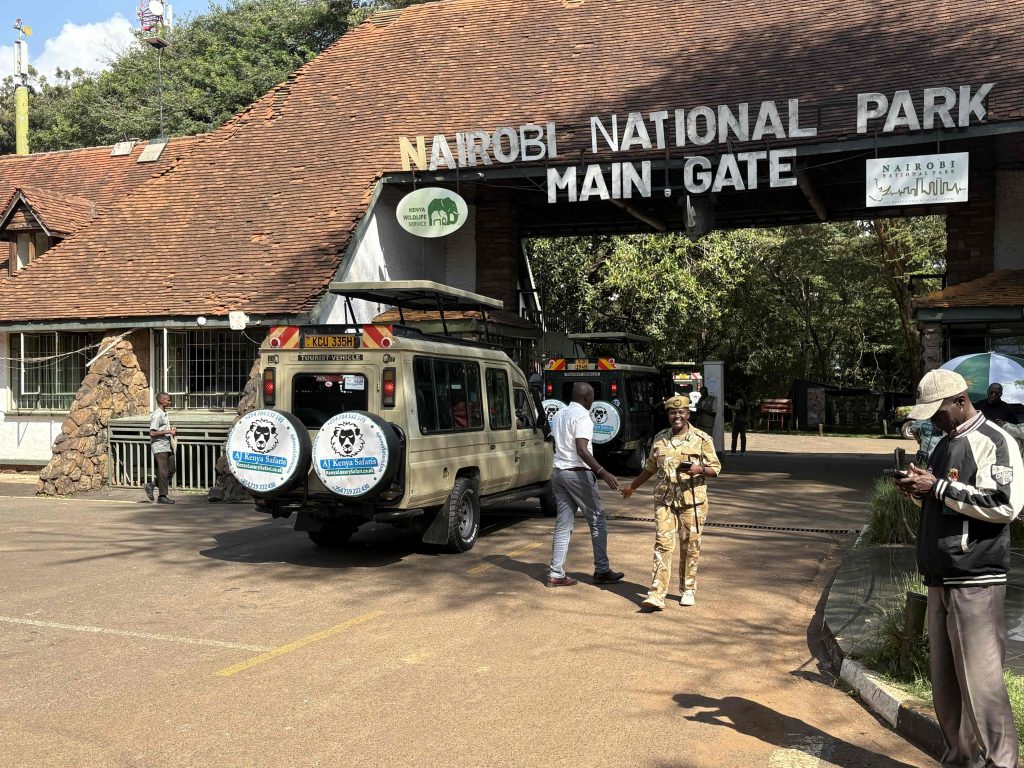
A Nairobi National Park day trip is the only place on earth where you can photograph wild black rhinos with city skyscrapers behind them. For 2027, a private half-day game drive in a 4×4 Land Cruiser costs from USD 225 per person for two people, with park fees included. Add the Sheldrick baby elephants, or make it a full day with the Giraffe Centre too. To see lions and leopards, be at the gate when it opens at 6 AM.
2027 Nairobi National Park Day Trip Prices
Every package is a private trip in a 4×4 Safari Land Cruiser with a pop-up roof, never a shared minibus. Prices are per person and include the park entry fee. International visitors and Kenyan citizens have separate tables, because citizens pay much lower park fees. Whether you call it a Nairobi National Park day tour, a half-day safari or a layover game drive, it is one of these three.
International Visitors (USD)
| Package | What You Do | 1 Person | Per Person (2 Sharing) |
|---|---|---|---|
| Half-Day Game Drive | About 4 to 5 hours in the park, from 6 AM or from 1:30 PM | USD 370 | USD 225 |
| Half-Day Game Drive + Sheldrick Elephants | Dawn game drive, then the 11 AM to noon nursery visit inside the park | USD 390 | USD 245 |
| Full Day: Game Drive + Sheldrick + Giraffe Centre | Dawn drive, the nursery, lunch in Karen and the Giraffe Centre, then an afternoon drive until 6 PM | USD 420 | USD 270 |
Kenyan Citizens (KES)
| Package | What You Do | 1 Person | Per Person (2 Sharing) |
|---|---|---|---|
| Half-Day Game Drive | About 4 to 5 hours in the park, from 6 AM or from 1:30 PM | KES 32,000 | KES 17,000 |
| Half-Day Game Drive + Sheldrick Elephants | Dawn game drive, then the 11 AM to noon nursery visit inside the park | KES 34,700 | KES 19,700 |
| Full Day: Game Drive + Sheldrick + Giraffe Centre | Dawn drive, the nursery, lunch in Karen and the Giraffe Centre, then an afternoon drive until 6 PM | KES 36,200 | KES 21,200 |
Every package includes:
- A private 4×4 Safari Land Cruiser with a pop-up roof, with pickup and drop-off at your Nairobi hotel or JKIA
- A professional TRA-licensed guide
- Entry fees: the Nairobi National Park ticket, plus the Sheldrick donation and Giraffe Centre entry on the packages that include them
- Drinking water in the vehicle
Not included:
- Lunch and drinks (on the full-day trip, lunch is in Karen and you pay on the spot)
- Tips for your guide
- The Kenya eTA at USD 34, for visitors who need one
East African residents pay their own park rates, which sit between the two tables. Tell us when you book and we will quote you on resident rates.
A sample day for each package:
- Half-day, morning: pickup 5:30 AM, gate 6 AM, back at your hotel around 11.
- Half-day + Sheldrick: gate 6:30 AM, game drive until 10:15, then across the park to the nursery for 10:30. The visit runs 11 to noon, and you are back at your hotel by about 1 PM.
- Full day:
- 6 AM to 10:15: dawn game drive for rhinos, lions and the skyline.
- 10:30 to noon: the Sheldrick nursery, then out through Mbagathi Gate.
- 12:30 to 2:30: lunch in Karen and the Giraffe Centre. Lunch is not in the price. Three good places within about ten minutes: Talisman for a long garden lunch, Boho Eatery near the Karen Blixen Museum for something lighter, and Cultiva Farm for farm-to-table food.
- 3 to 6 PM: back into the park through the Main Gate for the afternoon drive, when the heat drops and the cats start moving.
Your park ticket lasts 24 hours from the moment you first enter, so going back in that afternoon does not cost another ticket. We keep the gate receipt and scan out properly at Mbagathi.
2027 Park Fees
| Park & Ticket | Non-Resident Adult | Citizen / Resident Adult |
|---|---|---|
| Nairobi National Park (KWS). 24 hours from entry. | USD 80, child (5 to 17) USD 40 | Citizen KES 1,000, child KES 500. Resident KES 1,350, child KES 675. |
Citizens of other African countries pay USD 40 per adult and USD 20 per child. KWS also charges a fee for every vehicle that enters, on top of the per-person fees: about KES 1,500 a day for a safari Land Cruiser or tour van, and about KES 600 for a small saloon car. Our packages cover both the people and the vehicle, so there is nothing extra at the gate.
The park fees stay the same all year, unlike the Mara’s, which double in July. But July to October is still the busiest time in the park, with more vehicles at the big sightings, and the Sheldrick nursery slots sell out months ahead. If you are coming in those months, book early. Fees are paid in advance through KWS eCitizen, and the gates do not take cash. We pay it for you.
Two other fees come up on a day trip. The Sheldrick nursery asks for a donation of USD 20 per adult and USD 5 per child under 12 (KES 2,000 and KES 500 for Kenyans). The Giraffe Centre charges KES 1,500 per adult and KES 750 per child for non-residents, and KES 400 and KES 200 for Kenyans. Both are included in the packages that visit them. The Trust does not take payments through tour operators in advance, so your guide pays the donation directly to the Trust’s staff when you arrive at the nursery.
I have been a licensed safari guide for ten years, and most people treat a Nairobi National Park day trip as a filler while they wait for a flight. That is their first mistake. I have seen more action in this 117-square-kilometer park in four hours than some visitors see in three days in the Mara. But you have to know where the ghosts live.
The rhinos are the reason this park matters. Nairobi National Park is one of Kenya’s most important rhino sanctuaries, with both black and white rhinos. It is fenced on three sides and patrolled day and night by armed KWS rangers, which makes it one of the best-guarded patches of wildlife in Africa. The rhinos have bred so well here that the park has been used to restock other parks and conservancies around Kenya. You have a better chance of a close rhino sighting here, 20 minutes from the city, than almost anywhere else in the country.
If you show up at 10 AM in a sedan taxi, you are going to see a lot of tall grass and a few distant zebras. If you want the real experience, the kind where a collared lioness walks so close to your door you can hear her breathing, you need to follow a few rules.
The Junction 10 And Leopard Circuit Secrets
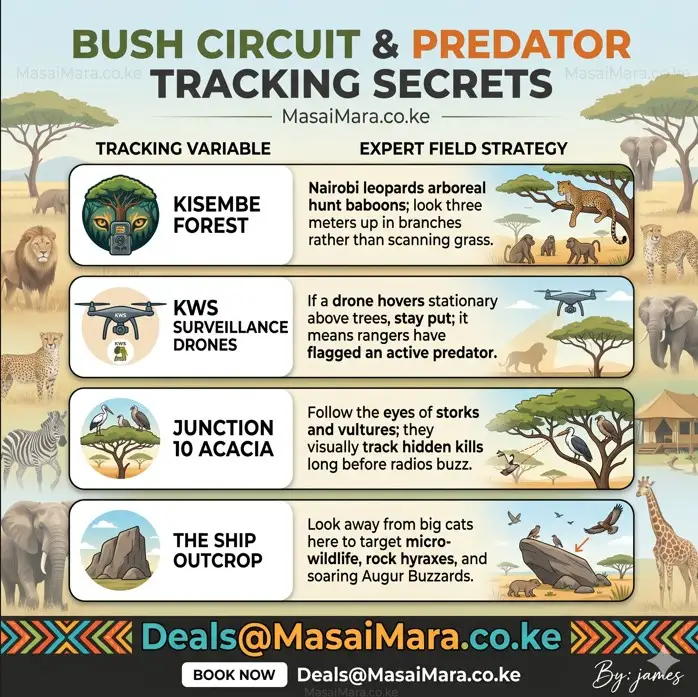
| Tracking Variable | Expert Field Strategy |
|---|---|
| Kisembe Forest | Leopards here hunt baboons, so look a few meters up in the branches, not in the grass. |
| Junction 10 Acacia | Follow the eyes of the vultures and storks. They see kills before the radios do. |
| “The Ship” Outcrop | Look away from the big cats here and enjoy the rock hyrax and Augur buzzards. |
| Early Morning | The first 45 minutes after the gate opens are the best for servals and lions on the move. |
Most drivers stick to Eland Hollow because the plains are wide and animals are easy to spot. But if you want the trophy sightings, ask your guide for the Kisembe Forest.
The Kisembe Forest Leopard Circuit
Leopards are the ghosts of Nairobi. In the Mara you often find them in the big riverine trees. Nairobi leopards spend even more time up high, because they hunt the park’s baboons. In the Kisembe Forest, do not look into the grass. Look up. I have found leopards sleeping on branches just three meters above the track.
The Junction 10 Vulture Tree
If the big cats are being shy, I always head to Junction 10. There is a dead acacia near the dam that works as a permanent apartment block for White-backed vultures and Marabou storks.
The tell: if all the vultures are looking in one direction, do not waste time on the tree. They have spotted a kill before the radio has even crackled. Follow their eyes.
The “Ship” Rock Formation
Deep in the Athi Basin near the southern boundary, there is a rock outcrop guides call “The Ship”. It looks like a ship’s prow rising out of the grass. Most visitors ignore rocks when they are scanning for cats, but this is where the smaller wildlife lives: Augur buzzards circling overhead and rock hyrax sunning on the ledges. If you are into birds, this spot is gold.
14 Things Your Guide Will Not Tell You
I have run these tracks for a decade. Here is the stuff that catches people off guard.
- The animal orphanage. Near the Main Gate there is a KWS rescue centre, where the animals live in enclosures. It does useful work, but if you only have a morning, spend it on the game drive.
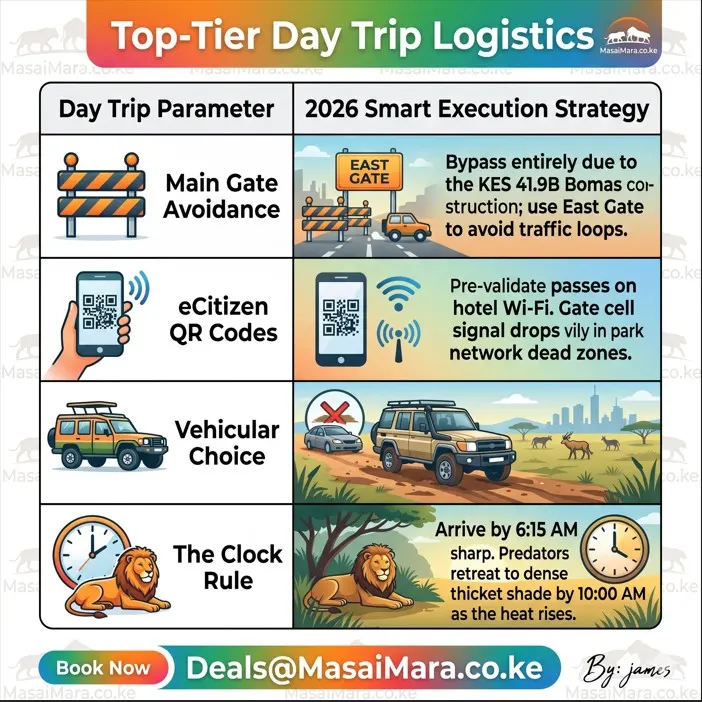
- The gate choice. Pick the gate that suits your hotel, and you skip most of Nairobi’s traffic.
- East Gate: best for JKIA layovers and Mombasa Road hotels such as Four Points, 67 Airport Hotel, Eka Hotel and Ole Sereni. It is quieter and drops you onto the open plains where cheetahs hang out.
- Main Gate (Langata Road): best for Karen, Langata, Kilimani and Westlands. It puts you near the northern plains, where the skyline shots are.
- Mbagathi Gate (Magadi Road): the southern entrance used for the Sheldrick nursery.
- Cheetah Gate and Banda Gate: useful exits at the end of the day to avoid the Langata Road rush.
- Ranger checks. KWS rangers patrol inside the park and may stop us to check tickets. Your guide should have the eCitizen receipt ready on his phone, or you lose 20 minutes.
- The Nile crocodiles. Nobody expects them 20 minutes from the city centre. They hang out near the river crossings. Smaller than the Mara River giants, but they are there.
- The serval. Nairobi National Park is one of the best places in Kenya to see a serval cat. Your best chance is the first 45 minutes after the gate opens.
- Bring your own toilet paper. The toilets at the picnic sites are basic. I carry a small kit for my guests, but check your guide has tissue and sanitizer.
- The Kingfisher picnic site. The best place to stretch your legs. It has shade and overlooks the water, so you can watch birds while you eat.
- The sedan mistake. You can enter in a taxi, but you should not. You sit too low and see nothing but grass. A 4×4 Land Cruiser is the difference between a drive and a safari.
- The rainy season mud. The park’s black cotton soil turns into a swamp in April and May. The dip near Hyena Dam is especially bad, and even Land Cruisers get stuck. In the rains, ask your guide for the rockier tracks along the Athi River circuit, which drain faster.
- Relaxed lions. The lions here are used to vehicles and sometimes walk right past your door. Do not panic. Keep your hands inside the vehicle and your voice low.
- Nairobi Tented Camp. You can stay inside the park overnight. It is a good way to get a sunset drive and a dawn drive without travelling far.
- The USD 80 shock. Some operators quote a cheap “tour” and leave out the park fee until you reach the gate. Ours includes it.
- Dung beetles. Ask your guide to stop for them. Watching them roll buffalo dung is oddly hypnotic, and great for kids.
- Watch the clock in the afternoon. The gate staff are not lenient about closing time. On an afternoon drive we start heading for the exit by about 5:15 PM.
The eCitizen Ticket Trap
This catches more people than anything else on the list. Your park ticket is an e-ticket with a QR code, and the gate scans it. The phone signal at East Gate and some of the smaller gates is patchy, and a payment page that will not load is the last thing you want at 6 AM.
Pay and download your ticket at your hotel, on their Wi-Fi, the night before. On our trips your guide handles this. If you are driving yourself, do it before you set off, and keep a screenshot as well.
The Sunday Walking Trap And Facility Secrets
If your Nairobi National Park day trip falls on a weekend, listen closely. Most online guides suggest the Hippo Pools nature trail, which needs a ranger to walk with you. Rangers are not always free, especially at weekends, so the walk is not guaranteed.
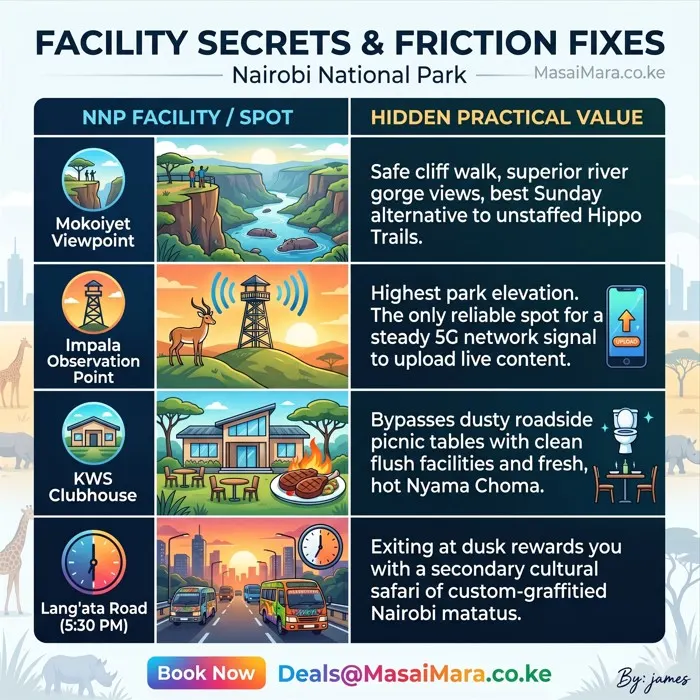
The fix: go to the Mokoyiet viewpoint instead. It sits on a cliff above the river gorge, the view is better anyway, and the rock hyrax put on a show.
The Impala Observation Point
This is one of the highest points in the park. It usually has the best phone signal and a steady breeze, so if you need to make a quick call or send a photo during the drive, this is the place. You also get a 360-degree view that the dams down in the valleys cannot match.
Photography: The “Award Winner” Shot
| Spot | Why It Works |
|---|---|
| Northern plains near the Main Gate | Giraffes, zebras and rhinos with the city skyline behind them |
| Nagolomon Dam at 7:30 AM | Still water for reflections of animals coming to drink |
| Impala Observation Point | A 360-degree view over the plains and the best phone signal |
| Langata Road around 5:30 PM | Nairobi’s painted matatus, a cultural safari on the way home |
Everyone thinks of the Mara for wildlife photos, but in Nairobi it is all about the skyline. The famous shot of giraffes or rhinos with the city behind them is taken on the northern plains, not far from the Main Gate. Ask for it at the start of the drive while the light is soft.
The Nagolomon Dam shot: head there around 7:30 AM. If a rhino or giraffe comes to drink, the water is usually still enough for a clean reflection, with the city on the horizon.
The ostrich display: the ostrich here is the Maasai ostrich. In the breeding season the males’ necks and thighs flush bright pink. It is a different bird from the Somali ostrich of Samburu in the north, whose males have blue-grey necks and legs. Worth stopping for either way.
Failure Story: The 8 AM Layover
I once had a client who landed at JKIA at 7 AM and wanted a day trip. By the time he cleared immigration and reached the gate it was 8:30. He insisted on a sedan to save money.
The grass was high and the sun was already baking the plains. The lions had moved into the deep shade. He saw a few hartebeest and a lot of grass, and he left thinking the park was hype.
The truth: you cannot cheat the clock. If you are not at the gate by about 6:15 AM, you have missed the best half of the day. If you land mid-morning, book the afternoon half-day instead and enter at 1:30, when the animals start moving again.
The Matatu Exit
If you leave by the Main Gate around 5:30 PM, you get a bonus. That is when Nairobi’s matatus, the custom minibuses, are out in force on Langata Road. They are rolling art galleries: LED screens, custom graffiti and speakers blasting Gengetone. The safari does not end at the gate.
The JKIA Layover Playbook
A lot of people searching for a Nairobi National Park day trip are not staying in Kenya at all. They have a long layover at JKIA and a few spare hours. It works well if you plan it properly.
- The minimum layover: 7 to 8 hours between flights. Less than that and you spend more time worrying about the clock than watching animals.
- Your eTA: most nationalities need an approved Kenya eTA to leave the airport, even for a few hours. Apply at least 3 days before you fly. More on our Kenya eTA page.
- Your luggage: if your bags are checked through to your final destination, you only carry hand luggage. If not, ask about the airport’s left-luggage service so you are not dragging a suitcase around the park.
- The timings:
- Allow 45 to 60 minutes to clear immigration and customs and meet your guide.
- East Gate is about 20 minutes from the terminal.
- Plan a game drive of about 3.5 hours.
- Be back at the terminal 3 hours before your onward international flight.
Land at 5 AM and you can be in the park for the dawn, which is the best layover of all. Land mid-morning and the afternoon half-day from 1:30 PM is the better choice.
Seasons In The Park
| Season | What Happens In The Park | What It Means For You |
|---|---|---|
| January to March (dry) | Water dries up on the Kitengela plains to the south, and zebra, wildebeest and eland move in to drink at the park’s permanent dams, such as Nagolomon and Hyena Dam. The lions follow them. | Prime viewing. The busiest the park gets for animals. |
| April and May (long rains) | The herds spread back south through the open boundary onto community land. The black cotton tracks become deeply rutted. | Quieter plains, though the rhinos and resident lions stay put against the green grass. A 4×4 is essential. |
| July to October (dry) | The same dry-season pull toward the dams, with cool, often overcast mornings. | Excellent viewing and the busiest months for vehicles. Book the Sheldrick slot early. |
| November and December (short rains) | Green grass, newborn animals and migrant birds arriving from Europe and Asia. | Lovely light and good birding. |
Frequently Asked Questions
How much does a Nairobi National Park day trip cost? From USD 225 per person for two people on a private half-day game drive, including the park fee. A solo traveler pays USD 370. Kenyan citizens pay from KES 17,000 per person for two, or KES 32,000 alone. Adding the Sheldrick elephants or the Giraffe Centre takes it to USD 245 to 270 per person for two.
What is the best time for a Nairobi National Park game drive? Enter at 6 AM. Predator activity drops after about 10 AM. The afternoon from 1:30 PM is the next best window. For seasonal advice, see our best time to visit guide.
Is a half-day safari in Nairobi National Park enough? For the park itself, yes. Four to five hours at the right time of day covers the main areas. Choose the full day if you want the Sheldrick nursery and the Giraffe Centre as well.
Are there elephants in Nairobi National Park? No. There have been no wild elephants in the park for decades. You can see orphaned babies at the Sheldrick nursery, but for wild herds you need the Masai Mara.
How much is the park entry fee? USD 80 for non-resident adults and USD 40 for children, KES 1,000 for Kenyan citizens and KES 1,350 for residents. The ticket lasts 24 hours from entry and is paid through KWS eCitizen. It is included in our day trip prices.
Can I do a Nairobi National Park layover safari from JKIA? Yes, if your layover is at least 7 to 8 hours. See the JKIA layover playbook above for the timings.
Is Nairobi National Park safe? Yes. KWS rangers patrol the park, and you stay in the vehicle except at the marked picnic sites and viewpoints.
What should I pack? Layers (it is about 12°C at dawn and 28°C by noon), a power bank, binoculars (8×42 is the sweet spot) and your own toilet paper. Full checklist on our packing list.
Can I self-drive inside the park? You can, but it is not ideal for a day trip. You will not be on the guides’ sighting groups, the tracks are not well signed, and a low car sees very little over the grass.
Final Advice From David
I love this park because it is a survivor. If you only have one day in Kenya, do not feel you have missed out because you could not reach the Mara. A good Nairobi National Park day trip can be just as wild. Bring layers, because the park is cold at 6 AM, and do not forget a power bank.
If you realize you want more, we can turn it into a Masai Mara and Nairobi National Park safari of 3 or 4 days.
Ready to track rhinos? Fill out our booking form and we will handle the eCitizen tickets for you.
Related Reading
- 2 Days Masai Mara Safari
- 3 Days Masai Mara Safari
- Masai Mara and Amboseli Safari
- First-Time Safari Guide
- Kenya eTA Guide
- Official KWS Park Fee Portal
Park fees change. Check KWS eCitizen for the latest Nairobi National Park rates.
Written by David Njunge, TRA-licensed safari guide with over 10 years in the Masai Mara. Edited by Cess Wambui, travel consultant, BSc Tourism and Hospitality Management. Verified for the 2027 season.
Welcome to Masaimara.co.ke
Thank you for visiting us! We're excited to help you plan an unforgettable safari adventure across Kenya.