
6 Days Masai Mara Safari: Packages & 2027 Pricing
6 Days Masai Mara Safari | Written by David Njunge, TRA Licensed Safari Guide (10+ years)
6 days Masai Mara safari prices for 2027 start at KES 159,000 for Kenyan citizens, KES 179,000 for residents and USD 2,325 for non-residents by road, two sharing, and drop to KES 99,000 a head for six. Five nights full board, nine game drives and time to learn the reserve properly.
The question people forget to ask is whether all six days should be in the Mara at all, or whether one night somewhere else would suit them better.
What the Price Covers
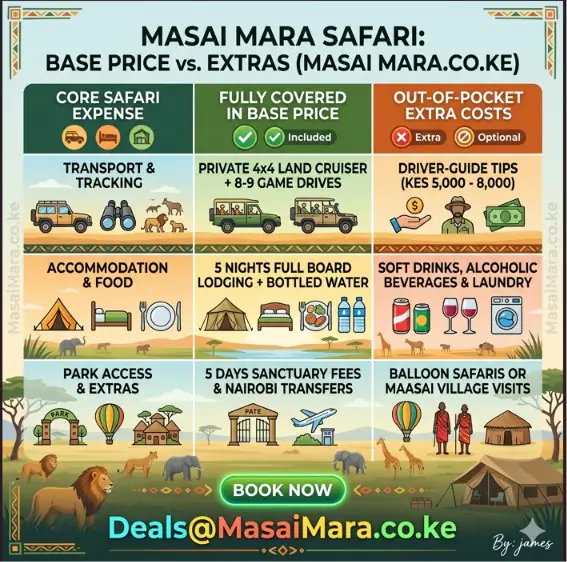
| Core Safari Expense | Fully Covered in Base Price | Out-of-Pocket Extra Costs |
|---|---|---|
| Transport & Tracking | Private 4×4 Land Cruiser and nine game drives | Guide tips |
| Accommodation & Food | Five nights full board, drinking water in the car | Sodas, beer, wine and laundry |
| Park Access & Extras | Masai Mara entry fees, Nairobi pickup and drop-off | Balloon, bush breakfast, village visit |
Included
- Pickup in Nairobi on Day 1, at your hotel or JKIA, and drop-off on Day 6
- A pop-top 4×4 Land Cruiser just for your group, with the same guide all week
- Five nights full board, from lunch the day you arrive to breakfast the morning you leave
- Masai Mara entry fees for every day you game drive
- Nine game drives. The full day in the Mara Triangle counts as two of them, a morning and an afternoon run together with a packed lunch in between
- Water in the vehicle
Not included
- Tips for your guide. Shilling payers usually give about KES 3,000 a day, roughly KES 18,000 over six days, and most overseas guests tip in dollars, somewhere around USD 20 to 30 a day. Camp staff have their own tip box
- Sodas, beer and wine (some of the upper camps include house drinks in their rate, so ask us which)
- Laundry, where the camp charges for it
- Travel insurance
- A sixth day’s entry fee, only if you want to game drive on the way out
- Easter, Christmas and New Year camp supplements
- The add-ons further down the page
The Actual Decision You Need to Make
Six days in one reserve is a long stay, and most people only realise it once they are there.
The first four days usually take care of themselves. Everything is new, every zebra gets photographed, and getting up at 5:30 still feels like part of the adventure.
Day 5 is where guests go one of two ways. Some look out at the same grassland and feel they have had enough. They have seen lions three or four times and the excitement has worn off. Others go the opposite way, and the Mara starts to feel like somewhere they know. They recognise the cheetah that uses the same termite mound every morning, or the fig near Bila Shaka where a leopard spends her afternoons, and they stop feeling like tourists.
I can’t tell you which one you are. Booking six days in the Mara when you wanted variety, or a two-park trip when you wanted depth, costs the same money either way, so it is worth deciding before you pay.
Option 1: Six Days Mara-Only
All five nights in the Mara. This suits photographers, repeat visitors and anyone who would rather know one place well than see three briefly.
Prices are per person with two sharing a room and a private Land Cruiser. Low season is January to June, peak season July to December. Each tier lists three camps and we price it on the dearest of them in that half of the year, so whichever you choose, the price holds. Holiday supplements at Easter, Christmas and New Year are charged by the camps on top.
Kenyan Citizens
| Tier | Low Season | Peak Season | Camps |
|---|---|---|---|
| Budget | KES 159,000 | KES 183,000 | Oldarpoi Mara Camp, Olailepo Mara Camp, Masai Mara Manyatta Camp |
| Mid-Range | KES 213,000 | KES 297,500 | Sentrim Mara, Mara Sopa Lodge, Mtito Safari Camp |
| Luxury | KES 425,000 | KES 449,000 | Mara Major Camp, Matira Bushcamp, Mara Maisha Camp |
| Luxury Plus | KES 721,500 | KES 895,500 | Sand River Masai Mara, Emboo Camp, Governors’ Camp |
Non-Residents
| Tier | Low Season | Peak Season | Camps |
|---|---|---|---|
| Budget | USD 2,325 | USD 3,075 | Oldarpoi Mara Camp, Olailepo Mara Camp, Masai Mara Manyatta Camp |
| Mid-Range | USD 2,550 | USD 3,765 | Sentrim Mara, Mara Sopa Lodge, Mtito Safari Camp |
| Luxury | USD 4,180 | USD 4,930 | Mara Major Camp, Matira Bushcamp, Mara Maisha Camp |
| Luxury Plus | USD 6,460 | USD 8,365 | Sand River Masai Mara, Emboo Camp, Governors’ Camp |
Kenya and East African Residents
| Tier | Low Season | Peak Season | Camps |
|---|---|---|---|
| Budget | KES 179,000 | KES 215,000 | Oldarpoi Mara Camp, Olailepo Mara Camp, Masai Mara Manyatta Camp |
| Mid-Range | KES 233,000 | KES 329,500 | Sentrim Mara, Mara Sopa Lodge, Mtito Safari Camp |
| Luxury | KES 445,000 | KES 481,000 | Mara Major Camp, Matira Bushcamp, Mara Maisha Camp |
| Luxury Plus | KES 741,500 | KES 927,500 | Sand River Masai Mara, Emboo Camp, Governors’ Camp |
At the gate, the resident rate needs a work or residence permit, or an East African passport. A few of the upper camps quote residents in dollars, so those shilling figures can move a little with the exchange rate.
Over five nights the room is the biggest part of the bill on every tier except Budget, which is why the jump between tiers looks so large here. On Budget, about half of what a couple pays is the vehicle, the guide and the entry fees.
Groups of Four and Six
With more people in the Land Cruiser, the vehicle cost is split more ways. Rooms are still priced two sharing and entry fees are still per person, so groups save most on Budget and least at the top. For six citizens on Budget in low season it works out at KES 99,000 each, compared with KES 159,000 for two. A group of seven or more needs two vehicles.
Kenyan citizens, per person:
| Tier | 4 People, Low | 4 People, Peak | 6 People, Low | 6 People, Peak |
|---|---|---|---|---|
| Budget | KES 114,000 | KES 130,500 | KES 99,000 | KES 113,000 |
| Mid-Range | KES 168,000 | KES 245,000 | KES 153,000 | KES 227,500 |
| Luxury | KES 380,000 | KES 396,500 | KES 365,000 | KES 379,000 |
| Luxury Plus | KES 676,500 | KES 843,000 | KES 661,500 | KES 825,500 |
Non-residents, per person:
| Tier | 4 People, Low | 4 People, Peak | 6 People, Low | 6 People, Peak |
|---|---|---|---|---|
| Budget | USD 1,875 | USD 2,550 | USD 1,725 | USD 2,375 |
| Mid-Range | USD 2,100 | USD 3,240 | USD 1,950 | USD 3,065 |
| Luxury | USD 3,730 | USD 4,405 | USD 3,580 | USD 4,230 |
| Luxury Plus | USD 6,010 | USD 7,840 | USD 5,860 | USD 7,665 |
Kenya and East African residents, per person:
| Tier | 4 People, Low | 4 People, Peak | 6 People, Low | 6 People, Peak |
|---|---|---|---|---|
| Budget | KES 129,500 | KES 155,000 | KES 113,000 | KES 135,000 |
| Mid-Range | KES 183,500 | KES 269,500 | KES 167,000 | KES 249,500 |
| Luxury | KES 395,500 | KES 421,000 | KES 379,000 | KES 401,000 |
| Luxury Plus | KES 692,000 | KES 867,500 | KES 675,500 | KES 847,500 |
Solo travellers pay a single room supplement and carry the vehicle alone, so we work that out case by case.
These are road prices. Flying from Wilson to a reserve airstrip and back, with transfers in Nairobi, comes to roughly USD 600 more per person and gives you back most of the first and last day. The fly-in versions, and trips that use conservancy camps, sit on our Masai Mara flying packages page.
Option 2: Multi-Destination

Four nights in the Mara and one at a lake on the way back. You get a different landscape and different animals, and it breaks the long drive to Nairobi into two halves. It costs you a Mara day, so it suits people who already know they like variety more than depth.
With Lake Nakuru (Rhinos + Flamingos)
Lake Nakuru National Park is fenced, and both black and white rhinos live there, so it is the surest place on this circuit to finish the Big Five. Flamingo numbers change a lot from year to year with the lake level, so treat them as a bonus. Park fees go to KWS through eCitizen and are booked before you arrive. The full itinerary and prices for this route are on our Masai Mara and Lake Nakuru safari page.
With Lake Naivasha (Boat Rides + Hell’s Gate)
Naivasha is the softer option: a boat ride past the hippos, a guided walk among the giraffes and zebras on Crescent Island, and cycling through the gorge country of Hell’s Gate, which is also a KWS park paid through eCitizen. Families with restless children and anyone not mad about game drives usually enjoy it. See the Masai Mara and Lake Naivasha safari for the route and its prices.
Sample 6-Day Itinerary
Day 1. Pickup is at 7:30. If you want to be in camp earlier, we can leave at 6 and get down the escarpment at Mai Mahiu before the lorries start crawling in low gear. From Narok the C12 is tarmac all the way to Sekenani Gate, where the paperwork usually takes a quarter of an hour, more on a busy morning. Lunch at camp, a rest, then out from 3:30 until 6 around the camp side of the reserve to get your eye in.
Day 2. North to Musiara Marsh, Bila Shaka and the Paradise Plain along the Mara River. Out at 6 when the gate opens. You could drive the Bila Shaka loop in two hours if you never stopped, which nobody manages.
Day 3. The central plains and the Talek. By now you have seen lions several times, so this is a day for the things that take patience: cheetahs out on the open ground and leopards in the riverine fig and sausage trees along the Talek.
Day 4. Across the New Mara Bridge, which older guides still call Purungat, for a full day in the Mara Triangle with lunch packed. It is run by the Mara Conservancy, has fewer cars, and gives you the reserve’s best chance of black rhino. The Triangle keeps its own ticketing, separate from the Narok side, but your package entry fees already cover it, so there is nothing to sort out at the bridge. Because we stay out from morning to late afternoon, this one day accounts for two of your nine drives.
Day 5. Mara-only guests go south to the Sand River and the Keekorok side, the corner of the reserve still left to see, or go back to whatever was missed earlier in the week. If you are doing the lake option, this is your transfer day instead: a morning drive, then roughly five to six hours to Nakuru with a lunch stop in Narok, arriving in time for an evening at the lake.
Day 6. Mara-only, you have breakfast and are through the gate by 10, then back in Nairobi by mid-afternoon. On the lake route there is an early drive in Nakuru before the road home.
Add-ons
| Activity | Kenyans & Residents | Non-Residents |
|---|---|---|
| Hot air balloon | KES 58,000 | USD 500 |
| Maasai village visit | KES 1,000 | USD 20 |
| Bush breakfast | KES 5,000 | USD 60 |
Night drives only happen in the conservancies, never inside the reserve, so they are not on this list. If one matters to you, the split stay under “When 6 Days Makes Sense” is the way to do it, and our night game drive page explains what to expect.
What Six Days Actually Does to You
The early starts never get easier. On Day 5 the knock on the tent at 5:30 still pulls you out of a deep sleep, and nobody pretends any more that it feels refreshing.
Your camera roll changes. On Day 1 it is hundreds of frames of one zebra herd. By Day 4 it is a few dozen, and you are waiting for the light instead of holding the shutter down.
The dust gets into your socks, the zip of the camera bag and somehow under the lid of your water bottle. By Day 3 people stop fighting it.
Then there is the afternoon nobody planned. On a six-day trip it is common for a couple to ask on Day 4 or 5 to skip the afternoon drive. You assume they are tired, but often they just want to sit on the tent veranda above the river and watch the hippos for three hours with the camera in the bag, and later that is the part they talk about.
A shorter trip doesn’t leave room for that kind of afternoon.
When 6 Days Makes Sense
Book six days if:
- You take photography seriously. Light changes from morning to morning, and so does what the animals do. The shot you want usually takes several tries at the same scene.
- You have done a shorter Mara trip already. You know you like it and want more of it.
- You are coming for the migration. Between July and October, crossings follow no timetable, and an extra day at the river is the only thing that improves your odds. Our river crossing guide covers where they happen.
- You want a reserve and a conservancy on the same trip. Three nights in the main reserve and two in a conservancy such as Olare Motorogi or Naboisho adds walks, night drives and off-road viewing. Conservancy camps cost more and aren’t in the tables above, so we quote that version separately.
Think again if:
- It is your first time in Kenya and you want variety. Fewer days in the Mara plus a second park may suit you better, for example Mara with Amboseli.
- You get restless in one place. Six days in the same reserve is a lot for some people.
- Money is tight. The sixth day adds KES 26,500 per citizen on Budget, two sharing, over the 5 days Masai Mara safari, and more on the upper tiers, where most of it is the extra night.
Why We Don’t Use Safari Vans for 6-Day Trips
We don’t use vans on any of our packages, but on a six-day trip the difference becomes obvious. A Mara trip of this length means thirty hours or more on reserve tracks.
What the Land Cruiser does better:
- It handles the roads. Four-wheel drive and a low-range gearbox get it through the black cotton soil after an afternoon storm, where a two-wheel-drive van gets stuck.
- Height. The higher clearance gets it over ruts and lugga crossings that tear at a van’s underside.
- Everyone gets a view. Every seat is a window seat, and the pop-top roof lets everyone stand at once, while in a van people take turns at the hatch.
- It is built for this. The chassis and suspension are made for corrugated murram. Over six days your back will notice the difference, even if it doesn’t on the first afternoon.
Vans are cheaper and fine on tarmac. Inside the Mara they are a false saving.
Which Month Works Best
| Month | What’s Happening | Crowds | Price Level |
|---|---|---|---|
| Jan-Feb | Dry, short grass, resident herds on the plains, cats easy to find | Low | Low season |
| Mar | Usually dry until late in the month, then the long rains may start | Low | Low season |
| Apr-May | Long rains, flooded low tracks, some camps closed | Very low | Low season, some camps discount |
| Jun | Rains clearing, long grass, first herds sometimes arriving late in the month | Medium | Low season |
| Jul-Aug | Migration in, river crossings possible, book months ahead | High | Peak |
| Sep-Oct | Herds still on the river, crossings continue, slightly quieter than August | High | Peak |
| Nov | Short rains, herds heading back south | Medium | Peak |
| Dec | Holidays, families, mixed weather, camp supplements over Christmas | High | Peak, plus festive supplements |
For a six-day trip, January to March lets you cover the whole reserve without the crowds. July to September is where the extra days pay for themselves if crossings are the goal, because you may need three or four river mornings before one happens. Month-by-month detail is on our best time to visit Masai Mara page.
2027 Updates Worth Knowing
Electric vehicles. Emboo Camp, one of our Luxury Plus camps, runs electric game-drive cars. They are silent and don’t vibrate, which helps with long-lens photos. Our package uses our own Land Cruiser, so ask the camp directly if you would like one of their drives.
Connectivity. There is Safaricom signal around the gates and Talek, and very little out on the plains. Camp Wi-Fi varies a lot, so if you plan to work or upload large files, ask the camp before you book rather than assuming.
Paying park fees. Lake Nakuru and Hell’s Gate are KWS parks, booked in advance on eCitizen. The main Mara reserve takes card or cash at the gate, or payment ahead at the KATO offices in Nairobi. The Mara Triangle is cashless and paid through the KAPS Float Management System. On a package all of that is done before you arrive.
Park Fees (2027)
The main reserve’s fees are set by Narok County. Paying ahead matters more than people think, because the card terminals at Sekenani, Talek and Ololaimutiek run on mobile data and stall whenever the network drops.
| Category | Low Season (Jan-Jun) | Peak Season (Jul-Dec) |
|---|---|---|
| Kenyan Citizen Adult | KES 1,500/day | KES 3,000/day |
| Kenyan Child (9-17) | KES 300/day | KES 500/day |
| East African Resident Adult | KES 2,500/day | KES 5,000/day |
| East African Resident Child (9-17) | KES 1,000/day | KES 2,000/day |
| Non-Resident Adult | USD 100/day | USD 200/day |
| Non-Resident Child | USD 50/day | USD 50/day |
Under 9: free. All the entry fees for the six days are built into the package price, and the ID rules for each rate are on our Masai Mara park fee page.
Practical Notes
Temperature. The Mara is highland country. Around 10°C at 6 in the morning, colder in the wind of a moving car, and up near 28°C by midday. Bring a proper fleece and layers, not only a light safari shirt.
Power. Many camps run on solar with a generator as backup, and some only power the tents for part of the day, so charging often happens at the main mess tent. Over five nights that means a lot of plug-hunting, so bring two power banks if you shoot video.
Laundry. You won’t have packed enough for six days of dust, and most camps run a laundry service. Many of them won’t wash underwear, which is a local custom, and they leave powder in the tent so you can rinse your own. Find out what your camp charges on the first evening.
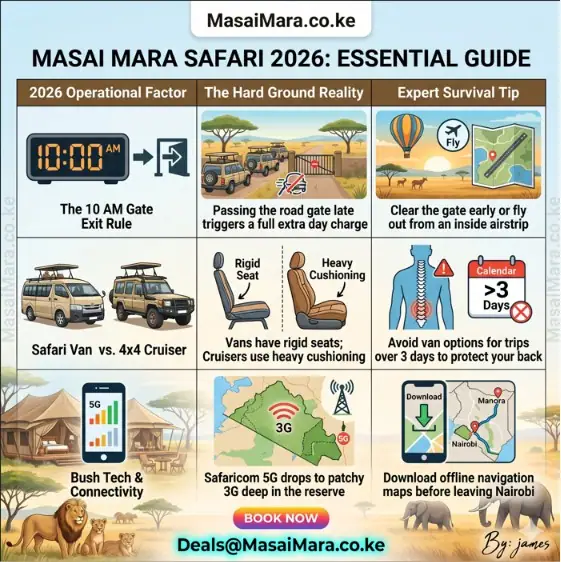
The 10 AM gate rule. If you are driving out on Day 6, you have to be through the gate by 10 or pay another full day, which is KES 3,000 for a citizen or USD 200 for a non-resident in peak season. Your guide will plan for it, so don’t ask for a quick drive on the way out unless you mean to pay for the day.
Frequently Asked Questions
How much does a 6 days Masai Mara safari cost?
By road, two sharing, from KES 159,000 to KES 895,500 for Kenyan citizens, KES 179,000 to KES 927,500 for residents and USD 2,325 to USD 8,365 for non-residents, depending on tier and season. Six people sharing one vehicle bring the starting price down to KES 99,000, KES 113,000 or USD 1,725 each. For prices that include a lake night, see the Nakuru and Naivasha routes.
Is 6 days too long for Masai Mara?
It depends on what you come for. Photographers and people on their second or third visit tend to love it. A first-timer who wants a bit of everything may be happier with four Mara nights and one at a lake.
What’s the difference between 5 and 6 days?
One more night and two more game drives, which on our plan means a whole day for the south of the reserve instead of squeezing it in. The rest is pace: you can skip an afternoon without feeling you’ve lost something.
Should I do Mara-only or multi-destination?
If rhinos or a change of scenery matter, add Nakuru or Naivasha. If you are a photographer or have been before, keep all six days in the Mara.
Will I see the Big 5 in 6 days?
Lions, elephants and buffalo, almost certainly. A leopard is likely with that many mornings along the rivers, though never certain. Rhino is possible on the Triangle day and much more reliable at Nakuru.
Ready to Plan?
Tell us your dates, how many of you are coming, whether you want the Mara only or a lake night as well, and which tier suits you. We’ll send back a day-by-day plan with every cost shown.
Related Reading
- 5 Days Masai Mara Safari
- 4 Days Masai Mara Safari
- 3 Days Masai Mara Safari
- Masai Mara and Lake Nakuru Safari
- Masai Mara and Lake Naivasha Safari
- Masai Mara Flying Packages
- Masai Mara Conservancies
- Best Time to Visit Masai Mara
About the Experts Behind This Safari
Written by: David Njunge, TRA-Licensed Safari Guide (10+ years of on-the-ground experience in the Masai Mara).
Edited by: Cecilia Wambui, Lead Travel Consultant & Logistics Expert.
✅ Verified for the 2027 travel season.
Welcome to Masaimara.co.ke
Thank you for visiting us! We're excited to help you plan an unforgettable safari adventure across Kenya.