
1 Day Masai Mara Safari From Nairobi: Fly-In Itinerary & 2027 Prices
1 Day Masai Mara Safari | Written by David Njunge, TRA Licensed Safari Guide (10+ years)
A 1 day Masai Mara safari from Nairobi can go by road or by air, but only flying works: the road takes 10 to 12 hours for two or three hours in the reserve. Our fly-in day trip leaves Wilson at 7:15 AM, gives you five hours of game drives and lands by 4:15 PM.
Most of the clients who book a 1 day Masai Mara safari with us are in transit. Some have a long layover at JKIA, and others are in Nairobi for meetings with one free day in the week and want to spend it in the Mara rather than in town. If you can stretch to three days, our 3-day Masai Mara safari is the trip I would rather sell you, but a single day can still be a good one if you fly in.
We run it in two ways. One is the full day out of Nairobi, with a morning flight in, a private Land Cruiser and guide waiting on the airstrip and an afternoon flight home, and the other is for clients already staying near the Mara, usually at a camp outside the gates that has no vehicles of its own, who want a whole day in the reserve with our car and one of our guides.
We stopped selling the road day trip from Nairobi. Clients came back tired and a little short-changed, and we agreed with them.
Checking seats for a particular date or a JKIA layover? Send us your date, the size of your group and whether you are a visitor, a resident or a citizen, and we will check the Safarilink and Airkenya times and send you a fixed quote within 24 hours.
1 Day Masai Mara Safari Prices 2027
Every figure below is per person, and it drops as more of you fill one private 4×4 Land Cruiser. Prices change twice in the year: once on 1 July, when the reserve doubles its entry fee for every kind of visitor, and again for the peak weeks from July to October and over Christmas, when vehicles cost more.
Fly-In Day Trip from Nairobi
| Guest | Jan to Jun | 1 Nov to 20 Dec | Jul to Oct, 21 to 31 Dec |
|---|---|---|---|
| Visitors, 2 guests | USD 1,000 | USD 1,100 | USD 1,125 |
| Visitors, 4 guests | USD 925 | USD 1,025 | USD 1,040 |
| Visitors, 6 guests | USD 900 | USD 1,000 | USD 1,010 |
| Residents, 2 guests | KES 111,000 | KES 113,500 | KES 117,000 |
| Residents, 4 guests | KES 102,750 | KES 105,250 | KES 107,000 |
| Residents, 6 guests | KES 100,000 | KES 102,500 | KES 103,650 |
| Citizens, 2 guests | KES 106,000 | KES 107,500 | KES 110,000 |
| Citizens, 4 guests | KES 98,500 | KES 100,000 | KES 101,250 |
| Citizens, 6 guests | KES 96,000 | KES 97,500 | KES 98,350 |
Game Drive Day for Guests Already in the Mara
| Guest | Jan to Jun | 1 Nov to 20 Dec | Jul to Oct, 21 to 31 Dec |
|---|---|---|---|
| Visitors, 2 guests | USD 400 | USD 500 | USD 525 |
| Visitors, 4 guests | USD 325 | USD 425 | USD 440 |
| Visitors, 6 guests | USD 300 | USD 400 | USD 410 |
| Residents, 2 guests | KES 33,000 | KES 35,500 | KES 39,000 |
| Residents, 4 guests | KES 24,750 | KES 27,250 | KES 29,000 |
| Residents, 6 guests | KES 22,000 | KES 24,500 | KES 25,650 |
| Citizens, 2 guests | KES 28,000 | KES 29,500 | KES 32,000 |
| Citizens, 4 guests | KES 20,500 | KES 22,000 | KES 23,250 |
| Citizens, 6 guests | KES 18,000 | KES 19,500 | KES 20,350 |
The resident rate covers foreign nationals living in Kenya, Uganda, Tanzania, Rwanda or Burundi on a valid work or residence permit, which covers many of the regional and international staff based in Nairobi, and the permit has to be shown at the gate with a passport. Kenyan citizens show their national ID, and anyone who arrives without the right document is charged the visitor rate.
There is no overnight stay, so no Easter, Christmas or New Year accommodation supplement applies to either trip.
Groups of four to six: a Land Cruiser seats six, each beside a window. Fill it and the vehicle and guide are split more ways, which is the whole of the drop you see in the 4 and 6 guest rows. Flights, lunch and the reserve fee cost the same per head whatever the group size. Seven or more travel in two vehicles, and we quote that separately.
Solo travellers: you can book a private vehicle on your own, which carries a single supplement because you pay for the whole Land Cruiser, or ask to share one when another booking falls on the same date.
Children: children aged 9 to 17 pay a reduced reserve fee (USD 50 for visitors, KES 300 to 500 for citizens and KES 1,000 to 2,000 for residents), and children aged 8 and under enter free. Airkenya also charges children under 12 about 70% of the adult fare, and infants under two fly free on a parent’s lap, so a family pays noticeably less than the adult price times four.
How the Day Trip Compares with Staying Overnight
The day trip gives you roughly six hours inside the reserve, five of them on game drives and one for lunch. A two-day Masai Mara safari adds a night under canvas and an evening drive, and the three-day one adds a full day on the plains as well. Our guide to how many days you need in Masai Mara counts the hours each length of trip gives you.
What’s Included and Excluded
Included in the fly-in day trip:
- Pickup from your Nairobi hotel or JKIA to Wilson Airport, and the drop-off back to your hotel or to JKIA in the evening
- Return scheduled flight from Wilson Airport to the Mara, with a 15 kg soft-bag allowance
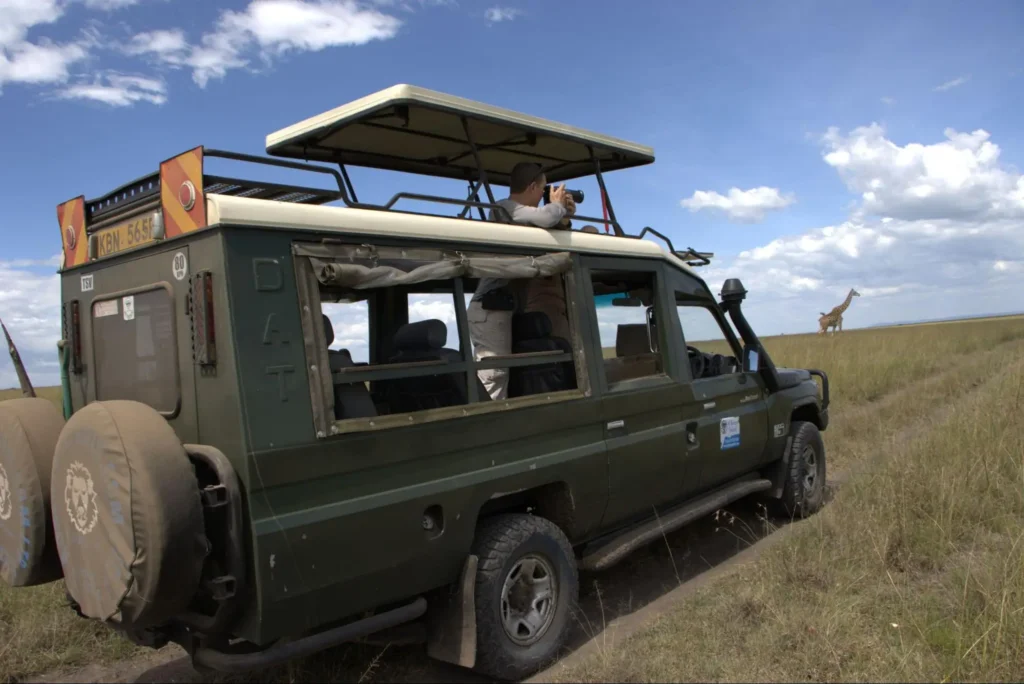
- A private 4×4 Land Cruiser with a pop-up roof, and a TRA-licensed guide who meets you at the airstrip
- The reserve entry fee and the vehicle fee for the day, paid before you arrive
- A hot lunch at a lodge or a picnic box in the bush, and bottled water through the day
Included in the game drive day:
- Pickup from and drop-off at your camp near the reserve
- A private 4×4 Land Cruiser and a TRA-licensed guide from first light to the evening gate time
- Your entry ticket and the car’s gate fee
- Lunch and bottled water
Not included in either:
- Tips for your guide
- Alcoholic drinks
- The Kenya eTA, for visitors (about USD 30)
- Travel insurance
- A Maasai village visit
I leave the village visit off the day trip because it takes at least 45 minutes out of the day, and I would rather clients spent that time with the animals and asked their guide about his own community during the drive.
Should You Drive or Fly?
| Road Day Trip | Fly-In Day Trip | |
|---|---|---|
| Time travelling | 10 to 12 hours | About 2 hours in the air, plus Wilson check-in |
| Time on game drives | 2 to 3 hours, in the midday heat | About 5 hours, morning and early afternoon |
| Back in Nairobi | Around 9 PM | Around 4:15 PM |
| JKIA flight the same night | Usually not possible | Yes |

Five to six hours. That is the drive from Nairobi to Sekenani Gate, which puts a road day trip at the barrier around midday, just as the cats settle into the shade. Then it has to turn round by about three to climb the Mai Mahiu escarpment before dark. The tarmac now runs all the way from Narok to the gate, and it still leaves you very little time inside.
Flying costs more. The extra buys time with the animals. On the Safarilink morning run to Kichwa Tembo you are down in the Mara an hour after take-off, while the light is still low and the lions are often still on the previous night’s kill, and on a clear morning the Ngong Hills and the floor of the Rift Valley slide past under the wing.
Flying out of JKIA tonight? The afternoon plane gets you back to Wilson in time for most evening departures.
Paying the Gate Fee Before You Arrive
Narok County runs the Masai Mara, not the Kenya Wildlife Service. A KWS eCitizen ticket is no use here. The fees go through KAPS instead, which covers both the main reserve and the Mara Triangle. The Triangle, on the western side where the Kichwa Tembo flight comes in, takes cards and M-Pesa and no cash at all, while the Narok gates take cash as well. On a busy morning at either one the signal drops, the card machine loses its connection, and nobody moves.
We pay for every client in advance, so your guide only has to show the receipt at the gate. If you are travelling on your own, pay on the KAPS portal at least 48 hours before you go, and read the rest on our Masai Mara park fees page.
What Happens at Sekenani Gate
Fly-in clients usually never see Sekenani. On the game drive day from a camp near it, your guide joins the queue. Between July and October it can be fifteen or twenty vehicles long by the time the barrier goes up at six, and the rangers check each one in turn for its ticket, its registration and its list of passengers.
The rangers look the payment up on their system, and a vehicle whose fee shows as pending is sent to wait at the side while the others go through. With the fee paid beforehand, you are usually inside in ten to twenty minutes. The ticket only covers daylight on the day you enter, so the game drive day ends with the car back outside before the barrier comes down. There is more on the gate itself in our Sekenani Gate guide.
Sample Day Trip Itinerary
By air, from Nairobi:
| Time | What Happens |
|---|---|
| About 5:30 AM | Pickup from your Nairobi hotel |
| 6:15 AM | Check in at Wilson Airport |
| 7:15 AM | Morning flight departs Wilson |
| 8:15 AM | Land in the Mara. Your guide and Land Cruiser are waiting |
| 8:15 AM to 12:30 PM | Morning game drive |
| 12:30 to 1:30 PM | Lunch at Mara Serena or Keekorok Lodge, or a picnic in the bush |
| 1:30 to 2:30 PM | Afternoon game drive back toward the airstrip |
| 2:30 PM | At the airstrip, 45 minutes before departure |
| 3:15 PM | Afternoon flight departs the Mara |
| 4:15 PM | Land at Wilson. Drop-off at your hotel or JKIA |
Those times come from Safarilink’s current Wilson to Kichwa Tembo schedule. Airkenya flies to Musiara, Keekorok and Mara Serena, and Safarilink also lands at Ol Kiombo and Keekorok, so the airstrip and the times depend on which airline has seats that day, and both confirm them a few days before you fly. If the plane drops passengers at other strips on the way, allow up to 45 minutes more.
When we land on the western side, I book a hot buffet lunch at Mara Serena Safari Lodge, which sits on a ridge above the river, and on the days we come down at Keekorok we eat at Keekorok Lodge. If we have found a pride on a kill or a cheetah that looks like hunting, I would rather stay with it, so the camp packs a picnic box and we eat in the vehicle with the roof up.
On the game drive day, from your camp: we collect you at about six and you are through the gate as it opens, then it is a long morning drive, lunch in the bush or at a lodge, and an afternoon drive until the gate closes at six, up to ten hours in the reserve.
Finding Animals in One Day
Starting from the Western Airstrips
When the morning flight comes down at Kichwa Tembo or Mara Serena, I start in the Mara Triangle. Fewer vehicles. A limit of five at any sighting. Graded tracks. It also keeps us well clear of the road vehicles coming in through Sekenani, which by late morning are bunched around the same few sightings near the Talek River.
Short Grass Months
February and March are the months I would pick for a day trip. The grass is short and a cheetah’s ears show from a long way off on the plains between Keekorok and the Talek, whereas between July and September it grows long enough in places for a lion to lie twenty metres from the track without being seen.
The Migration on a Day Trip
From July to October the herds are easy to find on a day trip, spread across the open plains around the Talek and through the Mara Triangle, often within a short drive of the western airstrips. A river crossing is another thing. The herds can gather at the bank for hours and then turn away, and on a fixed flight home you cannot wait them out. Come in those months for the herds and treat a crossing as a bonus, or read our Mara River crossing guide and give it two or three days.
Reading the Bush
I watch for vultures dropping into one spot, a line of topi all staring the same way or a fresh drag mark across the track before I listen to the radio, and on a day trip I pick one promising area and work it slowly.
Musiara Marsh After Rain
The marsh is one of the surest places for elephants. After rain, though, the black cotton soil around it turns to grease and holds a Land Cruiser to the axles, and a recovery vehicle can take two hours to reach you. If it has rained in the past two days, I keep day-trip clients on the hard ground along the ridges and leave the marsh for a dry morning.
Where the Animals Are
Lions are the easiest of the cats to find in a day. The Marsh Pride, which the BBC’s Big Cat Diary made famous, holds the country around the Musiara Marsh, and other prides hold the Talek River and the plains around Rhino Ridge. We ask the other guides each morning where they were last seen, because the prides move with the prey. Elephants come down to the marsh in dry weather and feed in the forest along the Mara River and across the Triangle’s plains.
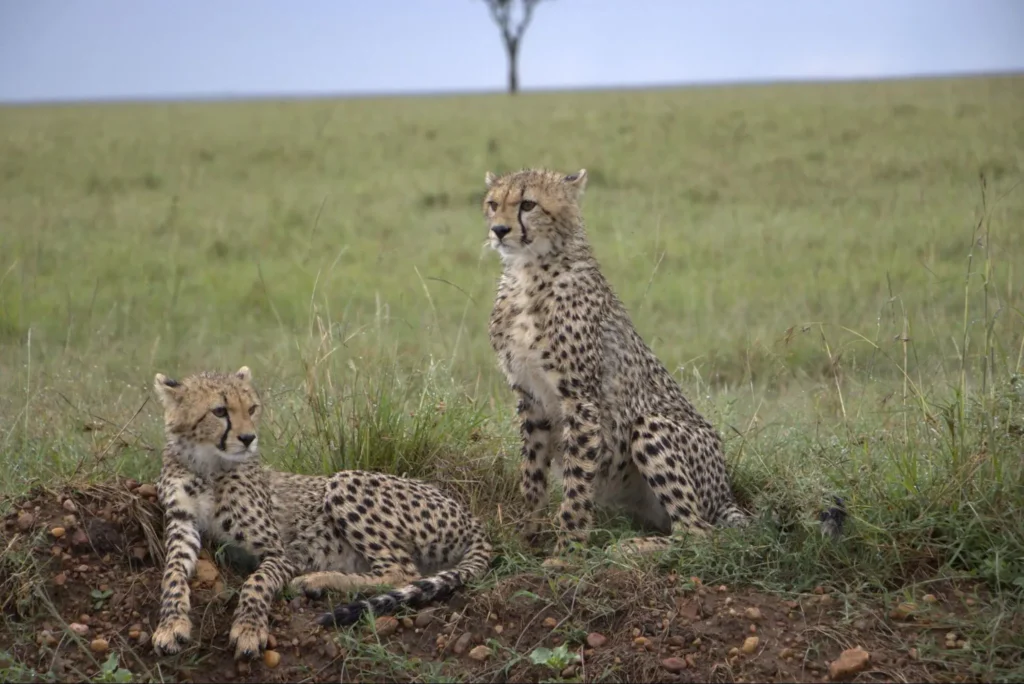
Cheetahs hunt the open plains in the east and south, mostly in the early morning, and the short-grass months make them much easier to see. Leopards stay close to the trees along the Talek and Mara rivers and are the hardest of the Big Five to find in a single day.
Black rhinos are rare anywhere in the Mara, and the Triangle and the thick country near the Tanzanian border give the best chance. Hippos and crocodiles are certain at any viewpoint on the Mara River.
Camera and Light Timing
The light in the Mara follows the same pattern most days. From about 6:30 to 9 AM it is warm and low, with long shadows and animals on the move, and fly-in clients land toward the end of it. From 10 AM to 3 PM the sun is hard and overhead, the colour goes flat and most animals lie up in the shade, which makes it a good time for lunch. From 3:30 to 6 PM the light softens and the predators start moving again. Game drive day clients get all of it. Fly-in clients are already on their way home, so the morning is their light.
Bring a lens cloth, because the dust settles on everything, charge every battery the night before and shoot moving animals in burst mode. Tell your guide early on that photographs matter to you, so he knows to put the sun behind you when he parks.
What to Pack for the Day
- Power bank (the phone hunts for signal all day)
- A soft bag, if you are flying (the airline weighs it at check-in)
- Buff or scarf for the dust, June to October
- Light jacket (13 to 15°C at dawn for much of the year, colder from June to August)
- Binoculars (our vehicles carry a pair, but your own saves sharing)
- Sunscreen and a hat
Weather, Flight Delays and Rain Contingency
Morning fog and low cloud sometimes hold aircraft on the ground at Wilson, or send them to a different airstrip from the one on the ticket. Safarilink or Airkenya decides where the plane lands, and your guide drives round to meet it, which can cost the first hour of the morning drive.
During the long rains of April and May, and after a heavy storm in November or December, some tracks inside the reserve close or turn too soft to use, so your guide keeps to the higher ground and the roads that hold, which are not always the ones with the best sightings. On the game drive day, a wet night can also push the start back until the tracks near your camp are passable.
The afternoon flight leaves on time whatever is happening on the ground, so your guide works the day backward from the departure and has you at the airstrip by 2:30 PM, even if a sighting is still going on. If your dates have any give in them at all, a second day takes most of this risk away.
Is This Trip Right for You?
Book the fly-in day trip if: you have an international flight from JKIA tonight or tomorrow, you have one free day in Nairobi, or you want to see the Mara without staying overnight.
Book the game drive day if: you are already staying near the Mara at a camp without its own game drives, or your camp’s drives are shared and you want a private vehicle and a full day out.
Do not book a day trip if: you can find two days instead, you hope for a river crossing, which needs time by the river, or you are afraid of small aircraft.
If you would like to talk your dates through, get a quote and we will come back to you with times and prices.
Best Time to Visit Masai Mara for Day Trips
| Months | What You See | Day Trip Verdict |
|---|---|---|
| January to March | Short grass, cats easy to find | The best months, and the lower reserve fee |
| April and May | Green plains, fewer vehicles | Good value. Some tracks close after heavy rain |
| June | Long gold grass, cool clear mornings | Good, with the lower fee until 30 June |
| July to October | The migration herds, the most vehicles | Busy, with the higher fee. Crossings need more than a day |
| November and December | Calves, green plains, short rains | Good when the rains are light |
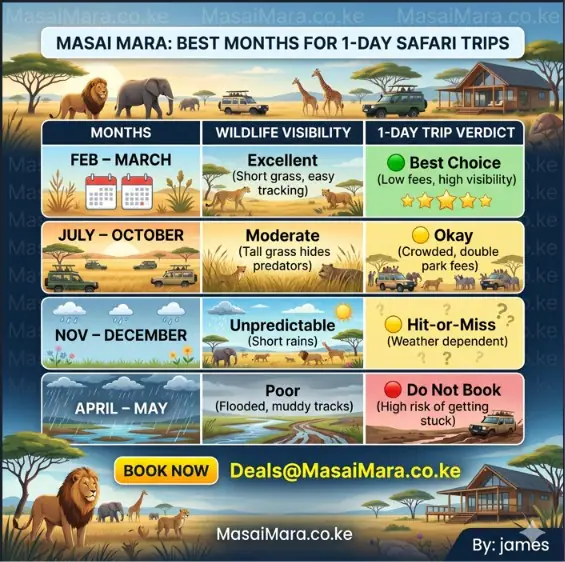
By air, every month works. Our guide to the best time to visit Masai Mara goes through each season.
February and March are still my pick for a single day, with short grass, busy predators and the lower fee, and you see almost everything except the migration clearly.
Cost Breakdown
Both prices cover the private Land Cruiser and guide, the reserve entry and vehicle fees, and lunch, and on the fly-in day they also cover the return flight and the road transfers in Nairobi.
The reserve fee is the biggest thing that moves through the year, and what separates one kind of client from another:
| Guest | January to June | July to December |
|---|---|---|
| Visitors (non-resident) | USD 100 | USD 200 |
| Kenya and East African residents | KES 2,500 | KES 5,000 |
| Kenyan citizens | KES 1,500 | KES 3,000 |
Airkenya and Safarilink sell Mara seats in US dollars to everyone, residents included, so for Kenyan citizens and residents the flight is the biggest single part of the fly-in price. There is more on the airlines and airstrips on our Nairobi to Masai Mara flights page.
Tipping Your Guide
Most clients leave a tip, and KES 3,000 for the day is the usual amount for the guide. If he found you the cats, parked well for your photographs and kept a long day comfortable, give a little more, and hand it to him yourself at the end.
Frequently Asked Questions
How much does a 1 day Masai Mara safari cost?
The fly-in day trip from Nairobi costs visitors USD 1,000 from January to June, USD 1,100 from 1 November to 20 December and USD 1,125 from July to October and over Christmas. Kenya and East African residents pay KES 111,000 to KES 117,000, and Kenyan citizens KES 106,000 to KES 110,000. Those figures are per person for two sharing; a group of six filling one vehicle brings the visitor price down to USD 900 to USD 1,010.
How far in advance do I need to book?
A week ahead is safest, because the morning Safarilink and Airkenya flights fill first. We can often arrange the trip 24 to 48 hours before you fly if there are seats, as long as we can pay the KAPS reserve fee straight away.
Can I do a day trip to the Masai Mara by road?
No. The road takes up most of the day and gets you into the reserve during its hottest, quietest hours, so fly in for the day or stay at least one night.
Is one day enough for the Masai Mara?
One day is usually enough to see elephants, giraffes, zebras, buffalo and lions. The Big Five and a river crossing need two or three days.
Can I do a 1-day trip and catch a flight at JKIA the same night?
Yes, if you fly. The afternoon flight lands at Wilson at about 4:15 PM, and the drive to JKIA takes 30 to 60 minutes depending on traffic, which suits most evening departures.
What is the latest time a vehicle can leave the Masai Mara?
On the Narok side the ticket is valid between 6 AM and 6 PM, so vehicles must be out by six, while in the Mara Triangle vehicles may drive until 7 PM. On the fly-in day, the afternoon flight sets your finish time.
Can I pay park fees at the gate with cash?
On the Narok side, yes. In the Mara Triangle, only cards and M-Pesa are accepted. On both our day trips the fee is paid before you arrive, so there is nothing to pay at the gate.
What vehicle will I be in?
A private 4×4 Toyota Land Cruiser with a pop-up roof, used only by your group, with a TRA-licensed guide.
Is phone signal available in the Mara?
It comes and goes. Safaricom has the widest coverage, but there are dead zones across the reserve, so download offline maps and tell anyone expecting to hear from you that you may be out of reach.
Related Reading
- 2 Days Masai Mara Safari
- 3 Days Masai Mara Safari
- How Many Days in Masai Mara
- Masai Mara Flying Packages
- Nairobi to Masai Mara Flights
- Masai Mara Park Fees
- Nairobi National Park Day Trip
- Best Time to Visit Masai Mara
- Hot Air Balloon Safari
- Budget Masai Mara Safari
About the Experts Behind This Safari
Written by: David Njunge, TRA-Licensed Safari Guide (10+ years of on-the-ground experience in the Masai Mara).
Edited by: Cecilia Wambui, Lead Travel Consultant & Logistics Expert.
✅ Verified for the 2027 travel season.
Welcome to Masaimara.co.ke
Thank you for visiting us! We're excited to help you plan an unforgettable safari adventure across Kenya.