
Masai Mara and Nairobi National Park Safari: 2027 Prices
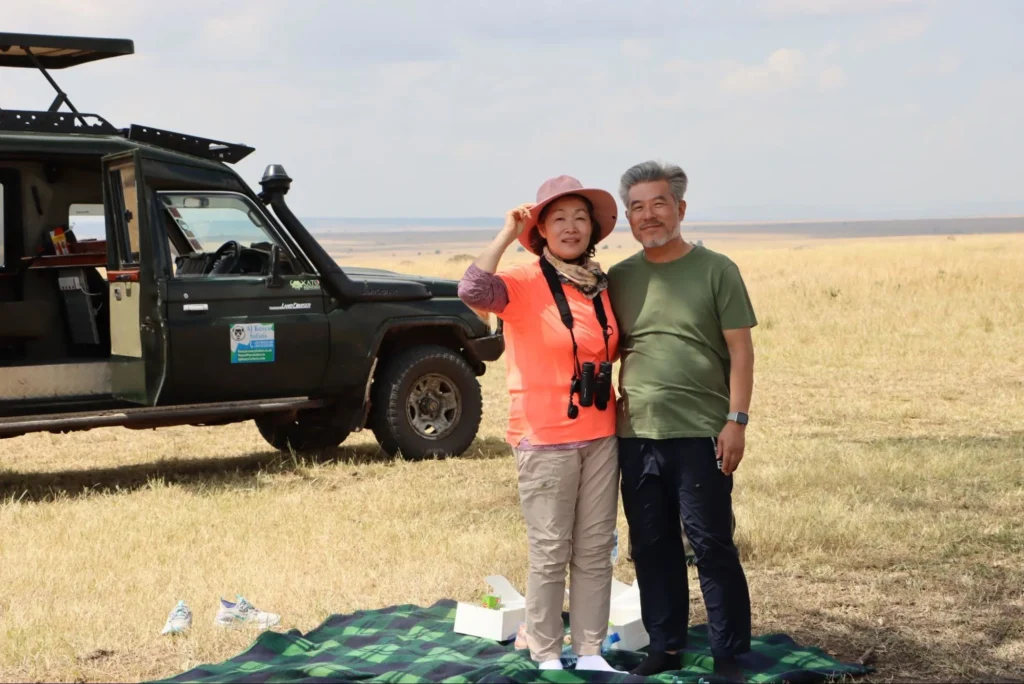
This 4 or 5 day Masai Mara and Nairobi National Park safari starts with an afternoon game drive in Nairobi National Park on arrival day, where rhinos are far easier to find than in the Mara, then two or three nights in the Mara. Prices start from KES 103,000 or USD 1,380 per person.
What This Guide Covers
A Masai Mara and Nairobi National Park safari runs 4 or 5 days. Start with Nairobi National Park on your arrival afternoon, sleep off the jet lag, and drive to the Mara the next morning. That is the short version.
Here is why this combination makes more sense than sitting in a hotel “resting” until tomorrow.
You land at JKIA exhausted. Most itineraries have you waiting around Nairobi doing nothing useful. But Nairobi National Park is about twenty minutes from the airport. You could be watching lions by 3 PM, lions with actual skyscrapers behind them. That image wakes people up faster than any amount of coffee.
I have run this route for years. The jet-lagged clients always think they are too tired. Then they see a black rhino with the Nairobi skyline in the background and suddenly they are fine.
There is a practical reason too. Rhinos are the hardest of the Big Five to find in the Mara. The few that live there keep to thick scrub and most visitors never see one. Nairobi National Park is one of Kenya’s key rhino sanctuaries, with both black and white rhinos, and on most afternoons we find one. Pair it with the Mara’s lions, leopards, buffalo and elephants and you have a real shot at all five in four days.
2027 Prices
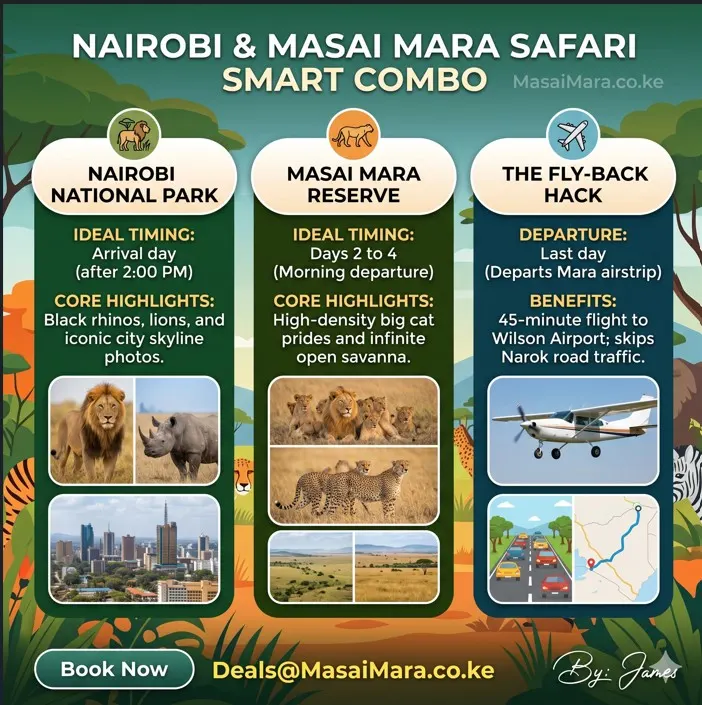
| Safari Stop | Ideal Timing | Core Highlight |
|---|---|---|
| Nairobi National Park | Day 1, arrival afternoon (from about 2 PM) | Black rhinos, lions and the city skyline in one frame |
| Masai Mara National Reserve | Days 2 and 3, with the drive in on Day 2 | Big cat prides and endless open savanna |
| Back to Nairobi | Day 4, after breakfast | By road, or the fly-back option to Wilson Airport |
Per person, two sharing, in a private Land Cruiser throughout. The 4-day trip is one night in Nairobi and two in the Mara. Kenyan prices are worked out on citizen park fees and resident lodge rates, so they are not the dollar price converted.
4-Day Safari, Non-Residents (USD)
| Tier | Lodges | Jan-June | July-Dec |
|---|---|---|---|
| Budget | 67 Airport Hotel or Ibis Styles Nairobi Westlands + Jambo Mara | 1,380 | 1,730 |
| Mid-Range | Four Points by Sheraton Nairobi Airport or The Resident at Karen + Sentrim Mara | 1,570 | 1,990 |
| Luxury | Villa Rosa Kempinski, The Emakoko or Nairobi Serena + Mara Serena | 2,140 | 2,890 |
| Super-Luxury | Ololo Safari Lodge + Mara Intrepids | 2,580 | 3,330 |
4-Day Safari, Kenyan Citizens (KES)
| Tier | Lodges | Jan-June | July-Dec |
|---|---|---|---|
| Budget | 67 Airport Hotel or Ibis Styles Nairobi Westlands + Jambo Mara | 103,000 | 113,000 |
| Mid-Range | Four Points by Sheraton Nairobi Airport or The Resident at Karen + Sentrim Mara | 117,000 | 133,000 |
| Luxury | Villa Rosa Kempinski, The Emakoko or Nairobi Serena + Mara Serena | 165,000 | 202,000 |
| Super-Luxury | Ololo Safari Lodge + Mara Intrepids | 200,000 | 239,000 |
Luxury prices are for Villa Rosa Kempinski or Nairobi Serena. The Emakoko sits inside the national park and includes all meals, so it costs a little more. Ask us for that quote. Ololo Safari Lodge, on the Super-Luxury tier, sits just outside the park on the southern bank of the Mbagathi River. On Day 2 we leave from there by road on the Magadi Road side, so you do not drive back through the park or need a second park ticket.
5-Day Safari (add a third Mara night): add USD 420 to 1,160 for non-residents, or KES 29,000 to 74,000 for Kenyan citizens, depending on tier and season. That covers the extra night, the extra day with your vehicle and guide, and the third Mara park ticket, and it gives you a second full day in the Mara.
Foreign nationals living in Kenya on a work or residence permit pay resident park fees, which sit between the two tables. Tell us when you book and we will quote you on resident rates.
The fly-back option: drive to the Mara (scenic, and it helps you settle in). On your last day, book a seat on a scheduled flight from a Mara airstrip to Wilson Airport. It saves you from the Sunday afternoon Narok to Nairobi traffic. Flights run about USD 280 / KES 36,000 per person. Wilson sits right beside Nairobi National Park, which matters if you land late on Day 1. More on that under Questions.
2027 Park Fees
| Park & Ticket | Non-Resident Adult | Citizen / Resident Adult |
|---|---|---|
| Nairobi National Park (KWS). 24 hours from entry. | USD 80, child USD 40 | Citizen KES 1,000, child KES 500. Resident KES 1,350, child KES 675. |
| Masai Mara National Reserve (Narok County). Calendar day, 6 AM to 6 PM. | USD 100 Jan-June, USD 200 July-Dec. Child (9 to 17) USD 50, under 9 free. | Citizen KES 1,500 / 3,000, child KES 300 / 500. Resident KES 2,500 / 4,500, child KES 1,250 / 2,500. |
The two tickets work differently, and it is worth knowing why. Nairobi National Park is a KWS park, and its ticket runs for 24 hours from the moment you enter. The Mara is run by Narok County and charges by calendar day, from 6 AM to 6 PM on the date you enter. Every ticket on this itinerary is already in your price. The full Mara rate card is on our park fee page.
What Is Included
- Airport pickup and drop-off
- Private 4×4 Land Cruiser with pop-up roof
- English-speaking driver-guide
- Fuel for all transfers and game drives
- Park fees: Nairobi National Park (1 × 24-hour ticket) and the Masai Mara (2 calendar days, Days 2 and 3)
- Full board in the Mara, bed and breakfast in Nairobi
- Drinking water during game drives, in reusable containers
- AMREF Flying Doctors emergency evacuation cover
What Is Not Included
- Tips for your guide (USD 15 to 20 / KES 2,000 to 2,500 per day)
- Alcoholic and soft drinks, and dinner on the Nairobi night
- Travel insurance (required)
- The Kenya eTA at USD 34 (apply at etakenya.go.ke)
- Hot air balloon: USD 500 (KES 58,500)
- Sheldrick Wildlife Trust nursery donation: USD 20 per adult and USD 5 per child under 12, or KES 2,000 per adult and KES 500 per child for Kenyans with ID or proof of residency, paid directly to Trust staff at the nursery by card, M-Pesa or cash
- Giraffe Centre entry: KES 1,500 per adult and KES 750 per child (3 to 12) for non-residents, KES 400 and KES 200 for Kenyan citizens and East African residents
- Maasai village visit: KES 1,500 for citizens / USD 20 for non-residents
- The fly-back flight, if you choose it
The Nairobi Day
Afternoon is the only sensible time. I know morning sounds logical (“get an early start”), but you are landing, and by late morning the park turns into an oven anyway. Animals disappear into shade. The light goes harsh and flat. By 2 PM things begin to cool and animals start moving again. Sunset light is what you actually want.
Gate choice matters. Coming straight from JKIA, use East Gate. It is far less crowded than the Main Gate on Langata Road and drops you straight into the open plains where cheetahs hang out. You avoid the minivan traffic jams entirely.
Think about where you will come out, too. Drives from East Gate tend to work west toward the skyline, which can leave you near the Main Gate at closing time. If you are staying at an airport hotel (67 Airport Hotel or Four Points), loop back and leave through East Gate or Cheetah Gate before 6 PM. Coming out at the Main Gate puts you on the wrong side of the city in evening rush hour, and the crawl back along the Southern Bypass and Mombasa Road can take 90 minutes. If you are staying in Karen (The Resident) or Westlands (Ibis Styles), leaving through the Main Gate or Banda Gate puts you right where you need to be.
If you are coming from Karen or Langata, the Main Gate works. It puts you closest to the northern plains, which is where you get the famous skyline shots, with Nairobi’s towers rising behind the grass.
Most tourists head for the Ivory Burning Site because it is famous. Locals go somewhere else, the Mokoyiet picnic site. It sits on a cliff above the Mbagathi River gorge. Rock hyrax everywhere (those odd little mammals that are distant relatives of elephants). Leopards use the trees in the gorge, and I have seen more of them from that cliff than anywhere else in the park.
The SGR train shot. This is the photo everyone shares: a giraffe or zebra with a modern train crossing the long concrete viaduct behind it. The railway bridge runs right across the park. Ask your guide which part of the line to wait near and when the next train is due, because timetables change. Many guides skip this “urban” corner, but for photographers it is the Nairobi shot. There is nothing like it anywhere else.
One thing to know about the park itself. It is fenced on three sides, but the southern edge is open to the Kitengela plains, and that changes what you see through the year. In the dry months, January to March and July to October, the water dries up out on the Maasai land to the south. Zebra, wildebeest and eland move into the park to drink at its permanent dams, and the lions follow them. That is when the park is at its busiest with animals. In the long rains of April and May the herds spread back out south onto the community land, and the park feels quieter, though the rhinos and resident lions stay put. And there are no wild elephants in Nairobi National Park. The park is too small to support them.
If you want elephant photos before the Mara, visit the Sheldrick Wildlife Trust nursery. Most people do not realize it is inside the national park, reached through the KWS Mbagathi Gate on Magadi Road. That means you need a Nairobi National Park ticket to get in. Here is the useful part: the park ticket lasts 24 hours from when you enter. If your flight lands early enough to reach the 11 AM public visit, you can see the baby elephants and then stay in the park for your afternoon game drive on the same ticket. Be realistic about early enough, though. Immigration and bags at JKIA take 45 to 60 minutes, and the drive to Mbagathi Gate takes another 45 to 75. The Trust wants you there by 10:30, so your flight needs to land before about 8:30 AM. If you land at 9:30, do not try it.
The nursery is open to the public from 11 AM to 12 noon only, and it is booked by email in advance with the Trust. There are no same-day bookings, and tickets from third-party websites are not accepted.
Land very early and you can do what Nairobi guides call the Nairobi Triple. The Sheldrick nursery from 11 AM to noon, then the Giraffe Centre in Langata from about 12:30 to 1:30 to feed the Rothschild’s giraffes from the platform (KES 1,500 per adult for non-residents, KES 400 for Kenyans), then into the park through the Main Gate by 2 PM for the afternoon drive. Leaving the park for the Giraffe Centre and coming back in can mean a second park ticket, so ask us to price the full Triple for you. Two separate payments happen here, and people mix them up. The KWS park gate is cashless and takes only the eCitizen park ticket, which we pay for you. The nursery donation is different: you pay it directly to the Trust’s own staff at the nursery, by card, M-Pesa or cash, not at the park gate.
The Road to the Mara
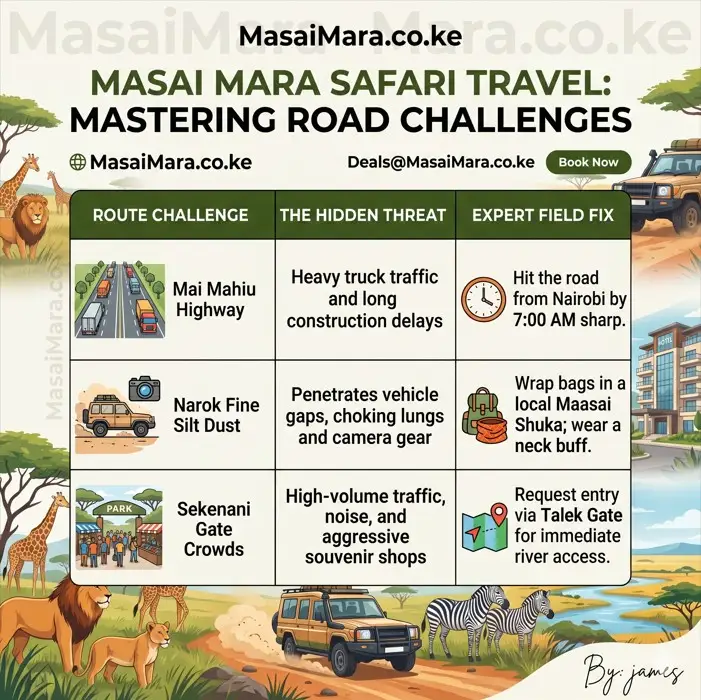
The Road To The Mara
| Route Challenge | The Hidden Threat | Expert Field Fix |
|---|---|---|
| Mai Mahiu Escarpment | Heavy trucks and breakdowns that stop traffic for hours | Leave Nairobi by 7:00 AM sharp |
| Dust Inside The Reserve | Fine silt gets into vehicles, lungs and camera gear | Wrap bags in a Maasai shuka, wear a neck buff |
| Sekenani Gate Crowds | Busy gate, noise and pushy souvenir shops | Ask about entering at Talek Gate for quicker river access |
Five to six hours. Sometimes seven. Depends on the lorries, and on where you slept.
Your Nairobi hotel changes the morning. Westlands (Ibis Styles) and Karen (The Resident at Karen) are already on the western side of the city, close to the road out toward the escarpment, which can save you 45 minutes. The airport hotels on Mombasa Road (67 Airport Hotel, Four Points) and the lodges on the park’s southern edge (The Emakoko, Ololo) mean crossing the city on the Southern Bypass, so we leave at 6:30 AM to get ahead of the school and office traffic.
The road over the Mai Mahiu escarpment gets clogged with trucks, and one broken-down lorry can hold everything up for hours. Budget extra time. Leave Nairobi by 7 AM if you can manage it.
Everyone stops in Narok. The unofficial safari pit stop is the Total station, with clean toilets and snacks, and all the drivers gather there. The Seasons Hotel across the road does decent food if you want to sit down. Narok is also the last town with ATMs and a proper supermarket. From Narok it is about an hour and a half on tarmac to Sekenani Gate.
The dust is inside the reserve, not on the road in. Once you are on the dirt tracks, even in a closed vehicle, fine silt gets everywhere: your camera, your lungs, your teeth. Buy a shuka (the Maasai blanket) at a roadside stall in Narok. Use it to cover your gear and bags. It works better than plastic and supports the local economy. Bring a buff or neck gaiter for your face.
Gate choice: Sekenani is the default because the tarmac goes there. It is also the busiest, loudest, most souvenir-shop-heavy entrance. If your lodge allows it, ask about Talek Gate instead. It drops you straight into big cat territory along the Talek River.
If your camp is in the Mara Triangle (the western side), you use Oloololo Gate. The Triangle is run by the Mara Conservancy, and they are strict: rangers fine drivers for going off-road or crowding animals. If you want a quieter, better-managed experience, ask your guide to spend time there. The Triangle runs its own cashless ticketing, so ask your guide before you cross over whether your ticket that day covers it.
The Mara Days
After Nairobi National Park’s compact 117 square kilometers, the Mara feels infinite. The national reserve alone is about 1,510 square kilometers of open savanna. Lions are almost guaranteed. I have seen three different prides before morning coffee on slow days. Cheetahs most drives. Leopards if your guide knows where to look.
Day 2 is the drive in, lunch at camp and an afternoon game drive. Day 3 is a full day: dawn drive, picnic lunch on the plains, back at camp by 6:30 PM. If you want the hot air balloon, Day 3 is the only morning it can happen on a 4-day trip. It means a 5 AM pickup and a champagne breakfast after you land, and it takes the place of your one dawn drive for big cats. Your guide meets you at the landing site and the game drive carries on from there. On Day 4 there is no game drive. You have breakfast and head back to Nairobi, or to the airstrip if you fly.
How you leave on Day 4 depends on your camp. Jambo Mara and Sentrim Mara sit outside the reserve. Your park tickets there ended at 6 PM on Day 3, so we do not go back through a gate at all. We take the public road straight toward Narok. Mara Serena and Mara Intrepids are inside the reserve. Your last night covers you until 10 AM, and the drive out to the gate is a transit with the roof closed. Reach the gate after 10 and you pay another full day.
During the migration (roughly July to October), add more than a million wildebeest to the picture. But the Mara delivers year-round.
The altitude catches people off guard. Nairobi and the Mara both sit above 1,500 meters (about 5,000 feet). At 6 AM on a Mara game drive it can be 10 to 12°C, and by noon it is close to 30°C. That “safari vest” everyone wears is not fashion. It holds the layers you peel off as the day heats up. Pack accordingly, starting with our packing list.
If you are vegetarian, bring supplies. At budget camps, “vegetarian” can mean boiled cabbage and rice. Hot sauce, nuts, protein bars: pack your own pantry essentials. Safari food leans heavily toward meat. Tell us when you book and we will warn the camps, which helps more than you would think.
Common Mistakes
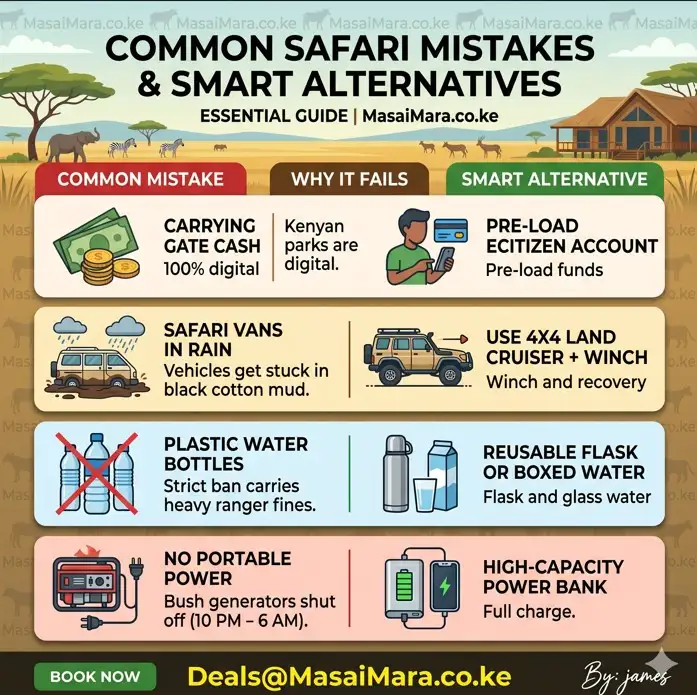
Common Mistakes
| Common Mistake | Why It Fails | Smart Alternative |
|---|---|---|
| Carrying Gate Cash | KWS gates and the Mara gates are cashless | Let your guide pay, or set up eCitizen before you travel |
| Safari Vans In Rain | Vans get stuck in deep black cotton mud | Insist on a 4×4 Land Cruiser |
| Plastic Water Bottles | Single-use plastics are banned in protected areas | Pack a reusable flask |
| No Portable Power | Many camps switch power off at night | Carry a fully charged, high-capacity power bank |
Expecting to pay cash at the gate. Kenya’s park gates have gone cashless. KWS parks like Nairobi National Park are paid through eCitizen, and the Mara gates take card and M-Pesa. Many tourists get stuck because they expect to hand over cash. Your guide handles this on our trips, but if you are driving yourself, set up an eCitizen account before you arrive.
Bringing plastic water bottles. Kenya bans single-use plastics in national parks, reserves and other protected areas. Rangers can fine you if they find them. Bring a reusable bottle, and we refill it from the water containers in the vehicle.
Booking a safari van for the rainy season. Do not. You will get stuck in the black cotton mud. Insist on a 4×4 Land Cruiser, especially in April, May and November. The price difference is worth not spending three hours being pulled out of a rut. This is not only a Mara problem. Nairobi National Park’s lower tracks along the Athi and Mbagathi valleys are black cotton soil too, and after rain low vans get stuck around places like Hyena Dam. A 4×4 matters in the city park as well.
Forgetting a power bank. Many budget and mid-range Mara camps run generators or solar banks only at set hours, often early morning and evening, and switch off late at night. If your phone dies during a long game drive, you are out of luck until you are back. Bring a charged power bank.
Underestimating M-Pesa. International credit cards fail at random moments because of poor signal. A local SIM with some M-Pesa float is a lifesaver for drinks, village fees or unexpected costs. Your guide can help you set this up at the airport.
Wrong binoculars. Nairobi National Park is a birdwatcher’s paradise, with more than 500 species recorded. If you are interested, 8×42 is the sweet spot. The Mara has big animals you can see with your eyes. Nairobi rewards people who look at the small stuff.
Questions
Can I do this in 3 days? Technically. Day 1: land, Nairobi National Park. Day 2: drive to the Mara, afternoon game drive. Day 3: drive back and fly out, with no game drive that morning. You get one afternoon in the Mara for two long days on the road. I do not recommend it. Four days minimum.
What if my flight arrives late? If you land after about 2:30 PM, skip the park that day and drive to the Mara the next morning as planned. Then take the fly-back option on Day 4. You land at Wilson Airport around midday, and Wilson is right next to Nairobi National Park’s Main Gate. Your guide picks you up there and you do the park in the afternoon before your evening flight home. The Nairobi National Park ticket in your price is simply used on Day 4 instead of Day 1, so you do not lose it and you do not pay twice.
Which park is better? Different experiences. Nairobi National Park for the surreal city-and-wildlife shots and the black rhinos. The Mara for everything else: big cats, the migration, open landscapes. Do both.
Do I need a separate ticket for the Sheldrick elephant nursery? Yes. The nursery asks for a cash donation at the gate, and because it sits inside Nairobi National Park, you also need a park ticket. If you visit on the same day as your game drive, one park ticket covers both.
Is Nairobi safe? The park is patrolled by KWS rangers and fenced on three sides. The city has its issues like any major city, but the areas visitors use (Karen, Langata, Westlands) are fine. Normal urban awareness applies.
Why is peak season more expensive? Mara park fees double from USD 100 to USD 200 per day, and lodges charge premium rates during the migration. Nairobi National Park fees stay the same all year.
When is the best time to go? January to March for dry weather and short grass, and July to October for the migration. Nairobi National Park is good year-round, though the roads inside it get muddy in April and May. See our best time to visit guide.
Book This
Tell us your arrival date and flight time. We handle the airport pickup, vehicle, lodges, park fees, all of it.
More Reading
- 3 Days Masai Mara Safari
- 5 Days Masai Mara Safari
- Budget Masai Mara Safari
- Masai Mara Migration
- Packing List
- First-Time Safari Guide
Park fees change. Check KWS eCitizen for Nairobi National Park and Narok County for the Masai Mara.
Written by David Njunge, TRA-licensed safari guide with over 10 years in the Masai Mara. Edited by Cess Wambui, travel consultant, BSc Tourism and Hospitality Management. Verified for the 2027 season.
Welcome to Masaimara.co.ke
Thank you for visiting us! We're excited to help you plan an unforgettable safari adventure across Kenya.