
Karen Blixen Camp: Mara North Rates & 2027 Safari Guide
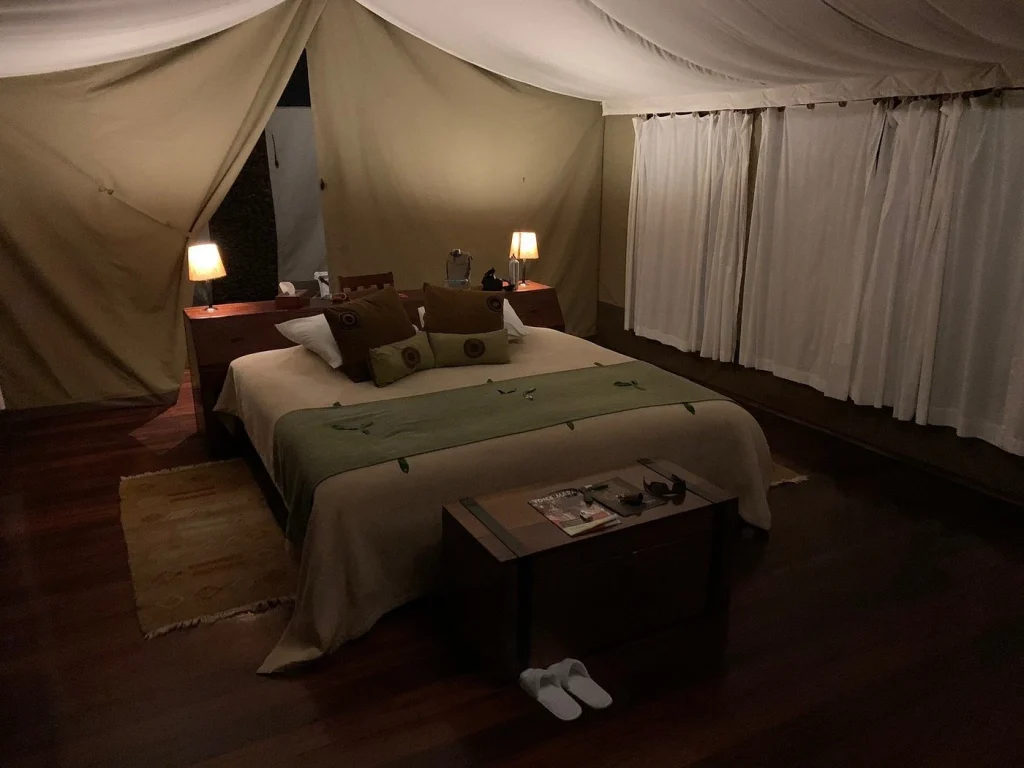
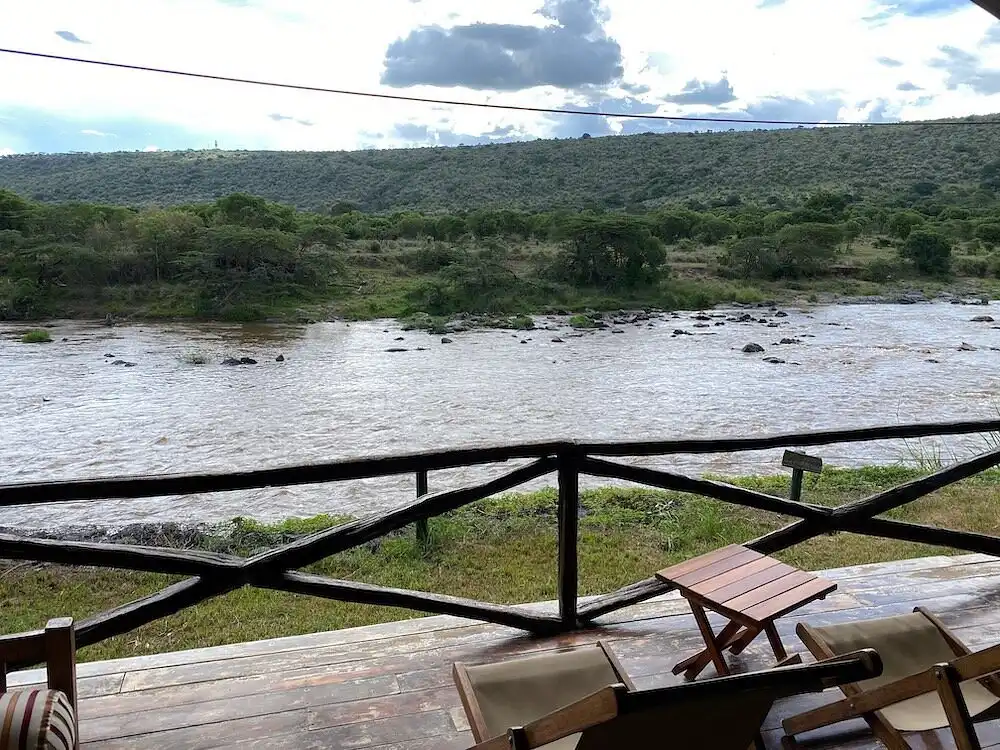
Karen Blixen Camp occupies a stretch of the Mara River bank in Mara North Conservancy, about 12 km from the airstrip. Twenty-two luxury canvas tents on raised wooden platforms. A resident hippo pod of 30-40 animals directly in front of the dining area, with Nile crocodiles working the banks.
The camp runs entirely on solar power and holds Gold certification from Eco Tourism Kenya. There’s a chemical-conscious swimming pool tucked under a canopy of indigenous African olive and acacia trees — designed to protect the surrounding ecosystem while offering genuine shade from the midday equatorial sun.
If you’re planning to cross into the main Masai Mara National Reserve for a migration crossing, know this: your all-inclusive rate covers Mara North Conservancy fees, but the moment you enter the reserve, you pay national reserve fees separately. That’s USD 100/day January-June, jumping to USD 200/day July-December. Per person. Per day. This catches people.
Packages (2027 Rates)
3-day/2-night safari from Nairobi, per person, two people sharing.
Included: Return flights Wilson Airport to Mara North Airstrip, all transfers, 2 nights fully inclusive at Karen Blixen Camp (meals, select drinks, unlimited game drives within Mara North), conservancy fees, Flying Doctor cover.
Not included: Kenya eTA (USD 34), premium drinks, balloon safari (USD 550), spa treatments, tips (USD 15-20/day), Maasai village visits, main Masai Mara reserve entry fees if crossing into reserve.
Package Rates & Reserve Fee Breakdown Table
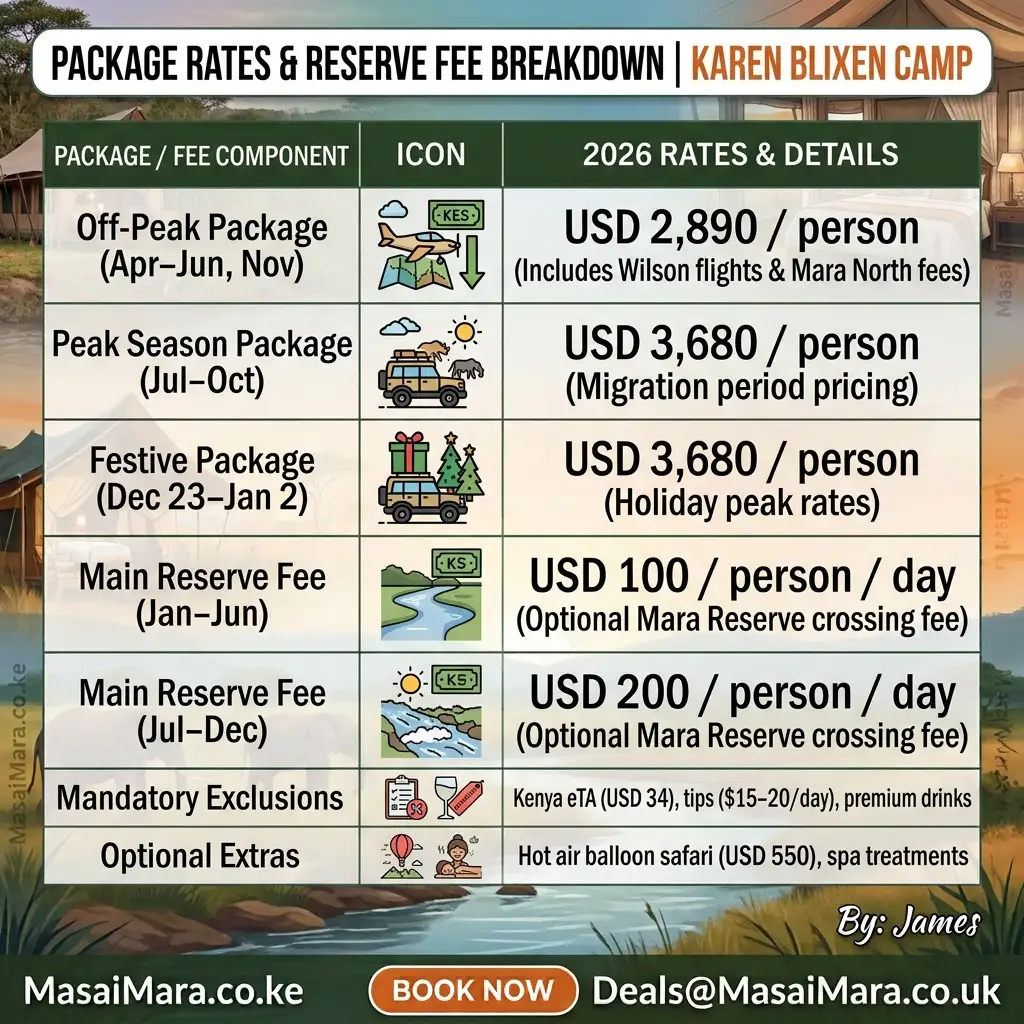
Planning your stay at Karen Blixen Camp requires understanding how transport choices and seasonal timing impact overall package costs. To avoid unexpected expenses—such as daily reserve entry fees—use the table below to review starting safari package rates and essential inclusions.
Package / Fee Component | 2027 Rates & Details |
High Season Package (Jan–Mar, Dec 1–22) | USD 3,250 / person (Wilson flights, transfers, full board, select drinks, and Mara North fees included) |
Off-Peak Package (Apr–Jun, Nov) | USD 2,890 / person (Includes Wilson flights & Mara North fees) |
Peak Season Package (Jul–Oct) | USD 3,680 / person (Migration period pricing) |
Festive Package (Dec 23–Jan 2) | USD 3,680 / person (Holiday peak rates) |
Main Reserve Fee (Jan–Jun) | USD 100 / person / day (Optional Mara Reserve crossing fee) |
Main Reserve Fee (Jul–Dec) | USD 200 / person / day (Optional Mara Reserve crossing fee) |
Mandatory Exclusions | Kenya eTA (USD 34), tips (USD 15–20/day), premium drinks |
Optional Extras | Hot air balloon safari (USD 550), spa treatments |
The Reserve Fee Trap
Your all-inclusive rate covers Mara North Conservancy. The conservancy has excellent wildlife and allows off-road driving with fewer vehicles.
But if you want to cross into the main Masai Mara National Reserve — say, to see a river crossing at the famous spots during migration — you’ll pay reserve park fees on top. For a family of four doing one full-day excursion into the reserve during August, that’s USD 800 in extra fees for that single day.
Budget accordingly. Or accept that Mara North has its own crossings and resident wildlife, and you may not need to enter the reserve at all. If you do choose a full-day reserve crossing drive, ask Masaimara.co.ke to prepay your Narok County entry permits in advance so your guide does not waste prime morning game-viewing hours troubleshooting portal connection failures at the gate.
Tent Selection
All 22 tents line the river on raised wooden platforms. Outdoor showers at the back of each tent, private but open to the sky with views upward. Double sinks, flush toilets, Persian rugs, day beds on the verandah, bathrobes, slippers.
The Family Unit
If you’re traveling as a family or group, don’t just book two adjacent tents and hope they’re near each other. The camp has one specialized Family Unit — two distinct luxury tents permanently joined by an expansive, continuous wooden verandah. It functions as a single private compound.
This unit sells out first. Request it explicitly by name at booking. Don’t assume the camp will automatically allocate it.
WiFi Strategy
WiFi doesn’t reach the tents. Signal is available around the main lodge, but if you actually need to send files or check messages reliably, ask about the WiFi hut near the office. One guest noted Tent 7 was close enough to the main building to catch usable signal. If connectivity matters for work, mention this at booking.
Noise and Rapids
Tent 6 sits near a section of river rapids. The water sound is constant — pleasant for some, disruptive for others who want to hear the hippos grunting without competition. Tent 11 gets mentioned for good positioning without the rapids noise.
Tents closer to the main lodge mean shorter walks, which matters because staff escort you after dark (the camp is unfenced, wildlife walks through). If mobility is a concern, request a tent near Reception.
Tent Selection & Placement Guide Table
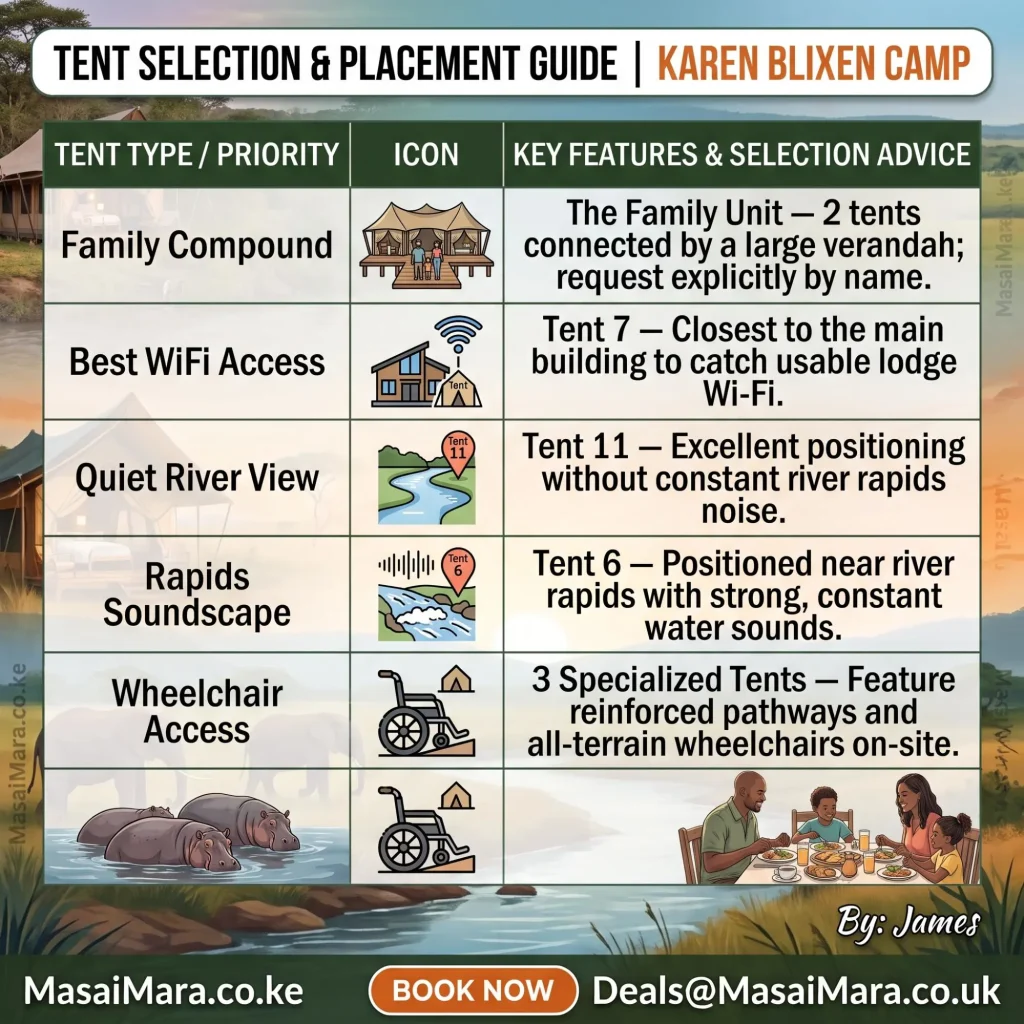
With 22 luxury riverfront canvas tents along the Mara River, choosing the right room assignment depends on your preference for river sounds, proximity to reception, or family layout needs. Use this selection guide to request the ideal tent location prior to arrival.
Tent Type / Priority | Key Features & Selection Advice |
Family Compound | The Family Unit — 2 tents connected by a large verandah; request explicitly by name. |
Best WiFi Access | Tent 7 — Closest to the main building to catch usable lodge Wi-Fi. |
Quiet River View | Tent 11 — Excellent positioning without constant river rapids noise. |
Rapids Soundscape | Tent 6 — Positioned near river rapids with strong, constant water sounds. |
Wheelchair Access | 3 Specialized Tents — Feature reinforced pathways and all-terrain wheelchairs on-site. |
Accessibility
Karen Blixen has three custom-designed, fully wheelchair-accessible luxury tents with structurally reinforced pathways to the main dining area. The camp keeps specialized, ruggedized all-terrain wheelchairs on-site.
The property is flat throughout. One guest traveled with a 90-year-old family member using a mobility walker, and the camp handled it smoothly. If you have accessibility needs, communicate them at booking so they can allocate the right tent and prepare the equipment.
The Solar Reality
The camp runs 100% on solar power. Hot water comes from solar heaters, which the camp’s own materials say serve all 22 tents on a 24-hour basis. In practice, some guests have experienced timing limitations — morning and evening tend to be most reliable for the outdoor showers.
You cannot plug in high-draw devices. Travel kettles, hair dryers — the solar system won’t support them. If you need hot drinks, ask staff for a thermos. They don’t normally offer room service, but they’ll organize this workaround.
Charging phones and cameras is fine. The power points work for low-draw electronics.
Beyond Game Drives
Aitong and Mararienda Market Days
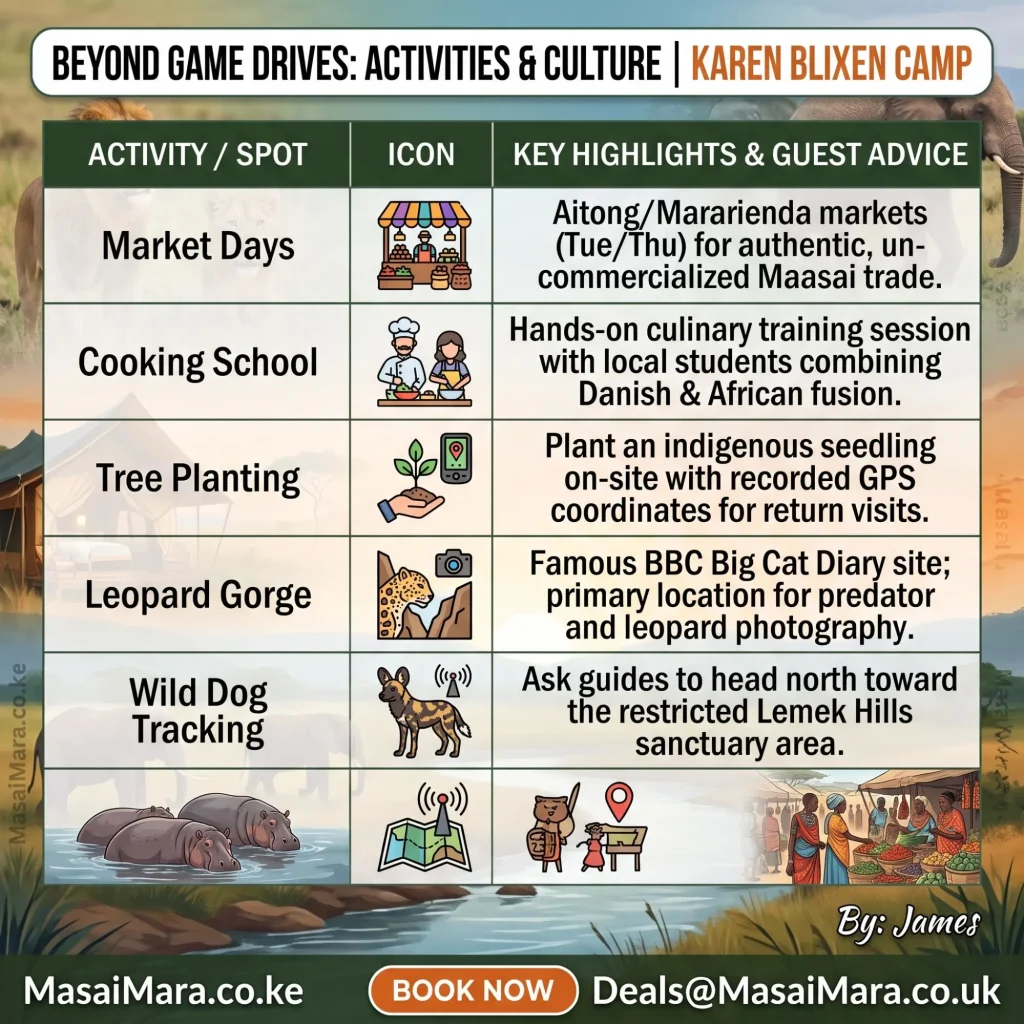
Skip the predictable curio stalls at the camp. If your itinerary lands on a Tuesday or Thursday (depending on the village), ask your guide to take you to the authentic weekly market in Aitong or Mararienda. This is where Maasai community members actually gather to trade livestock, vegetables, and vibrant shukas. Loud, un-commercialized, sensory-rich. The smell of goat, the sound of haggling in Maa, the colours everywhere.
This isn’t a tourist experience. It’s real local commerce. Some guests find it the most memorable part of their trip.
The Cooking School
The camp runs a hospitality training school on-site for local Maasai youth. Guests can request a hands-on cooking session alongside the students, learning the camp’s distinctive culinary fusion — traditional Danish, Indian, and classic African flavors mixed together.
It’s a window into how the camp trains local staff while preserving distinct food traditions. Ask about availability.
Tree Planting
For a small conservation fee, you can physically plant an indigenous seedling on the camp grounds. They record GPS coordinates. Returning guests have asked guides to drive them back to check on “their” tree years later.
The camp has invested heavily in restoring the degraded Mara Woodlands — solar panels, rainwater harvesting, composting, a helicopter donation to the Mara Elephant Project that reduced poaching significantly.
Leopard Gorge
When your guide takes you to Leopard Gorge, they’re not just showing you rocks. This geological feature is a legendary apex-predator nursery, made famous globally by the BBC’s Big Cat Diary series. The camp’s local Maasai guides know the generational lineages of the leopards that frequent the rocky crevices here.
The Mara River crossings get the headlines, but Leopard Gorge is where the serious wildlife photography happens year-round.
Beyond Game Drives: Activities & Culture Table
While daily game drives showcase the wildlife of Mara North, Karen Blixen Camp offers several unique cultural and conservation activities on-site and nearby. The directory below highlights key experiences to arrange with your guide during your stay.
Activity / Spot | Key Highlights & Guest Advice |
Market Days | Aitong/Mararienda markets (Tue/Thu) for authentic, un-commercialized Maasai trade. |
Cooking School | Hands-on culinary training session with local students combining Danish & African fusion. |
Tree Planting | Plant an indigenous seedling on-site with recorded GPS coordinates for return visits. |
Leopard Gorge | Famous BBC Big Cat Diary site; primary location for predator and leopard photography. |
Wild Dog Tracking | Ask guides to head north toward the restricted Lemek Hills sanctuary area. |
Arrival Details
On arrival, expect passion-fruit juice and warm towels — a tactile welcome after the journey.
By air (recommended): Wilson Airport (Nairobi) to Mara North Conservancy Airstrip, roughly one hour. The camp is 12 km from the airstrip, transfer included.
By road (not recommended): Six-plus hours from Nairobi. The last 73 km on the C13 road is notorious for bone-rattling bumps on terrible road conditions. Multiple guests have specifically warned against driving. Fly if your budget allows.
Camp Life
Meals: Open-air restaurant overlooking the river and hippo pod. Buffet breakfast includes full English options. Dinner menus change nightly. The kitchen handles dietary requirements well — communicate in advance.
Bush breakfast: Highly recommended. Your guide takes you out early, then sets up a full breakfast in the bush after the morning drive. Request it.
Private dinners: Available with advance notice. Fire pit, personal service, just you and the bush sounds.
Sundowners: Arranged daily. Wine, the sunset, the sounds of the Mara settling into night.
Nightly entertainment: Traditional Maasai dance performances most evenings. Some nights, staff set up an open-air projector in the bush garden to screen the classic film Out of Africa under the stars while the real hippo pod grunts in the background.
Spa: Anne handles massage — particularly useful after rough game-drive days on corrugated roads. Some packages include complimentary treatments.
Laundry: Genuinely useful here. Everything gets coated in fine Mara dust. They’ll wash and return your clothes.
Pool: Chemical-conscious eco-design under indigenous tree canopy. Genuine shade for midday escapes.
Monkeys: Vervet monkeys frequently move through the trees around the camp. Always lock your mesh tent zips when leaving for drives, and never leave snacks, fruit, or open food on your verandah. Store cash, passports, and small electronics inside your room’s digital safe.
Guides Who Know This Land
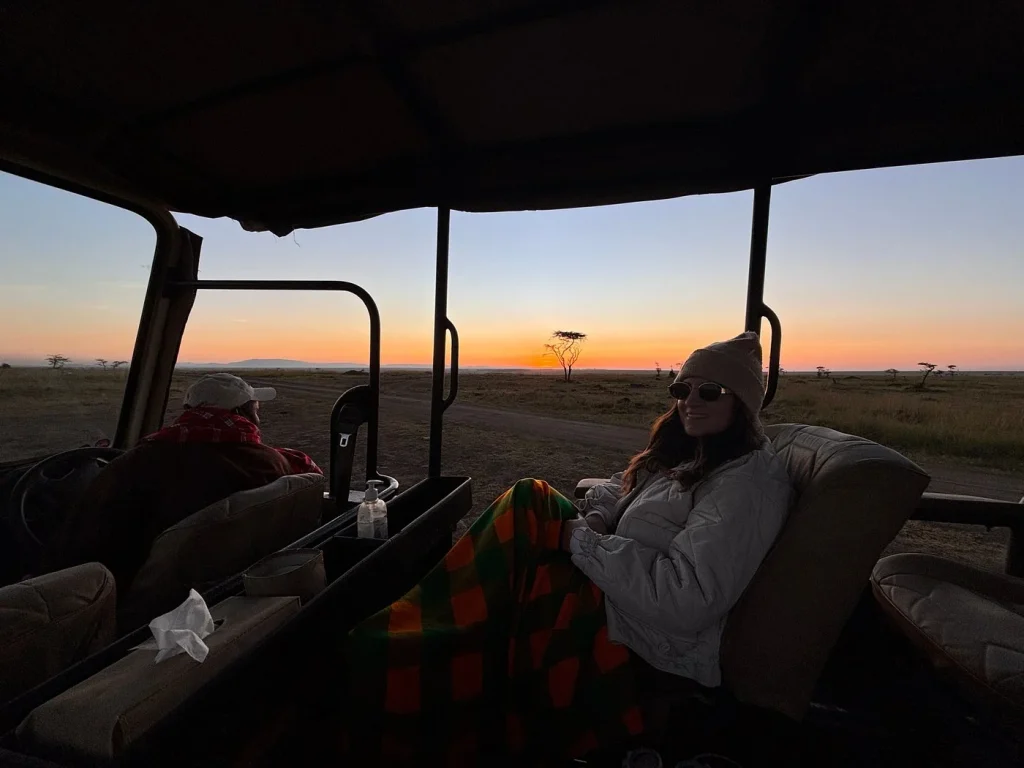
The camp’s Maasai guides have generational knowledge of the conservancy. Francis asks each family member individually what they want to see, then works the radio network to deliver. Simon knows positioning for photography. Jonathan is excellent with elderly guests and those who need a calmer pace.
For wild dog sightings, ask about heading north toward the Lemek Hills — a restricted sanctuary area in the northern conservancy corridor where a resident pack of threatened African wild dogs is protected. You won’t find them in the crowded main reserve.
When to Visit
July-October: Peak migration season. High herd densities across Mara North and river crossings along the Mara River. Peak rates and highest demand; reserve months ahead.
November-December: Shoulder season (short rains). Lush landscapes, migratory birds arrive, fewer vehicles, and moderate rates.
January-March: Warm and dry season. Clear skies, excellent resident big cat tracking, and dust-free game drives before the long rains.
April-June: Long rains (green season). Emerald savannahs, dramatic photography light, lowest rates, and special promotions (such as stay 3 nights, pay for 2). Roads can be slick.
For the ideal rhythm between drives and camp amenities, book a minimum of three nights. This allows you to combine early morning drives with relaxing afternoons on your deck watching the hippo pod, rather than exhausting yourself on rushed full-day transits across the conservancy.
Questions People Ask
Is Karen Blixen Camp inside the Masai Mara reserve?
No. It’s in Mara North Conservancy, which borders the main reserve. Your all-inclusive rate covers conservancy fees. If you cross into the main reserve, you pay additional fees: USD 100/day (Jan-Jun) or USD 200/day (Jul-Dec).
Does Karen Blixen Camp have wheelchair-accessible tents?
Yes. Three custom-designed accessible tents with reinforced pathways and all-terrain wheelchairs available on-site.
Can families stay together at Karen Blixen Camp?
Yes. The Family Unit consists of two tents with a shared continuous verandah. It sells out first — request by name. Regular tents can accommodate a family of four with extra beds.
What is the best tent at Karen Blixen Camp?
Depends on your priorities. Tent 7 for WiFi proximity. Tent 11 for good positioning without rapids noise. The Family Unit for groups. The accessible tents for mobility needs.
Plan Your Karen Blixen Safari
With 22 luxury riverfront tents and high demand for specialized units like the Family Compound and wheelchair-accessible suites, Karen Blixen Camp sells out months in advance—particularly during the peak July–October migration. Tell us your travel dates, party size, and flight preferences from Nairobi Wilson. Our team at Sekenani Gate will check live availability directly with the camp and deliver a fully itemized quote including domestic flights, transfers, Mara North Conservancy fees, and optional reserve crossing permits.
- Email: [email protected]
- WhatsApp: +254 180 297 751
- Online Booking: Get a Quote
Related Pages
- Masai Mara Safari from Nairobi
- Mara North Conservancy
- Mara River
- Park Fees 2027
- Weather in Masai Mara
- Masai Mara Booking
Sources
Written by David Njunge, TRA-licensed safari guide with over 10 years in the Masai Mara. Edited by Cess Wambui, travel consultant, BSc Tourism and Hospitality Management. Verified for the 2027 season.
Welcome to Masaimara.co.ke
Thank you for visiting us! We're excited to help you plan an unforgettable safari adventure across Kenya.