
5 Days Masai Mara and Lake Naivasha Safari: 2027 Prices

This 5 days Masai Mara and Lake Naivasha safari starts at the lake with Hell’s Gate, Crescent Island and a boat ride, then spends three nights in the Mara with five game drives. Prices run from KES 130,000 to 473,000 for Kenyans and USD 1,720 to 7,070 for visitors.
One night at Naivasha, three nights in the Mara. Five game drives in the reserve. KES 130,000 to 473,000 for Kenyans, USD 1,720 to 7,070 for visitors. I will explain why I route it Naivasha-first instead of the usual way.
Most operators do the Mara first, then Naivasha on the way back. I stopped doing that years ago. The thing is, after three days of 5:30 AM wake-ups and bumpy roads, the last thing anyone wants is a bike ride through a gorge and a boat on the lake. They are tired. The lake feels like an obligation. Put it first and you get to Naivasha fresh, with energy for Hell’s Gate in the morning and the water in the afternoon. And the Mara becomes the finale, not the middle.
So. Day 1 we go to Naivasha. It is close. You are fresh. The boat ride actually means something.
The Summarized 5 Days Safari
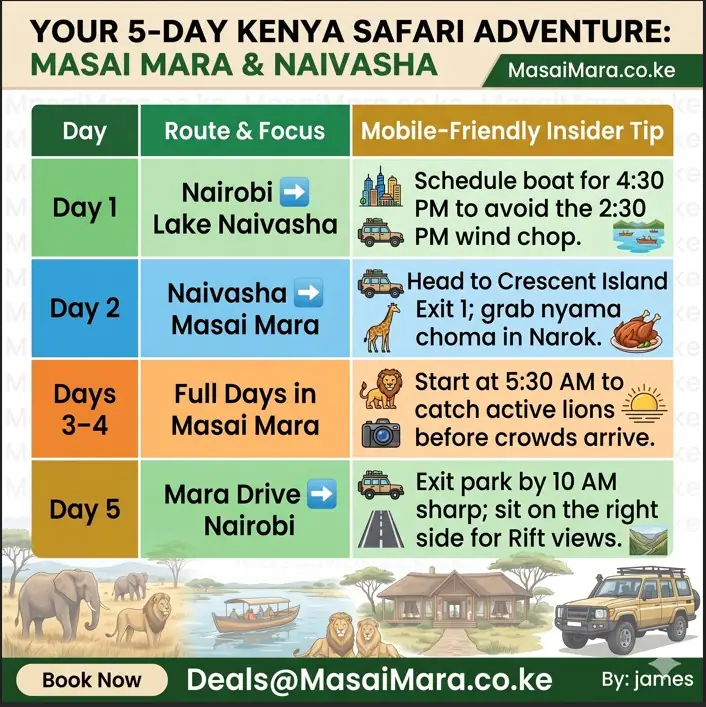
Day | Route & Focus | Insider Tip |
Day 1 | Nairobi ➔ Hell’s Gate ➔ Lake Naivasha | Cycle by 9 AM, gorge capped at 1.5 hours. Crescent Island by 3:15 PM, cruise from 4:30 PM. |
Day 2 | Naivasha ➔ Masai Mara | Short stop in Narok for shopping, then lunch at your Mara camp. |
Days 3–4 | Full Days in Masai Mara | Be at the gate by 6 AM to catch active lions before the crowds. |
Day 5 | Mara Drive ➔ Nairobi | No game drive. Camps inside the reserve, out of the gate by 10 AM. |
Day 1: Nairobi to Naivasha
We leave Nairobi at 6:30 AM. The road drops over the escarpment at Mai Mahiu and we are at Elsa Gate of Hell’s Gate National Park by about 8:30.
Hell’s Gate is cycling, then the gorge. Get on the bikes by 9. The track from Elsa Gate to the gorge is about 7 to 8 km one way on dirt with almost no shade, and by 11 the heat bounces off the rock. Test the brakes and the gears before you leave the rental stand, not halfway down a slope. Zebras and giraffes move off when cyclists come by. Wildebeest sometimes do the opposite and stand their ground, so give them room.
Most people focus on the gorge floor, understandably. But look up at the Njorowa cliff faces. This is one of the few places in Kenya where Rüppell’s vultures nest on the cliffs. Rare bird. Bring binoculars for the cliffs specifically. The gorge walk itself is led by one of the registered community guides who work the gorge, and it means scrambling over rocks and a few steep sections with fixed ropes. Budget around KES 2,000 for the guide, shared by your group, and agree the price before you set off. On this trip we keep the walk to 1 to 1.5 hours. The full loop can take four, and that would wreck the afternoon on the lake. If you have bad knees or a fear of heights, cycle and skip the gorge. You lose nothing on the wildlife side.
Hell’s Gate is a KWS park and the gate does not take cash. Fees are paid through KWS eCitizen. We pay it online the day before and add it to your bill, so you do not stand at the gate fighting a weak network.
We are back on the bikes and out of the park by about 12:30, then along Moi South Lake Road to your lodge for lunch and check-in.
Crescent Island comes next, and timing matters here. The island stops letting visitors in around 4:30 PM and clears everyone out before the hippos come ashore at dusk. So the boat picks you up around 3:00 and lands you on the island by 3:15, 3:30 at the latest. It is one charter for the whole afternoon. The crossing is short and the captain keeps it close to the shore, so the chop that ruins an open-water cruise barely matters for those ten minutes. The same boat waits while you walk. You walk among giraffes, zebras, wildebeest and waterbuck without a vehicle. The animals descend from stock brought in for the 1985 Out of Africa filming. I assume you have heard this, everyone mentions it. What they do not mention: there is a flat-top acacia on the ridge where the wind is blocked. Good spot for a quiet rest away from the other walking groups. Ask your guide.
Then back on the same boat for the cruise proper, from 4:30. Not earlier. The wind on Naivasha picks up around 2:30 most days, locals call it the afternoon chop, and by 4:30 it usually settles. I have done 2 PM rides where we spent the whole time getting sprayed and could not hear the guide over the waves.
The hippos start grunting as the light changes. Fish eagles wait in the yellow fever trees along the shore. Boat captains throw tilapia to bring them close. Everyone does this, it is basically trained behaviour at this point. Most captains throw the fish too close to the boat. The eagle swoops before you can react. If you want the wingspan shot, ask yours to throw it 15 to 20 meters out, parallel to the boat. Gives you time to track the descent.
Now here is something most itineraries will not mention. If you are staying at Lake Naivasha Sopa Resort or one of the other lakeshore lodges, ask the night guard to walk you to the fence line around 9 PM. The hippos come out of the water to graze on the lawns. You will see them closer than you ever will from a boat, maybe 10 to 15 meters. Bring a torch with a red filter if you have one. White light startles them. Never go without the guard.
The guards are used to this. Tip them KES 200 to 300. They know exactly where to stand.
Day 2: The Drive And First Mara Evening
Breakfast without rushing, and we leave around 9. The drive to the Mara takes about 4 to 4.5 hours. We follow the lake road south to Mai Mahiu on the valley floor, then turn west on the B3 past Mount Suswa to Narok.
About Narok. We stop there, but not for lunch. It is a stretch of the legs and a chance to shop, maybe twenty or thirty minutes. Narok is the last proper town before the reserve. If you need cash from an ATM, airtime, sunscreen or snacks from the supermarket, get them here. The clean toilets at the supermarket are better than anything you will find further on.
Lunch is at your camp in the Mara. We arrive around 1:30 to 2, eat, check in, and rest through the hottest part of the day. At 4 we head out for your first game drive. Maybe two and a half hours of light left.
Days 3 and 4: The Mara
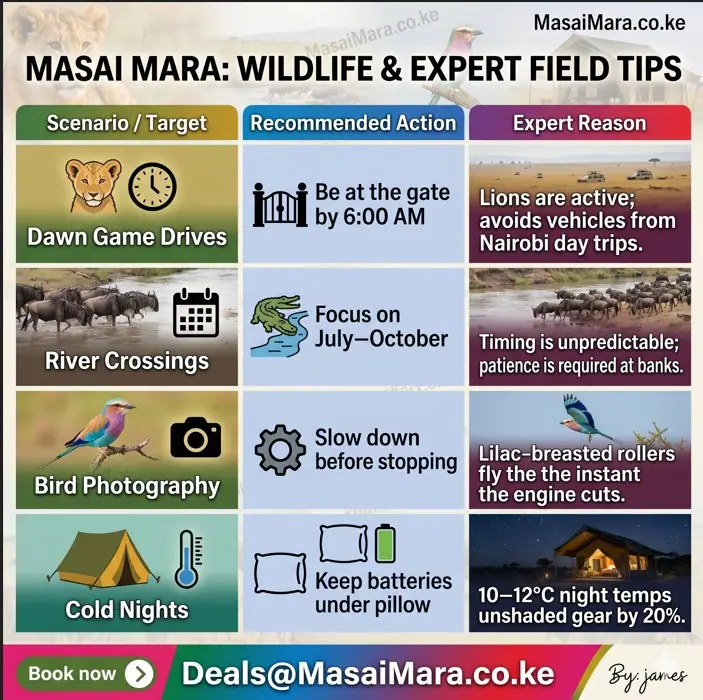
Scenario / Target | Recommended Action | Expert Reason |
Dawn Game Drives | Be at the gate by 6:00 AM | Lions are active; avoids vehicles from Nairobi day trips. |
River Crossings | Focus on July–October | Timing is unpredictable; patience is required at banks. |
Bird Photography | Slow down before stopping | Lilac-breasted rollers fly the instant the engine cuts. |
Cold Nights | Keep batteries under pillow | 10–12°C night temps drain unshaded gear by 20%. |
I am combining these because they blur together in a good way.
5:30 AM starts. The grass smells different at dawn. Wet, earthy, something sharp from the wild sage that grows near the camps. Lions are still active from night hunting. By 9 AM the later vehicles arrive and it gets crowded around the popular spots.
Day 3 we usually cover the Mara River: hippo pools, crocodiles, crossing points if you are here July through October. Day 4 a different sector, maybe Talek for leopards or Sand River near Tanzania where it is quieter.
A few things about guide communication. They share sightings by radio, sometimes in Swahili. “Chui” is leopard, “simba” is lion. If your guide suddenly picks up speed without touching the radio, he has probably seen a signal from another vehicle. Headlight flash, hand gesture, something. Do not ask what is happening. Get your camera ready.
The lilac-breasted roller is the most photographed bird in the Mara. Everyone stops when they see one perched. The bird flies the instant the engine cuts. If you want the wingspan shot, ask your driver to slow down before you reach it, not stop when you are alongside.
Day 4 you will have a picnic lunch somewhere in the reserve. The person who packed that lunch, the askaris who scouted the site for predators. Most people tip the driver and forget these people. KES 200 to 500 to the kitchen hand matters.
The Mara gets cold at night. 10 to 12°C sometimes. Batteries drain faster in the cold. Keep your phone and camera batteries under your pillow. Otherwise you wake up at 5:30 with less charge than you expected.
If you want the hot air balloon, Day 3 or Day 4 is the morning for it. Pickup is around 5 AM, you land with a champagne breakfast, and your guide meets you at the landing site to carry on the game drive.
Day 5: Out
Breakfast at leisure. There is no game drive on the day you leave the Mara, whichever camp you stay at. The drive to the gate is a transit with the roof closed, straight out.
If your camp is inside the reserve, you have to be out of the gate by 10 AM. After that, the system charges another full day’s park fee. I had guests in March who lingered over a late breakfast at a camp inside the reserve and reached the gate at 10:40. Cost them KES 26,000 between the two of them, a full extra day at USD 100 each. The system does not negotiate.
Cell service at the gates is unreliable exactly when you need to show your e-ticket. Take a video screen recording of your booking confirmation scrolling down. Sometimes a static screenshot does not have whatever “live” elements the rangers want to see.
On the drive back, sit on the right side of the vehicle. The Rift Valley escarpment view is better from the right when you are climbing toward Nairobi. Left side is for the drive down.
Drop-off in Nairobi mid to late afternoon. If you are flying out the same night, book a flight that leaves after 10 PM.
Costs
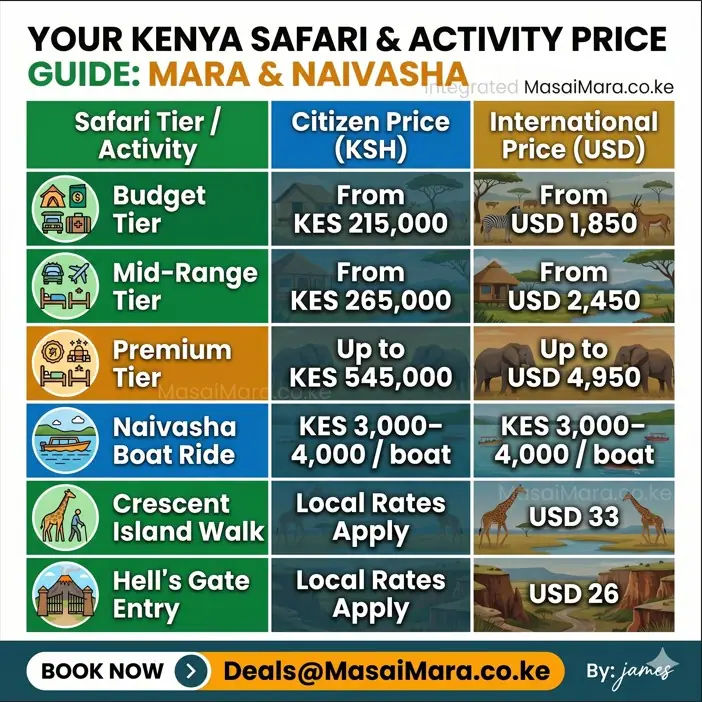
Costs
I will give you ranges. Exact quotes depend on specific dates, lodge availability, and whether it is peak season. All prices are per person, two people sharing, in a private 4×4 Land Cruiser. Kenyan prices are worked out on citizen park fees and resident lodge rates, so they are not the dollar price converted.
Kenyan Citizens (KES)
| Tier | Lodges | Jan-June | July-Dec |
|---|---|---|---|
| Budget | Naivasha Kongoni Lodge + Jambo Mara | 130,000 | 148,000 |
| Mid-Range | Lake Naivasha Sopa Resort + Sentrim Mara | 151,000 | 177,000 |
| Luxury | Enashipai + Mara Crossing Camp | 223,000 | 277,000 |
| Super-Luxury (fly-in) | Loldia House + Governors’ Camp | 353,000 | 473,000 |
Non-Residents (USD)
| Tier | Lodges | Jan-June | July-Dec |
|---|---|---|---|
| Budget | Naivasha Kongoni Lodge + Jambo Mara | 1,720 | 2,260 |
| Mid-Range | Lake Naivasha Sopa Resort + Sentrim Mara | 2,020 | 2,690 |
| Luxury | Enashipai + Mara Crossing Camp | 2,960 | 4,060 |
| Super-Luxury (fly-in) | Loldia House + Governors’ Camp | 5,000 | 7,070 |
One night at the Naivasha lodge, three nights at the Mara camp.
Naivasha Activities (Paid Separately)
| Activity | Kenyan Citizens | Non-Residents |
|---|---|---|
| Naivasha Boat Ride | KES 3,000 to 4,000 per boat | KES 3,000 to 4,000 per boat |
| Crescent Island Walk | KES 800 per adult, KES 400 per child | USD 33 per adult, USD 16 per child |
| Hell’s Gate Entry | KES 500 per adult, KES 250 per child | USD 50 per adult, USD 25 per child |
| Hell’s Gate Cycling Permit | KES 300 per person | USD 10 per person |
| Hell’s Gate Gorge Guide (community guide) | About KES 2,000 per group | About KES 2,000 per group |
| Hell’s Gate Bicycle Hire | KES 500 to 800 per bike | KES 500 to 800 per bike |
The Super-Luxury option keeps the same order but swaps the road for the air. You fly from Wilson Airport to Loldia House on Day 1, on to the Mara on Day 2, and back to Nairobi on Day 5 after breakfast. All three flights are in the price. Because you land at Loldia mid-morning, on the north-western shore, the 9 AM Hell’s Gate ride does not fit that day. Fly-in guests relax at the house or take a short morning boat outing instead, then do Crescent Island and the evening boat ride with Loldia’s own team.
What is in those numbers:
- The vehicle for all five days, with your driver-guide and fuel (on Super-Luxury, the flights and the camp’s own game vehicles instead)
- Full board at every stop
- Masai Mara park fees for 3 calendar days (Days 2, 3 and 4)
- Drinking water
- AMREF Flying Doctors evacuation cover
What is not:
- Naivasha activities: the boat at KES 3,000 to 4,000 per boat, Crescent Island at KES 800 for citizens or USD 33 for non-residents, Hell’s Gate at KES 500 plus a KES 300 cycling permit for citizens or USD 50 plus USD 10 for non-residents, the gorge guide at about KES 2,000 per group, and a bike at KES 500 to 800
- Tips and drinks
- The hot air balloon, if you want it, at USD 500 (KES 58,500)
- A Maasai village visit at KES 1,500 (USD 20)
- The Kenya eTA at USD 34, for visitors who need one
Things You Will Not See
Worth saying up front.
Rhinos are rare in the Mara. If that is a priority, this is not the right trip. Lake Nakuru is better.
Flamingos are rarely on Naivasha itself. Crater Lake on the western shore sometimes has a few, and Bogoria is the surer bet.
Kilimanjaro views are Amboseli. Different direction.
If you book accommodation on the Narok side of the reserve, which is most camps, you will not automatically see the Mara Triangle. That is the western section, run by the Mara Conservancy with its own fee system, and it is a long drive across. Ask which side your lodge is on.
Gear Thing
Bring a pillowcase for your camera. I mean it. Mara dust is finer than beach sand and gets into everything. Camera bags are too slow to unzip when a leopard appears. A pillowcase keeps your gear protected but grab-ready.
For Hell’s Gate, pack cycling gloves if you have them and a buff for the dust. The rental bikes have hard saddles and the track is corrugated in places, so padded shorts are not a silly idea.
Also, do not wear blue, black or dark denim. Tsetse flies love all three. And skip heavy perfumes. Some biting flies are drawn to them, and the bites are worse than tsetse. More in our packing list.
Questions
How is this different from 4 days? An extra night in the Mara and a second full day there. More game drives, better odds on the harder sightings.
Is there a game drive on Day 5? No. Game drives are not possible in the Mara on the day you leave, whichever camp you stay at. Breakfast is at leisure, then the drive home.
Can I skip Hell’s Gate? Yes. Swap it for a slow morning at the lodge or a visit to Elsamere. The afternoon on the lake stays the same.
Best time? September for crossings. January through March for fewer crowds.
Solo travelers? You will pay a single supplement. Some camps now price per tent, which helps. Ask when you book.
What wildlife? Lions almost guaranteed. Elephants yes. Cheetah decent odds. Leopard possible. Rhinos no
Related:
- 3 Days Masai Mara and Lake Naivasha Safari
- 4 Days Masai Mara and Lake Naivasha Safari
- Budget Masai Mara Safari
- Luxury Safari Masai Mara
- Masai Mara Flying Packages
Park fees change. Check Narok County for the Mara and KWS eCitizen for Hell’s Gate.
Written by David Njunge, TRA-licensed safari guide with over 10 years in the Masai Mara. Edited by Cess Wambui, travel consultant, BSc Tourism and Hospitality Management. Verified for the 2027 season.
Welcome to Masaimara.co.ke
Thank you for visiting us! We're excited to help you plan an unforgettable safari adventure across Kenya.