
5 Days Masai Mara and Amboseli Safari: 2027 Pricing & Itinerary
A 5 days Masai Mara Amboseli safari costs KES 278,000 to KES 785,000 per person sharing in 2027. You will spend 3 or 2 nights in the Mara and 1 or 2 nights in Amboseli depending on your priorities. The fifth day is the difference between rushing through both parks and actually absorbing them.
The Night Split Decision
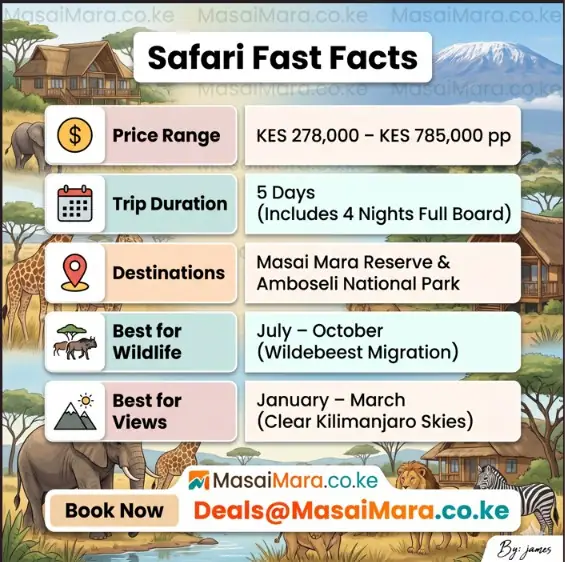
Detail | Safari Fast Facts |
2027 Price Range | KES 278,000 – KES 785,000 pp |
Trip Duration | 5 Days (Includes 4 Nights Full Board) |
Destinations | Masai Mara Reserve & Amboseli National Park |
Best for Wildlife | July – October (Wildebeest Migration) |
Best for Views | January – March (Clear Kilimanjaro Skies) |
Five days means four nights in camps or lodges (you leave on Day 5). The question: how do you divide them between parks?
Option A: 3 Nights Mara + 1 Night Amboseli
This works for predator-focused travelers, migration season visitors, or photographers chasing lion, leopard and cheetah shots. You get two full days of Mara game drives plus a morning drive on Day 4 before your transfer.
The downside: only one afternoon and one morning in Amboseli. If Kilimanjaro hides behind clouds, you do not get another chance.
Option B: 2 Nights Mara + 2 Nights Amboseli
The balanced option. You will have meaningful time in both parks without feeling like you are just passing through either one.
What you give up: less time for the Mara’s predator density. During migration, you might miss river crossings that happen on your transfer day. But outside migration season (November to June), this split makes the most sense.
Option C: 1 Night Mara + 3 Nights Amboseli
This only makes sense for specific travelers: elephant researchers, photographers who have already done extensive Mara time, or guests specifically wanting multiple Kilimanjaro sunrise attempts.
The Mara deserves more than one night. You will arrive, do an afternoon drive, a morning drive, then leave. It will feel incomplete.
My recommendation: Option A (3+1) during July to October when the Mara is at its peak. Option B (2+2) the rest of the year when both parks offer comparable experiences.
Package Pricing 2027

Safari Tier | Road Safari (From) | Fly-In Safari (From) |
Budget Tier | KES 278,000 pp | Not Available |
Mid-Range Tier | KES 345,000 pp | KES 445,000 pp |
Luxury Tier | KES 445,000 pp | KES 545,000 pp |
Premium Tier | Not Available | KES 685,000 pp |
Per person sharing. Based on two travelers. All prices in Kenya Shillings.
Road Safari Packages (Drive Throughout)
Tier | Low Season | Peak Season | Nights | Accommodation |
Budget | KES 278,000 | KES 445,000 | 3 Mara + 1 Amboseli | Mara Sidai + AA Lodge |
Mid-Range | KES 345,000 | KES 525,000 | 2 Mara + 2 Amboseli | Loyk Mara + Kibo Safari |
Luxury | KES 445,000 | KES 628,000 | 3 Mara + 1 Amboseli | Sarova Mara + Amboseli Serena |
Fly-In Packages (Flights Between Parks)
Tier | Low Season | Peak Season | Nights | Accommodation |
Mid-Range | KES 445,000 | KES 598,000 | 2 Mara + 2 Amboseli | Mara Leisure + Ol Tukai |
Luxury | KES 545,000 | KES 698,000 | 3 Mara + 1 Amboseli | Mara Serena + Amboseli Serena |
Premium | KES 685,000 | KES 785,000 | 3 Mara + 1 Amboseli | Governors Camp + Tortilis |
Low season: January to June, November to mid December Peak season: July to October, Christmas/New Year
What Is In The Price
Important: A “5-day safari” typically means 4 nights of accommodation. Day 5 is usually a morning game drive, breakfast, then transfer home. Some first-time travelers assume 5 days = 5 nights and are surprised when the final night is not included. Check your itinerary carefully. Look for “4 nights full board” or similar language.
Covered: Transport (vehicle or flights as per package), all park entry fees, 4 nights full board accommodation, all meals, game drives as scheduled, bottled water, airstrip/airport transfers.
You pay separately: Alcoholic drinks, tips (budget KES 8,000 to 12,000 total), travel insurance, visa fees (Kenya eTA, USD 34), personal items.
Bring a dust kit for Amboseli: The park is extremely dusty in dry months, fine volcanic powder that gets into everything. Pack a lens blower, microfiber cloths, ziplock bags for camera gear, and a bandana or buff for your face. Open-sided vehicles are better for photography, but in peak dust season some travelers prefer vehicles with closable windows.
Add-ons available:
Experience | Cost |
| KES 58,500 (USD 500) | |
Amboseli sundowner at Observation Hill | KES 5,200 (USD 60) |
KES 1,500 (USD 20) | |
Night game drive (conservancy only) | KES 9,100 (USD 100) |
Bush breakfast | KES 6,500 (USD 70) |
Sample Itinerary: 2 Nights Mara + 2 Nights Amboseli
This is our most popular 5-day configuration. Fly-in version shown. Road version follows the same sequence but replaces flights with drives.
Day 1: Nairobi To Masai Mara
Catch the 7:30 AM flight from Wilson Airport. Land at your designated Mara airstrip (Keekorok, Musiara, or Olkiombo) around 8:15 AM.
The camp vehicle meets you, usually an open-sided Land Cruiser. That first drive from airstrip to camp is technically a transfer, but you are already inside the reserve. I have had guests photograph their first lion pride before reaching their tent.
Check in. Lunch. The afternoon stretches ahead without pressure.
Afternoon drive from 3:30 PM. Your guide spends these first hours reading the landscape: where the territorial males are, which areas have good grass, where other vehicles clustered this morning. This reconnaissance pays off on Days 2 and 3.
Overnight: Masai Mara
Day 2: Full Day In Masai Mara
This is the day that justifies the 5-day trip.
Morning drive leaves at 6:15 AM. Cheetahs hunt in the first hour of light. Leopards are still active before retreating to shade. Your guide has yesterday’s intel plus overnight radio chatter from night watchmen who heard roaring.
Return for breakfast around 9:30 AM. The middle hours are yours. Sleep. Read. Sit by the river if your camp overlooks one. Some guests book the balloon safari for this morning. It launches at 6 AM and lands around 8 AM with champagne breakfast in the bush.
Afternoon drive from 3:30 to 6:00 PM. This is when you follow up on the morning’s “almosts.” The lioness who was stalking zebra but got spotted. The leopard your guide thinks might descend from her tree around 5 PM.
Overnight: Masai Mara
Day 3: The Transfer Question
Here is where the 5-day trip reveals its structure.
Flying option: Morning drive from 6:15 to 9:00 AM. Return, pack, and be at the airstrip for the 10 AM flight to Amboseli. Mara airstrips count as your exit point, so this keeps you inside the 10 AM departure rule. On a direct flight you land around 10:45 AM. If your flight routes through Wilson, expect to land in the early afternoon. Afternoon game drive from 3:30 PM.
Driving option: Early breakfast, depart the Mara by 7:00 AM. Drive back through Narok and stop at The Narok Mall for clean restrooms and coffee. Climb the Great Rift Valley escarpment toward Nairobi with views of Mount Longonot and the caldera of Mount Suswa across the valley floor. Bypass city traffic via the Southern Bypass onto Mombasa Road (A109), branch south at Emali, and reach Amboseli around 3:30 to 4:00 PM for an evening game drive against Mount Kilimanjaro.
The drive takes 8 to 9 hours including stops. You lose the day to transit but save roughly KES 90,000 on flights. For some travelers, that is worth it. For others, the flight preserves what makes a 5-day trip valuable.
The road option’s hidden advantage: you cross the Rift Valley. If you have never seen the escarpment from the ground, it is worth experiencing once. The climb out of the valley floor, with Longonot’s crater on one side and Suswa’s broken rim on the other, sticks with people.
Do not treat the Rift Valley viewpoint as a toilet stop. Ask your driver to give yourself a proper 15 to 20 minutes there. The view from the escarpment edge, looking out over what is essentially a crack in the earth’s crust, is one of Kenya’s most dramatic sights. Too many itineraries rush past it.
Overnight: Amboseli
Day 4: Full Day In Amboseli
Set your expectations: Amboseli can look harsh, with dry lake beds, sparse vegetation and swirling dust. It is not the lush savanna of the Mara. Some visitors find it stark, almost barren-looking in dry spells. The payoff is elephant density and, when conditions align, Africa’s highest mountain rising directly behind them.
Your guide knows this is your Kilimanjaro day.
Early start, 5:45 AM departure if your lodge allows. The mountain is most likely clear before 8 AM. Drive toward Observation Hill (Noomotio) where you can see both the swamps and Kilimanjaro in one frame.
The elephants are already moving. Family groups heading from the acacia groves where they spent the night toward the springs and swamps. The volcanic dust rises when they walk, grey powder that smells mineral and alkaline, like wet concrete curing. Against a clear Kilimanjaro, this is the shot that sells Amboseli.
Mid-morning back at the lodge. The mountain typically clouds over by 10 AM. Rest.
Afternoon drive from 3:30 PM. Different focus now: the swamps at Enkongo Narok, hippos, buffalo, maybe the Amboseli lion prides (they are fewer than the Mara’s, but they exist). Watch for Long-toed Lapwings in the shallow water, one of the few places you can photograph birds walking on lily pads with Africa’s highest mountain behind them.
Overnight: Amboseli
Day 5: Amboseli To Nairobi
If Kilimanjaro did not show yesterday: Request an early drive. Sometimes the mountain appears for 20 minutes around 6:30 AM then disappears. Worth trying.
The Amboseli ticket reality: Amboseli is a KWS park, and KWS tickets run on a strict 24-hour cycle from the time you entered, not by the calendar day. If you entered at 3:30 PM on Day 3, your first ticket runs to 3:30 PM on Day 4 and your second to 3:30 PM on Day 5, so your final morning is covered. If you entered earlier on Day 3, your Day 5 cut-off is earlier too, so check your entry time on the ticket. And you still need to reach Nairobi by late afternoon if you have an evening international flight.
Final morning drive until 8 to 9 AM. Pack up. Depart for Nairobi.
Flying: Catch the 11 AM flight to Wilson. Arrive around 11:45 AM. Plenty of time for afternoon flights home.
Driving: Leave by 9 AM to reach Nairobi around 1 to 2 PM. Factor in Athi River traffic, worse on weekday afternoons.
Why The Fifth Day Matters
Four days covering two parks means constant movement. Pack, drive or fly, unpack, squeeze in an afternoon drive. Do it again the next day.
With five days, you are not always rushing to the next thing. You get at least one full day in each park where you can actually settle in.
In the Mara, that means morning and afternoon drives with real rest between them. Time to sit by the Talek River watching hippos, that deep, almost mechanical grunting that carries across the water. Time for your guide to follow up on morning sightings instead of watching the clock.
In Amboseli, it means two mornings to wait for Kilimanjaro. The mountain shows itself when it wants to. With one morning, you are hoping. With two, you have a real chance.
Things That Go Wrong

The Disruption | The Guide’s Pivot (Expert Solution) |
Kilimanjaro is Cloudy | Shift focus to Amboseli’s 60+ year old elephant families. |
Missed River Crossing | Use a 3-night Mara split to secure 5 separate drive windows. |
Stuck in Black Mud | Track gravel routes post-rain; keep a recovery tractor on radio. |
“Kilimanjaro Never Showed”
It happens. The mountain creates its own weather. Guests visit for two full days in Amboseli and never see the summit.
What we do: If clouds persist, we pivot to what Amboseli does better than anywhere: elephant observation. Researchers have tracked individual elephants here since 1972. Some matriarchs are over 60 years old. Guides know their names, their family histories. The mountain would be nice, but the elephants are guaranteed.
In our experience: January to March tends to offer the clearest Kilimanjaro mornings, maybe 7 out of 10 days you will get some view. July and August are tougher. Cloud cover rolls in earlier and stays longer. In August 2025, I had a family at Ol Tukai for three mornings straight without a clear summit view. On their transfer day to the airstrip, the clouds parted for about 15 minutes around 6:40 AM. We stopped the vehicle on the tarmac and they finally got their shot. That is sometimes how it works.
“We Missed The River Crossing”
Mara River crossings during migration (July to October) are unpredictable. Herds can wait on the bank for days, then cross while you are at lunch.
What we do: Your guide positions you near likely crossing points based on herd movements. But there is no guarantee. In September 2025, I had guests at the Mara River lookout near Serena for nearly 4 hours. Thousands of wildebeest on the north bank, refusing to move. We finally gave up for lunch. The crossing happened 20 minutes after we left. Another guide sent photos. That is sometimes the reality.
We have also stumbled onto crossings by accident while driving to something else entirely. There is no formula.
The 5-day advantage: With 3 nights in the Mara during migration, you have 5 game drives. That is 5 chances to be in the right place at the right time. A 3-day trip gives you 3 chances. Longer stays improve your odds, but nothing guarantees a crossing.
“The Black Cotton Soil Trapped Our Vehicle”
This happens after rain, especially in Amboseli. The soil near the swamps turns to glue. A 4×4 can sink to its axles.
What we do: Experienced guides know which routes to avoid after rain. If your guide takes the “boring” gravel road instead of the scenic swamp-side track, trust them. The alternative is a 4-hour wait for a tractor while your safari day evaporates.
Park Fees 2027
Included in all packages above. Listed for transparency.
Amboseli National Park (via KWS eCitizen): Non-resident adults pay USD 90 per 24 hours (USD 45 per child aged 5 to 17, under 5 free). East African citizens pay KES 1,500 (children KES 750), and Kenya residents pay KES 2,025. Tickets run on a strict 24-hour cycle from the gate entry timestamp.
Masai Mara National Reserve (Narok County): Non-resident adults pay USD 100 per calendar day (January to June) or USD 200 per calendar day (July to December). Children aged 9 to 17 pay USD 50, under 9 enter free. Tickets are valid from 6:00 AM to 6:00 PM on the date of entry. Departure past 10:00 AM on check-out day triggers an extra day’s entry fee. More on our park fee page.
The Mara exit rules (Narok vs Mara Triangle): This gets confusing because the reserve has two management zones with different ticketing systems.
The Narok County side (Sekenani, Talek, Musiara gates) uses calendar-day tickets, valid from 6 AM to 6 PM. On your departure day, you must exit by 10 AM or pay another full day’s fee.
The Mara Triangle (Oloololo Gate, managed by the Mara Conservancy) takes payment through its own KAPS system rather than the Narok County system. If your camp is in the Triangle, confirm the current exit rules directly with them before your trip.
For flying guests on either side, the airstrip counts as your exit point, giving you slightly more morning time than road travelers.
Flying vs Driving: The Real Trade-Off
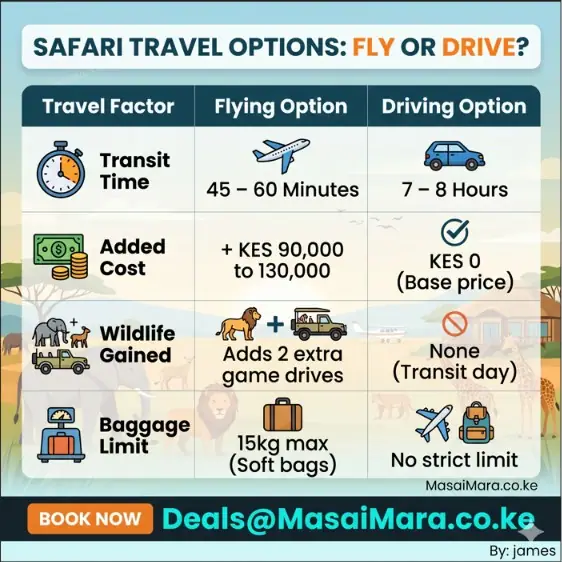
Factor | Flying | Driving |
Transfer time | 45-60 mins | 7-8 hours |
Cost difference | +KES 90,000-130,000 | — |
Game drives gained | 2 additional drives | — |
Scenic value | Aerial views | Rift Valley escarpment |
Baggage limit | 15kg soft bags only | No limit |
Flexibility | Fixed flight times | Stop anywhere |
For a 5-day trip, flying makes sense if you are optimizing for wildlife time. The extra KES 90,000 buys you roughly 6 to 8 more hours of game viewing.
Driving makes sense if: you want to see the Rift Valley from the ground, you are traveling with heavy camera gear, or budget is the priority.
The flight routing nuance: Confirm whether your Mara to Amboseli leg is direct or routes through Wilson Airport in Nairobi. Direct triangle flights exist, but they do not run daily. A Wilson connection adds 90 minutes to your transfer and changes your checkout timing. Ask specifically when booking.
The Wilson arrival trick: When you fly into Amboseli from Wilson, ask your operator if the pickup vehicle is a game-drive vehicle and whether the route to camp counts as a drive. On some routings, your guide can turn the 30-minute airstrip transfer into an hour-long game drive through the elephant corridor, folding wildlife viewing into what would otherwise be dead time.
The hybrid approach: Some guests drive Nairobi to the Mara (5 to 6 hours), then fly Mara to Amboseli to Nairobi. This saves one flight while avoiding the brutal cross-country Mara-to-Amboseli drive.
Practical Details
Getting To Wilson Airport (2027 Reality)
Since early 2026, the Lang’ata Road expansion near T-Mall has created a permanent bottleneck. If you are staying in Westlands or the CBD for a 7:30 AM flight, tell your driver to take Raila Odinga Way (formerly Mbagathi Way) instead. It adds 2 km but saves 30 to 40 minutes of stop-and-go exhaust fumes.
Stay the night before in Karen or Lang’ata if possible. The morning rush from Westlands to Wilson is unpredictable.
Baggage For Flying Safaris
Safarilink’s policy: 15 kg per person including hand luggage. Soft-sided bags only. Hard shells do not fit in Cessna cargo pods.
The workaround: Wear your heaviest items (boots, jacket) onto the plane. Camera lenses go in jacket pockets, not camera bags. They weigh luggage, not passengers.
Wilson Airport storage: Both Safarilink and AirKenya offer secure luggage storage at Wilson if you are continuing to other destinations after your safari.
Guide Radio Codes
If you want real-time intel, learn the lingo. Guides use Swahili code words on VHF radio:
- “Madoadoa” = spots (leopard)
- “Simba mwekundu” = red lion (fresh kill)
- “Kifaru” = rhino
- “Duma” = cheetah
When your guide says “Madoadoa” into the radio, get your camera ready before they tell you what is happening.
The Mara Simba Restroom Tip
If you are on a road safari and need facilities between parks, the public restrooms at Sekenani gate are often overwhelmed. Mara Simba Lodge (near Talek gate) allows non-guests to use their facilities for a coffee fee, maybe KES 500. Much cleaner option.
The Washboard Track Warning
The 4 km access road from Keekorok airstrip toward the Talek camps is in rough shape after the 2025 rains. Corrugated “washboard” surface that rattles cameras loose and aggravates back problems. If you have spine issues, ask your camp manager specifically for a vehicle with upgraded suspension (some camps have “Old Man Emu” shock absorbers) for the airstrip pickup.
The eCitizen Friction (Amboseli)
The KWS payment system at Amboseli gates can be slow during midday. The park’s connectivity drops when everyone is trying to process payments at once. Have your guide verify your eCitizen QR code and payment confirmation before you leave Nairobi. I have seen families stuck at Meshanani Gate for over an hour because the system was down.
Frequently Asked Questions
How Much Does A 5 Days Masai Mara Amboseli Safari Cost?
KES 278,000 to KES 785,000 per person depending on accommodation tier, season, and whether you fly or drive between parks. Budget road safaris start around KES 278,000. Premium flying packages reach KES 785,000.
Is 5 Days Enough For Both Masai Mara And Amboseli?
Yes. 5 days is the minimum for a meaningful experience in both parks. You can do 4 days, but it feels rushed. With 5 days, you get at least one full day in each park without transit.
Should I Start In Amboseli Or Masai Mara?
Start in the Mara. While Amboseli is physically closer to Nairobi (4 hours vs. 5 to 6 hours for the Mara), starting with the Mara gets the high-energy predator action and intense game drives out of the way first. Ending in Amboseli offers a relaxed, scenic finish with open swamp views, massive elephant herds, and Mount Kilimanjaro sunrises before an easy drive back to Nairobi.
What Is The Best Time For This Safari?
July to October for migration and peak predator activity (but worst Kilimanjaro visibility). January to March for best Kilimanjaro odds and good wildlife throughout. April and May rains can make roads difficult. Our best time to visit guide goes month by month.
Will I See The Big 5?
Lions, elephants, and buffalo are almost certain. Leopards are likely in the Mara. Rhinos are uncommon in both parks. If rhinos matter, consider adding Lake Nakuru.
Can I Combine This With A Beach Extension?
Yes. Many guests add 2 to 3 nights in Diani or Mombasa after their safari. Fly from Amboseli or Nairobi to the coast. Ask Masaimara.co.ke about combined bush-and-beach packages.
Questions? Let Us Figure Out Your Dates
Every 5-day trip is slightly different depending on when you travel, what you want to prioritize, and how you want to move between parks. Send us your dates and we will map out the options.
More Kenya Safaris
- 3 Days Masai Mara Safari
- 4 Days Masai Mara Safari
- 7 Days Masai Mara Safari
- Masai Mara & Amboseli Safaris
- Best Time to Visit Masai Mara
- Masai Mara National Reserve
Prices verified for the 2027 season. Park fees per Narok County and KWS. Flight schedules per Safarilink and AirKenya.
Written by David Njunge, TRA-licensed safari guide with over 10 years in the Masai Mara. Edited by Cess Wambui, travel consultant, BSc Tourism and Hospitality Management.
Welcome to Masaimara.co.ke
Thank you for visiting us! We're excited to help you plan an unforgettable safari adventure across Kenya.