
Masai Mara & Lake Nakuru Safari Packages: 2026 Rates & Itineraries
Masai Mara and Lake Nakuru Safari: A 4-5 day circuit covering Kenya’s premier Big Five reserve and its best rhino sanctuary. You’ll see predators hunting in the Mara’s golden grasslands, then watch white rhinos grazing by an alkaline lake rimmed pink with flamingos. This guide breaks down exact costs, specific hotels, and things I wish someone had told me before my first Nakuru visit.
The Quick Answer
Combining Masai Mara and Lake Nakuru works best as a 4-5 day road safari. You’ll spend 1 night in Nakuru (it’s compact enough to cover in half a day), then 2-3 nights in the Mara. Budget around KES 169,600-333,400 per person depending on accommodation tier.
The route makes geographic sense. Nakuru sits roughly halfway between Nairobi and the Mara, so you’re not backtracking.
What’s in the Package
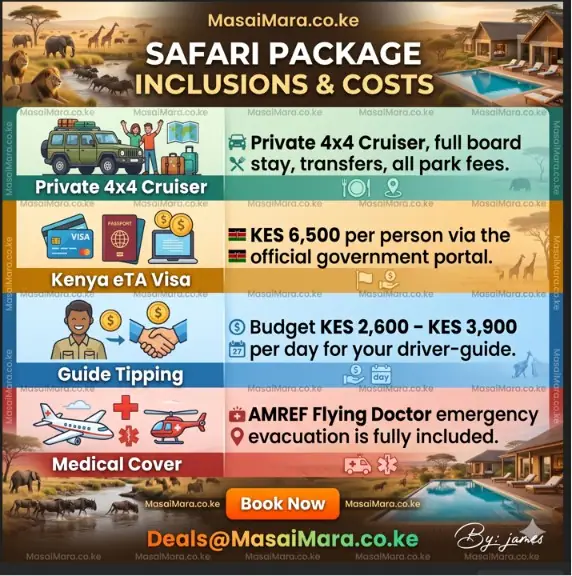
Category | What to Expect (2026 Baselines) |
Full Inclusions | Private 4×4 Cruiser, full board stay, transfers, all park fees. |
Kenya eTA Visa | KES 6,500 per person via the official government portal. |
Guide Tipping | Budget KES 2,600 – KES 3,900 per day for your driver-guide. |
Medical Cover | AMREF Flying Doctor emergency evacuation is fully included. |
Covered in All Options:
- Return transfers from Nairobi (JKIA or city hotel)
- Private 4×4 Land Cruiser with pop-up roof
- English-speaking driver-guide throughout
- Full-board meals at your lodge (breakfast, lunch, dinner)
- All park entry fees (Nakuru + Masai Mara)
- Bottled water during game drives
- Flying Doctor emergency evacuation insurance
Not Covered:
- Kenya eTA visa (KES 6,500 via etakenya.go.ke)
- International flights to Kenya
- Travel insurance
- Alcoholic drinks and premium beverages
- Tips for guide and lodge staff (budget KES 2,600-3,900 daily)
- Optional activities (balloon safaris, boat rides, village visits)
4-Day Safari Packages
One night Nakuru, two nights Mara, game drives in both parks. This is what most people book.
Tier | Hotels | Per Person (KES) | |
Budget | Flamingo Hill Camp + Mara Sidai Camp | 169,600 | |
Mid-Range | Lake Nakuru Lodge + Mara Leisure Camp | 198,400 | |
Luxury | Sarova Lion Hill + Mara Serena Lodge | 243,400 | |
Ultra-Luxury | Sarova Lion Hill Suite + Governors’ Camp | 333,400 |
I put Mara Sidai in the budget tier because, while it’s basic, the staff there have been with the camp for over a decade. Their morning coffee is genuinely the best in the Talek area—I’m not sure what they do differently, but it matters at 5:30am. Flamingo Hill works for Nakuru because it’s inside the park boundary. You’ll hear hyenas at night. Can’t say that about the lodges outside the fence.
Sarova Lion Hill is the obvious luxury choice at Nakuru—views straight down to the lake, pool that actually gets cleaned daily, food that doesn’t repeat the same buffet three nights in a row. For the Mara, I like Mara Serena because the guides there share radio frequencies with us. That matters more than thread count.
Governors’ Camp is for people who want the full experience. Canvas tents, kerosene lamps, hippos walking through camp at 2am. It’s expensive. It’s also the closest thing to what safari felt like before Instagram.
Prices valid Jan-June 2026. July-October add 35-50%. Based on 2 people sharing.
5-Day Safari Packages
Add Lake Naivasha for hippos, boat rides, and walking with giraffes on Crescent Island.
Tier | Hotels | Per Person (KES) |
Budget | Flamingo Hill + Naivasha Sopa + Mara Sidai | 204,700 |
Mid-Range | Lake Nakuru Lodge + Naivasha Country Club + Sentrim Mara | 238,500 |
Luxury | Sarova Lion Hill + Great Rift Valley Lodge + Mara Serena | 298,600 |
Ultra-Luxury | Sarova Suite + Lake Naivasha Sopa + Angama Mara | 412,800 |
Boat ride at Naivasha (KES 5,200) and Crescent Island walk (KES 4,300) charged separately.
The Guide’s Choice 4-Day Route
This isn’t a generic schedule. It’s optimized for light angles and high-density wildlife pockets.
Day 1: The Rhino Strategy (Nairobi to Lake Nakuru)
07:30 departure from Nairobi. We skip the main highway viewpoint—too crowded with curio sellers. Instead, we stop at the “smallest church in Kenya” near Maai Mahiu. Quieter, more photogenic, better toilets. Fair warning though: the souvenir guys there are persistent. If you don’t want to buy a wood carving, don’t make eye contact. Just get your photo of the church and get back in the Cruiser.
11:30 entry via Lanet Gate. The Main Gate gets congested with day-trippers from Nakuru town. Lanet puts you immediately into the Acacia Belt—prime leopard territory that most visitors miss entirely.
Afternoon drive focuses on the southern Nderit area. Last time I took a group here, we actually had to turn back near the old Park Office because the road was completely underwater. It was a mess. But we ended up spotting a leopard in the trees right above the flooded road—something that wouldn’t have happened five years ago when that area was dry grassland.
One thing I always tell my guests—and they usually don’t believe me until they see it—is to look at the giraffe’s legs. If they’re wearing “white socks” (no markings below the knee), you’re looking at a Rothschild’s. If not, it’s just a common Masai giraffe. Sounds minor. But there are fewer than 1,600 Rothschild’s left on the planet. Worth knowing what you’re looking at.
Day 2: The Short-Cut and Mara Entry
06:30 pre-breakfast drive to Baboon Cliff. In 2026, this cliff offers the only panoramic view of the “new lake” levels. You’ll see how the rising water has reclaimed sections of forest. It’s strange to look at, honestly. Trees standing in water that wasn’t there a decade ago.
09:00 departure on what I call the “guide’s route” to the Mara. We take the C12 through Narok, but lunch happens at a local nyama choma spot rather than the standard tourist buffets. Better meat, half the price, zero other safari vehicles. The owner knows me. He’ll give you extra kachumbari if you ask.
15:30 entry via Sekenani Gate, then straight to the “Double Crossing” area—a confluence of two seasonal rivers that concentrates topi and gazelle. Where prey gathers, predators follow. I’ve seen the Aitong pride here more times than I can count.
Day 3: The Full Circuit (Mara River and Hidden Valleys)
06:00 sunrise chase. Most vehicles head directly to the Mara River hoping for crossings. We go to the Sand River corridor first—the border with Tanzania’s Serengeti. Significantly less crowded. On good days it feels almost private, which is rare in the Mara these days.
Midday picnic lunch near the Mara Triangle lookout. I usually tell people about the Marsh Pride here—this specific pride has been documented for decades by BBC’s Big Cat Diary. Knowing the lionesses’ names transforms a sighting from just a photo op into something that feels like meeting a celebrity. Strange, but true.
Afternoon drive along the Mara River sector for hippo pools and crocodile basking spots.
Day 4: Last Light and Return
Look, if you want a leopard, you need to be at the Talek river by 6:15 AM. Any later and they’re just spots in a tree that you’ll need a telescope to see. It’s frustrating, but that’s the Mara. The Talek riverine forest is where they drag kills into trees before the sun gets too high.
10:30 departure for Nairobi. We use the Maji Moto route only if weather has been dry for 7+ days. If it’s rained recently, we stick to tarmac. I’ve seen vehicles stuck in that black cotton mud for six hours. Not exaggerating. The recovery trucks charge more than the entire safari cost.
2026 Park Fees
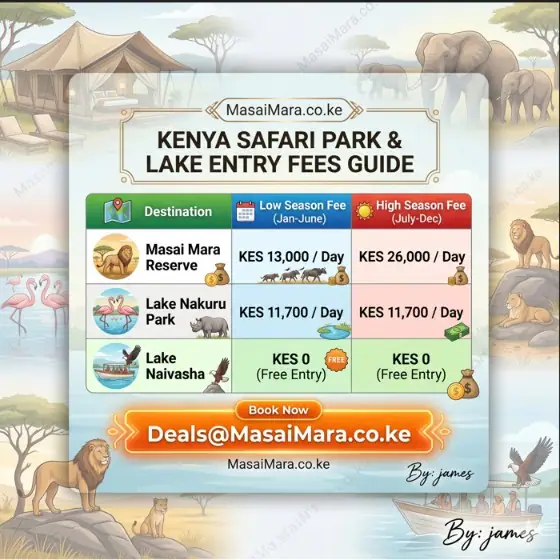
Destination | Low Season Fee (Jan-June) | High Season Fee (July-Dec) |
Masai Mara Reserve | KES 13,000 / Day | KES 26,000 / Day |
Lake Nakuru Park | KES 11,700 / Day | KES 11,700 / Day |
Lake Naivasha | KES 0 (Free Entry) | KES 0 (Free Entry) |
These are already included in package prices.
Lake Nakuru: KES 11,700/day non-resident, KES 1,500 EA citizen. Payment via KWS GavaPay.
Masai Mara: KES 13,000/day low season (Jan-June), KES 26,000 high season (July-Dec). Payment via KAPS portal.
The Flamingo Reality Check
Here’s something most tour operators won’t tell you straight: Nakuru’s flamingo spectacle isn’t guaranteed anymore.
I took a group there in November 2024, fully expecting that classic postcard image of a million pink birds blanketing the shoreline. Reality? A few thousand scattered in patches. Still beautiful. Not the overwhelming spectacle from old documentaries.
The lake’s water levels have risen dramatically since 2010—surface area increased by 91% according to research from King’s College London. Higher water dilutes the alkaline concentration, which reduces the blue-green algae that flamingos eat. Simple as that.
If flamingos are your primary goal, Lake Bogoria (2 hours north of Nakuru) currently hosts larger populations—around 300,000 at last count versus roughly 2,000-10,000 at Nakuru depending on conditions. We can add it to your itinerary if you’re serious about the pink.
But here’s why I still bring people to Nakuru: the rhinos. Nakuru became Kenya’s first rhino sanctuary in 1984 and now protects over 70 white rhinos and 25+ critically endangered black rhinos. I’ve never had a guest leave Nakuru without seeing at least one rhino. Never. The park is fenced and compact (188 km²), so animals don’t wander off like they do in the Mara.
What Nakuru Has That the Mara Doesn’t
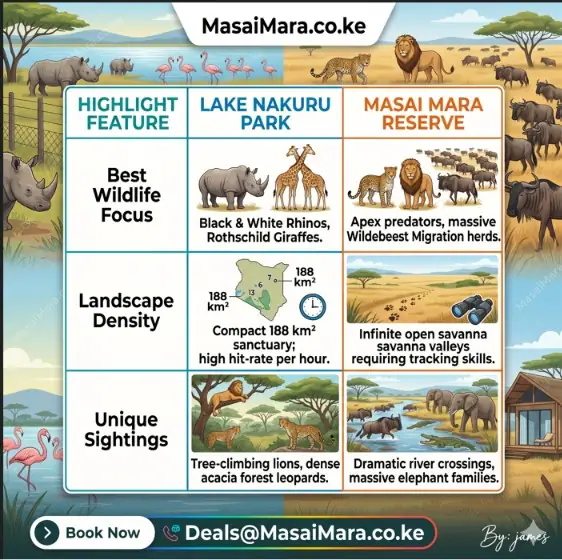
Highlight Feature | Lake Nakuru Park | Masai Mara Reserve |
Best Wildlife Focus | Black & White Rhinos, Rothschild Giraffes. | Apex predators, massive Wildebeest Migration herds. |
Landscape Density | Compact 188 km² sanctuary; high hit-rate per hour. | Infinite open savanna valleys requiring tracking skills. |
Unique Sightings | Tree-climbing lions, dense acacia forest leopards. | Dramatic river crossings, massive elephant families. |
Everyone asks whether Nakuru is “worth it” when the Mara is supposedly better for everything. Not quite.
Nakuru wins on rhino density (almost guaranteed sightings), Rothschild’s giraffes (you won’t find them in the Mara), tree-climbing lions along the eastern escarpment, and leopards in the yellow fever acacia forest. It’s compact—you see more per hour.
Mara wins on predator action, wildebeest migration (July-October), elephant herds, open savannah, and river crossings.
The combination gives you genuine variety. Different ecosystems, different wildlife behaviors.
Optional Add-Ons
Hot air balloon safari in the Mara runs KES 58,500—expensive but worth it if you can swing it. Lake Naivasha boat ride is KES 5,200, Crescent Island walking safari KES 4,300. Maasai village visits cost around KES 3,900.
Practical Tips
Gate strategy: Enter Nakuru via Lanet Gate—Main Gate is congested with minibuses. For the Mara, if Sekenani looks busy, ask about Talek Gate.
Left-side rule: Sit left when driving to Nakuru for Rift Valley views. Switch right on return.
Road choice: Stay on the C12 through Narok. GPS suggests Maji Moto routes that destroy suspensions.
Cash backup: Both parks run cashless systems that crash constantly. Keep KES 25,000 cash plus loaded M-Pesa.
The radio thing: If your guide has the radio blaring, it’s fine to ask them to keep it low. You can’t hear birds otherwise. Also—watch the impalas. If one stares intensely in one direction and snorts, tell me immediately. That’s an alarm call.
Photography and Comfort
Beanbag trick: Forget tripods. Drape a beanbag over the roof edge for your lens. Absorbs engine vibration.
Polarizing filters: Essential. Without one, Lake Nakuru’s surface just reflects white light. No flamingos visible.
Skip the welcome juice: If your stomach is sensitive, stick to bottled water for 48 hours. The ice can cause problems.
Fly whisk: Lake flies ignore DEET. Get a Maasai fly whisk from any lodge gift shop. KES 500. Works perfectly.
When to Book
January-March: Dry season. Short grass, animals cluster at water. Calving season.
April-May: Long rains. Rates drop 20-30%. Roads get muddy. See “Green Season Secret” below.
July-October: Peak season. Migration crossings in the Mara. Book 3-4 months ahead.
November-December: Short rains clear by mid-morning. Good light, fewer crowds.
The Green Season Secret
Most websites tell you to avoid April-May entirely. That’s not wrong, but it’s incomplete.
After the first rain hits the Mara, the whole reserve smells like wild sage. I know that sounds like something from a brochure, but it’s true. The dust washes out of the air completely. If you’re a photographer, the “green season” offers colors you won’t get any other time of year—zero haze, which actually beats dry season for long-distance shots. The light is different. Richer.
Here’s something I figured out over years of doing this: lions and cheetahs hate getting their bellies wet. When the grass grows tall and dewy, predators spend more time walking directly on vehicle tracks where it’s dry. You get eye-level shots on the road that would be impossible during dry season when cats disappear into the short grass. I’ve gotten some of my best lion photos in April.
The trade-off? Some roads become impassable. Black cotton soil turns to glue. I’ve cancelled game drives because we literally couldn’t move. But if you’re flexible and trust me to know which routes are safe, green season can deliver exceptional wildlife encounters at 30% lower prices.
Nakuru’s Cactus Problem
Something you won’t find in the top 10 Google results: an invasive prickly pear cactus (Opuntia) is spreading through sections of Lake Nakuru National Park. It’s ugly and it’s changing everything.
Rhinos and Rothschild’s giraffes are being pushed into smaller pockets where the cactus hasn’t taken hold. The southern grasslands that used to be prime territory are now patchy and difficult to navigate. I’ve had to completely change my game drive routes over the past three years.
Here’s the upside, if you can call it that: leopards have shifted to the higher, rockier northern ridges near Baboon Cliff where they can survey the thinning plains below. Ask me to take you that way. Leopard sightings near the cliff have actually increased since the cactus spread started. Sometimes the animals adapt better than we expect.
The 3-Day Mistake
I had a family in 2023 who insisted on squeezing both parks into 3 days. They wanted to save on accommodation. I told them it wouldn’t work. They booked anyway.
Day 1 became a 5-hour transfer plus one rushed game drive. Day 2 was 6 hours of driving to the Mara, arriving exhausted at 4pm. The wife was carsick. The kids were crying. They missed the afternoon game drive entirely because everyone just wanted to lie down. Day 3 was one game drive plus 6 hours back to Nairobi.
Total game viewing: 8 hours. Total sitting in a vehicle on bad roads: 17 hours.
They saved KES 20,000. They missed half the safari. The dad emailed me afterward and said he wished he’d listened. I felt bad for him. I really did. But I’d warned them.
Four days is the minimum. Five is comfortable. Anything less and you’re paying for a driving tour.
Our Package vs DIY Safari
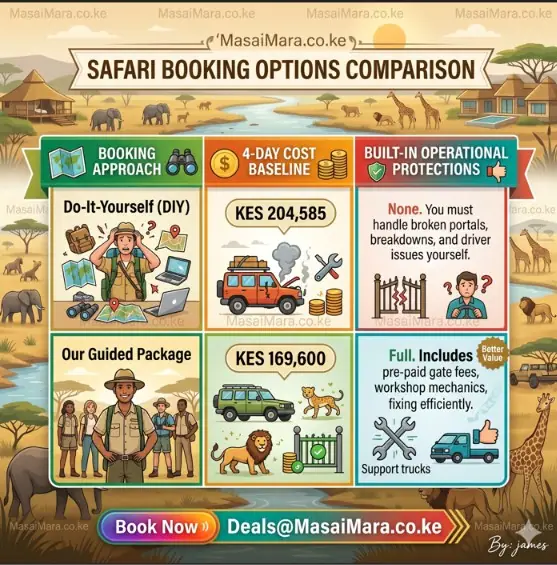
| Booking Approach | 4-Day Cost Baseline | Built-In Operational Protections |
| Do-It-Yourself (DIY) | KES 204,585 | None. You must handle broken portals, breakdowns, and driver issues yourself. |
| Our Guided Package | KES 169,600 | Full. Includes pre-paid gate fees, workshop mechanics, and field backups. |
| Component | DIY Cost (KES) | Our Package |
| Land Cruiser + fuel (4 days) | 96,500 | Included |
| Driver/guide | 20,000 | Included |
| Park fees (Nakuru + Mara) | 41,285 | Included |
| Accommodation + meals | 46,800 | Included |
| DIY Total | 204,585 | |
| Our Budget Package | 169,600 |
You save KES 34,985 and avoid the hassle of pre-paying through glitchy KWS portals, coordinating drivers, and handling emergencies yourself.
Seasonal Wildlife Calendar
Month | Predators | Migration | Rhinos | Flamingos |
Jan-Mar | ★★★★ | — | ★★★★★ | ★★★ |
Apr-May | ★★★ | — | ★★★★ | ★★ |
Jun | ★★★★ | Arriving | ★★★★ | ★★ |
Jul-Sep | ★★★★★ | Peak | ★★★★ | ★★★★ |
Oct-Dec | ★★★★ | Departing | ★★★★★ | ★★★ |
Rhino sightings stay consistent year-round because Nakuru is fenced. Flamingos? Nobody can predict them anymore.
Why Book Through Masaimara.co.ke
We operate these routes weekly. The vehicles are ours—Toyota Land Cruisers maintained in our Nairobi workshop by a mechanic named Peter who’s been with us for eight years. Guides are employees, not contractors we hired last week.
When a vehicle breaks down inside the park—and it happens, don’t let anyone tell you otherwise—we dispatch a replacement from our Narok base within hours. When the KAPS payment system crashes at Sekenani Gate at 6:30am (which happens about twice a month), I know the workarounds.
We’re based here. We’re not going anywhere. That matters more than you might think.
Frequently Asked Questions
Can I do this in 3 days?
You can. I wouldn’t recommend it. You’ll spend more time on roads than watching wildlife.
Is Nakuru worth it without flamingos?
Yes. The rhino sanctuary alone justifies the stop. I’ve never had a guest leave without seeing at least one rhino.
Which park first?
Nakuru. Shorter drive from Nairobi, builds anticipation. Nakuru is excellent but the Mara is extraordinary. End on the high note.
Best time for flamingos?
July-November typically. But honestly? Nobody can predict them anymore. If guaranteed flamingos matter, we can add Lake Bogoria.
Kids allowed?
Absolutely. Both parks welcome families. Kids under 3 enter free. The Mara’s open landscapes are easier for children than forest reserves.
Related Safaris
- 3-day Masai Mara — skips Nakuru, solid Big Five
- 5-day with Lake Naivasha — adds boat safaris
- Mara + Amboseli for elephants — Kilimanjaro backdrops
- Flying safari packages — Mara in 45 minutes
- Full cost breakdown
- When to visit
- Accommodation guide
- Budget options
- Luxury packages
- Nairobi logistics
Ready to Book?
Tell us your dates and group size. We’ll build something that actually works.
I’m Daniel Kimani. I’ve been running the Nakuru-Mara corridor since 2014—that’s over a decade of the same roads, same parks, same lodges. I know which cooks make good chapati and which roads flood first. For current park fees, check Kenya Wildlife Service and KAPS. This page was last updated August 2026.
Welcome to Masaimara.co.ke
Thank you for visiting us! We're excited to help you plan an unforgettable safari adventure across Kenya.