
3 Days Masai Mara Nairobi National Park Safari: The Quick Combo Done Right
A 3 Days Masai Mara Nairobi National Park Safari is the most efficient way to see Kenya’s big cats and rhinos starting right from the capital. This trip typically includes one dawn game drive in Nairobi National Park followed by two nights in the Masai Mara. For the 2026 season, expect to pay between KES 145,000 and KES 480,000 per person depending on your choice of lodging and the time of year. Flying between cities can save you six hours of driving but adds significantly to the cost.

Safari Phase | Smart 3-Day Execution |
Day 1: Dawn | Enter Nairobi National Park at 6:30 AM sharp for prime predator action and clean skyline light. |
Day 1: Midday | Complete game drive by 10:00 AM; hit the road to the Mara by 11:30 AM to catch a sunset drive. |
Days 2–3: The Core | Dedicate to high-density loops via Sekenani Gate and cold-dawn tracking runs. |
3 Days Masai Mara Nairobi National Park Safari Costs (2026/2027)
Pricing for 2026 has changed. KWS park fees and the eCitizen payment system have shifted how we calculate these trips. Below is a breakdown for two people traveling together in a 4×4 Safari Land Cruiser.
2026/2027 Price Table (Per Person Sharing)
Package Tier | Suggested Hotels | Regular Season (KES) | Peak Season (KES) | Book Now |
Budget | Eka Hotel (Nairobi) & Talek Bush Camp (Mara) | KES 145,800 | KES 255,400 | |
Mid-Range | Tamarind Tree (Nairobi) & Ashnil Mara Camp | KES 189,200 | KES 315,600 | |
Luxury | Ole Sereni (Nairobi) & Mara Serena Safari Lodge | KES 245,500 | KES 385,000 | |
Luxury Plus | Hemingways (Nairobi) & Angama Mara | KES 320,000 | KES 485,000 |
Note: All prices are calculated using the 2026 Land Cruiser rates of USD 190 (Regular) and USD 400 (Peak) per person per day. Conversion is based on current 2026 KES rates. Peak season runs from July to October during the Great Migration.
What’s Included and Excluded
Included in your price:
- Private 4×4 Safari Land Cruiser with a pop-up roof.
- Professional TRA-licensed guide.
- All park fees for Nairobi NP and Masai Mara (paid via eCitizen).
- Accommodation on full board (breakfast, lunch, dinner).
- Airport transfers in Nairobi.
- Bottled water in the vehicle.
Excluded from your price:
- Sheldrick Wildlife Trust donation (KES 1,500 per person).
- Tips for the guide (we suggest KES 2,500 – 5,000 per day per group).
- Alcoholic drinks and sodas at the lodges.
- International flights and Kenya eTA.
- Optional hot air balloon safari in the Mara (approx KES 65,000).
- Optional Masai village visit (KES 4,500).
I’ve been guiding out here for ten years, and I’ve seen every mistake a traveler can make. Usually, it starts with someone trying to find a wild elephant in the middle of Nairobi. I have to tell them gently: “You’re about fifty years too late for that.”
If you’re looking for a 3 Days Masai Mara Nairobi National Park Safari, you’re likely short on time but high on expectations. You want the Big Five — lion, leopard, elephant, buffalo, rhino — you want the savanna, and you want to be back in time for your flight home. It’s a tight squeeze. You can pull it off, but only if you stop treating the itinerary like a grocery list and start looking at the logistics.
Before we get into the dirt and the details, you might want to get a custom safari quote here to see what’s available for your specific 2026 dates.
The Realistic 3-Day Itinerary
Most operators sell this trip as Day 1 Nairobi NP, Day 2 drive to the Mara, Day 3 game drive and return. That itinerary has a problem: Day 2 is basically a transit day. You arrive at the Mara around 1:00–2:00 PM, settle into your camp, and get maybe a two-hour afternoon game drive. You’ve burned a full day sitting in a vehicle on a highway.
Here’s the smarter play — the one I actually run:
Day 1: Dawn in Nairobi, Sunset in the Mara
We start at 6:30 AM in Nairobi National Park. Three hours of game driving — lions, rhinos, zebras against the Nairobi skyline. By 10:00 AM, we exit the park. Quick stop at the Sheldrick Wildlife Trust (11:00 AM–Noon) if you’ve pre-booked. Then we hit the road to the Mara by 11:30 AM. We arrive around 5:00 PM — just in time for a sunset game drive. You’ve now got animals on both ends of Day 1 instead of wasting it on transit.
Day 2: Full Day Game Drive in the Mara
This is the payoff. Morning game drive from 6:15 AM — you’ll get the 5:30 AM wake-up call with a thermos of Kenyan tea — back for breakfast, then out again at 3:30 PM until dusk. This itinerary runs through the Masai Mara National Reserve (entering via Sekenani Gate), not the private conservancies that surround it. The reserve is where the highest density of wildlife sits, though the conservancies offer off-road driving and fewer vehicles if you upgrade. A full day gives you the best chance of finding leopards along the Talek River and cheetahs on the open plains. If the Mara River crossing is happening (July–October), we position near the banks in the morning and wait.
Day 3: The Early Hunt and the Journey Back
One last dawn game drive. This is when the air is cold enough to see your breath and the cats are still on the move. We check out by 8:30 AM and head back to Nairobi, arriving mid-afternoon — enough time for an evening flight.
Flying vs. Driving to the Mara
On a 3-day trip, the Nairobi-to-Mara transit eats into your game drive time. Here’s how the two options compare:
Feature | Driving (4×4 Land Cruiser) | Flying (Safarilink / AirKenya) |
Duration | 5–6 hours | 45 minutes |
Cost | Included in base price | Approx. KES 52,000 extra pp |
Experience | Rift Valley views, Maasai villages, lunch in Narok | Aerial views of the Mara plains |
Best for | Budget travelers, those who enjoy road trips | Short layovers, anyone who hates bumpy roads |
If you fly, you land at Keekorok or Olkiombo airstrip and your Mara-based guide picks you up on the runway. You gain roughly five extra hours of game drive time — which on a 3-day trip is massive. More on flights in our Nairobi to Masai Mara flights guide.
Nairobi NP: No Elephants — and Other Things Nobody Warns You About
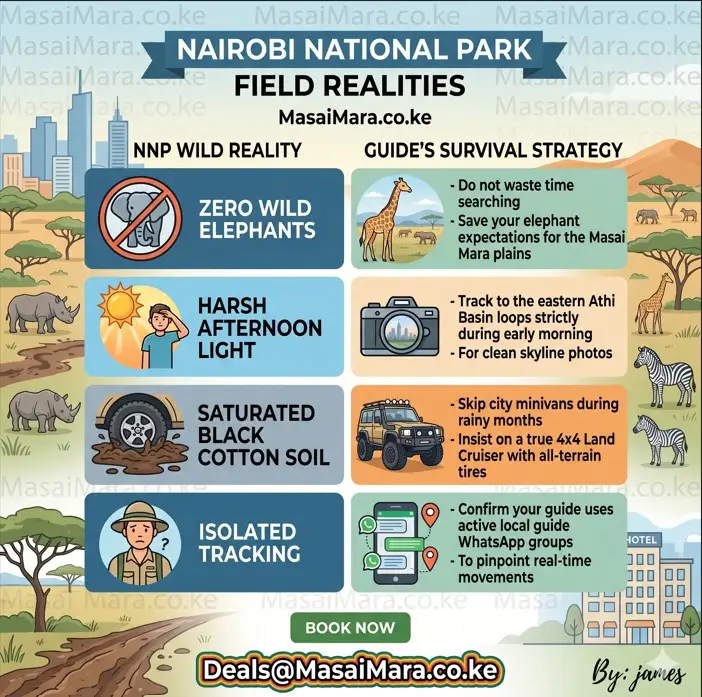
NNP Wild Reality | Guide’s Survival Strategy |
Zero Wild Elephants | Do not waste time searching; save your elephant expectations for the Masai Mara plains. |
Harsh Afternoon Light | Track to the eastern Athi Basin loops strictly during early morning for clean skyline photos. |
Saturated Black Cotton Soil | Skip city minivans during rainy months; insist on a true 4×4 Land Cruiser with all-terrain tires. |
Isolated Tracking | Confirm your guide uses active local guide WhatsApp groups to pinpoint real-time movements. |
This catches people off guard every time. Nairobi National Park is probably the best place in East Africa to see the Black Rhino — but there are no wild elephants. Haven’t been for decades. The migration routes to the Amboseli plains were cut off by human settlement long ago. If you see a picture of an elephant with the Nairobi skyline, it’s either from the Sheldrick nursery or a clever edit. Don’t worry — the Mara leg of this trip will more than cover your elephant quota.
The skyline shot: That famous photo of giraffes or zebras framed against Nairobi’s towers? It requires driving to a specific viewpoint on the eastern side of the park, near the Athi Basin. It’s not on the standard loop. Tell your guide you want it at the start of the drive — and go in the morning. Afternoon light hits the skyline at a harsh angle that washes out photos.
The roads: NNP’s internal tracks are worse than the Mara’s during rainy season (April–May, November). The black cotton soil turns into a genuine mud pit. I’ve seen vehicles stuck for 40 minutes near the hippo pools — even Land Cruisers with heavy-duty all-terrain tires struggle when the black cotton gets saturated. If you’re visiting in the rains, confirm that your operator sends a 4×4 for the NNP portion. Some budget companies use minivans for the Nairobi leg and only switch to a Land Cruiser for the Mara. That’s a problem when you’re sliding sideways on a wet track.
The cold: Nairobi sits at 1,700 meters. At 6:30 AM, expect 12°C (54°F) with wind chill in an open-roof vehicle. Pack a fleece specifically for this morning drive. The Mara is warmer by midday, but that first NNP game drive can leave you shivering if you assumed Kenya means hot weather all the time.
The WhatsApp factor: In the Mara, guides share sightings over handheld radio in Maa. In NNP, they use WhatsApp groups. Ask your guide if they’re in the active NNP guide group that morning. A freelance driver without group access is driving blind in 117 km² of bush — you could miss the lions by 500 meters and never know it.
Local advice: When we’re in Nairobi NP, ask me to head toward the “hyena dam” or the “no. 2 circuit.” Most drivers stay on the main tarmac loops. The rocky tracks in the south give us a much better shot at finding a leopard.
The Sheldrick & Ivory Burning Truths
If you’re adding the Sheldrick Wildlife Trust to your first day, three things to know:
The one-hour rule. The visit runs from 11:00 AM to Noon. No flexibility. If you arrive at 11:45, you’ve missed the feeding. The nursery entrance is through the Mbagathi/Magadi Gate — not the main NNP gate. If your guide takes the wrong exit, you lose 20 minutes.
The double fee. Since 2024, KWS requires you to pay the full Nairobi National Park entry fee just to reach the orphanage — even if you’ve already done your game drive and exited. That’s on top of the Sheldrick’s own KES 1,500 donation. Pay your KWS fees online before arriving; the cell signal at Mbagathi Gate is unreliable.
The ivory burning site. Almost every operator skips this. It’s a quiet spot inside NNP where 105 tons of confiscated ivory were turned to ash in 2016. Just a pile of gray dust and a monument. I like stopping here because it reminds us why we do this work. Takes ten minutes. Ask for it.
The Guide’s Failure Story: The “Gate Timeout”
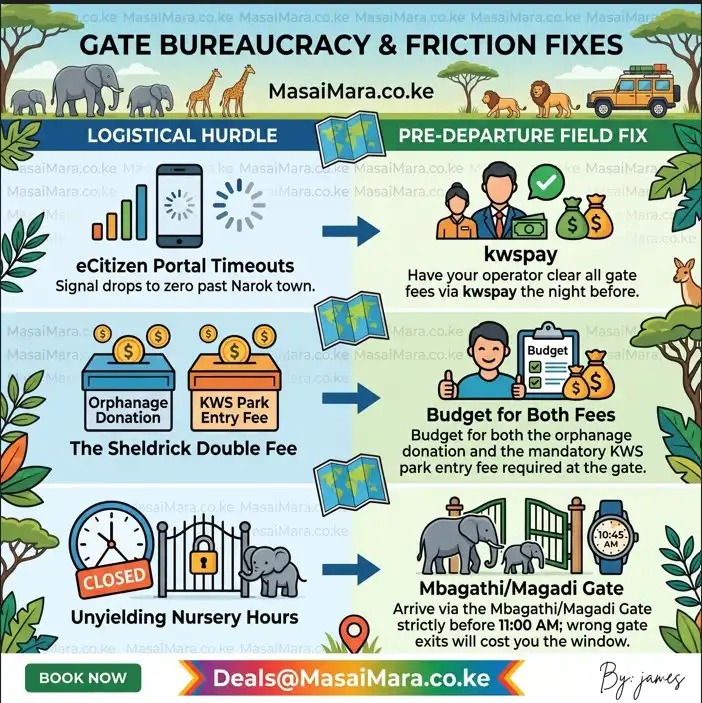
Logistical Hurdle | Pre-Departure Field Fix |
eCitizen Portal Timeouts | Signal drops to zero past Narok town. Have your operator clear all gate fees via kwspay the night before. |
The Sheldrick Double Fee | Budget for both the orphanage donation and the mandatory KWS park entry fee required at the gate. |
Unyielding Nursery Hours | Arrive via the Mbagathi/Magadi Gate strictly before 11:00 AM; wrong gate exits will cost you the window. |
I once had a couple who insisted on paying their own Masai Mara park fees to keep control of their budget. We got to Sekenani Gate at 9:00 AM. The sun was getting hot.
The eCitizen portal kept timing out on their phones because the signal at the gate is awful. We sat in that hot Land Cruiser for 50 minutes while they refreshed their browser. By the time the payment went through, the lions we were tracking had moved into the thickets to sleep.
Here’s the thing nobody tells you about the Nairobi to Masai Mara drive: the last 80 km past Narok town has almost no cell signal. If you need to confirm lodge bookings, call ahead, or pay park fees, do everything before you leave Narok. Trying to load a payment page while bouncing on corrugated murram is a recipe for frustration and lost game-viewing time.
My tip: Let your operator handle the fees through the official kwspay portal the night before. Don’t be the person stuck at the gate while the wildlife is out hunting.
Local Tips You Won’t Find on Google
The Giraffe Centre shortcut
The Karen Blixen / Giraffe Centre area sits right on the route between NNP’s main gate and the highway to the Mara. If your timing lines up (they open at 9:00 AM), a 30-minute stop to hand-feed Rothschild giraffes makes a solid add-on — especially if you’re traveling with kids. Skip the Carnivore Restaurant nearby though. It’s overpriced for mediocre game meat. Grab lunch in Narok instead; the food is cheaper and you save 45 minutes.
The “African Massage”
On the road from Narok to the Mara, you’ll experience what we call the “African Massage.” It’s 75 kilometers of corrugated dirt road. If you have a choice, sit in the middle row. The back row of a Land Cruiser acts like a catapult over those bumps.
The smell of the bush
In the Mara, when we drive off-track (where allowed in conservancies), the tires crush wild sage and wild mint. That peppery, herbal scent fills the car. In Nairobi NP, especially near the dams, the smell is different — heavy with damp earth and acacia blossoms when the rain has just passed.
Avoid the curio trap
On the drive to the Mara, many drivers stop at a specific curio shop “for the bathroom.” You’ll be swarmed by five guys trying to sell you a KES 15,000 carving that costs KES 2,000 in Nairobi. I always stop at the Shell or Total stations in Narok town. Cleaner facilities. Nobody tries to sell you a spear while you’re washing your hands.
Frequently Asked Questions
What is the best time for this safari?
The best time to visit Masai Mara is July through October if you want the migration. January and February are better for seeing big cats in Nairobi NP because the grass is shorter. Read more about Masai Mara in January or February.
Is 3 days enough for both parks?
It’s a taster trip. If you can spare more time, a 3 days Masai Mara safari on its own gives you more game-viewing hours. But if you want both parks, this combo works — especially with the itinerary above that avoids wasting Day 2 on transit.
How much are the 2026 park fees?
For Nairobi NP, roughly $43 for non-residents. For the Mara, $100 per 24 hours in regular season and $200 in peak season (July–December). Full breakdown on the Masai Mara park fee page and the official KWS website.
Can I drive from Nairobi to the Mara?
Yes, 5–6 hours via the Narok road. If you want more game drive time and less road time, check the how to get to Masai Mara guide for flight options from Wilson Airport.
What should I pack?
Layers (fleece for NNP mornings, t-shirt for the Mara by noon), power bank, physical passport, binoculars, and a hat. Full list in our Masai Mara packing list.
Is this trip safe?
Yes. Both parks have rangers, your guide carries a radio, and the lodges are well-established. More detail in our Masai Mara safety guide. The real risk isn’t wildlife — it’s road accidents on the Narok highway after dark, which is another reason to leave Nairobi early and arrive before sunset.
Ready?
A 3 Days Masai Mara Nairobi National Park Safari is a lot of driving and early mornings. If you’re okay with dust and a 5:30 AM wake-up knock from the camp askari, you’ll see things most people only watch on TV. If you decide you need more time, look at a 4 days Masai Mara Nairobi National Park safari or a 5 days Masai Mara safari. But if 72 hours is what you’ve got, let’s make them count.
Fill out our booking form at Masaimara.co.ke and I’ll build you a trip that actually works.
Written by David Njunge, a TRA-licensed safari guide with over 10 years in the field. Edited by Cecilia Wambui, a travel consultant with a degree in Tourism and Hospitality Management.
Related Reading:
Welcome to Masaimara.co.ke
Thank you for visiting us! We're excited to help you plan an unforgettable safari adventure across Kenya.