
Masai Mara and Nairobi National Park Safari – The Smart First-Day Combo
A Masai Mara and Nairobi National Park safari runs 4-5 days. Start with Nairobi NP on your arrival afternoon, sleep off jet lag, drive to the Mara next morning. That’s the short version.
Here’s why this combination makes more sense than sitting in a hotel “resting” until tomorrow.
You land at JKIA exhausted. Most itineraries have you waiting around Nairobi doing nothing useful. But Nairobi National Park is twenty minutes from the airport. You could be watching lions by 3 PM – lions with actual skyscrapers behind them. That image wakes people up faster than any amount of coffee.
I’ve run this route for years. The jet-lagged clients always think they’re too tired. Then they see a black rhino with the Kenyatta International Convention Centre in the background and suddenly they’re fine.
What This Guide Covers
2026 Prices
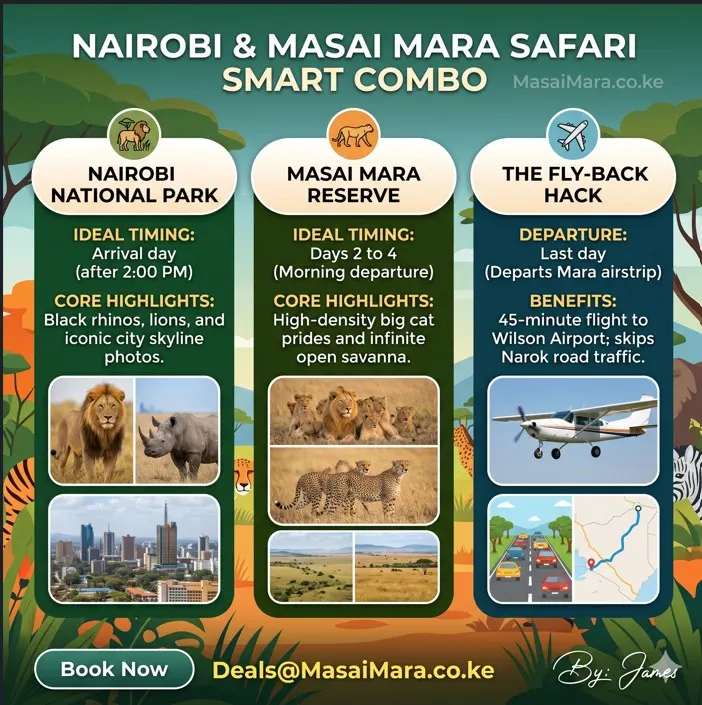
Safari Stop | Ideal Timing | Core Highlight |
Nairobi National Park | Arrival day (after 2:00 PM) | Black rhinos, lions, and iconic city skyline photos. |
Masai Mara Reserve | Days 2 to 4 (Morning departure) | High-density big cat prides and infinite open savanna. |
The Fly-Back Hack | Last day (Departs Mara airstrip) | 45-minute flight to Wilson Airport; skips Narok road traffic. |
Two sharing, private Land Cruiser throughout.
Park Fees (Non-Resident, USD)
- Nairobi NP: USD 80/day
- Masai Mara: USD 100/day (low) / USD 200/day (peak)
4-Day Safari – Non-Resident (USD)
Tier | Lodges | Low Season | Peak Season |
Budget | Eka Hotel + Jambo Mara | 1,280 | 2,380 |
Mid-range | Ole Sereni + Sentrim Mara | 1,580 | 2,780 |
Luxury | Hemingways + Mara Serena | 2,180 | 3,580 |
Premium | The Emakoko + Mara Intrepids | 2,780 | 4,380 |
4-Day Safari – Kenyan Residents (KES)
Tier | Lodges | Low Season | Peak Season |
Budget | Eka Hotel + Jambo Mara | 168,000 | 248,000 |
Mid-range | Ole Sereni + Sentrim Mara | 208,000 | 318,000 |
Luxury | Hemingways + Mara Serena | 288,000 | 418,000 |
Premium | The Emakoko + Mara Intrepids | 368,000 | 528,000 |
5-Day Safari (add a Mara night): Add USD 280-480 / KES 38,000-65,000 depending on tier and season.
The fly-back hack: Drive to the Mara (scenic, helps you acclimatize). On your last day, book a seat-rate flight from the Mara airstrip to Wilson Airport. Saves you from the Sunday afternoon Narok-Nairobi traffic nightmare. Flights run USD 230 / KES 30,000 per person.
What’s Included
- Airport pickup and drop-off
- Private 4×4 Land Cruiser with pop-up roof
- English-speaking driver-guide
- Fuel for all transfers and game drives
- All park fees: Nairobi NP (1 day) + Masai Mara (2 days)
- Full board in Mara, B&B in Nairobi
- Bottled water during game drives
- AMREF emergency evacuation cover
What’s Not Included
- Tips for guide (USD 15-20 / KES 2,000-2,500 per day)
- Alcoholic and soft drinks
- Travel insurance (required)
- Balloon safari (USD 500 / KES 65,000)
- Sheldrick Elephant Orphanage / Giraffe Centre entry
- Maasai village visits
The Nairobi Day
Afternoon is the only sensible time. I know morning sounds logical – “get an early start” – but the park turns into an oven by 10 AM. Animals disappear. The light goes harsh and flat. By 2 PM things cool slightly and animals start moving. Sunset light is what you actually want anyway.
Gate choice matters. If you’re coming from the airport area or staying near JKIA, use the East Gate. It’s far less crowded than Main Langata Gate and drops you straight into open plains where cheetahs hang out. You avoid the mini-van traffic jams entirely.
If you’re coming from Karen or Langata, Main Gate works. It puts you closest to the lion areas and the famous skyline shots near Athi Basin.
Most tourists hit the Ivory Burning Site because it’s famous. Locals go somewhere else entirely – Mokoiyet Picnic Site. It sits on a cliff overlooking the Mbagathi River gorge. Rock hyrax everywhere (those weird little mammals that are somehow related to elephants). And leopards use the trees in the gorge to stash their kills. I’ve seen more leopards from that cliff than anywhere else in the park.
The SGR train shot. This is the viral photo – giraffe or zebra with the modern Madaraka Express train crossing behind. You need to be near Athi Basin around 8:30-9 AM or 3:30-4 PM when trains pass. Many guides skip this “urban” area, but for photographers it’s THE Nairobi shot. Nothing else like it anywhere.
One thing that confuses first-timers: there are zero elephants in Nairobi National Park. The park is too small to support their feeding habits. If you want elephant photos before the Mara, visit the Sheldrick Trust – it’s physically next to the park but separated by a fence, and they only do public visits at 11 AM. Book online in advance or you’ll get turned away.
The Road to the Mara
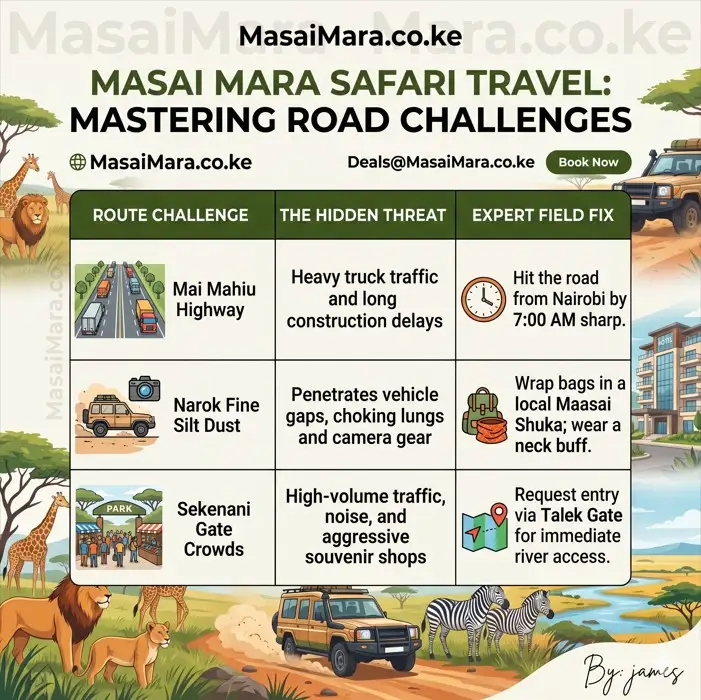
Route Challenge | The Hidden Threat | Expert Field Fix |
Mai Mahiu Highway | Heavy truck traffic and long construction delays | Hit the road from Nairobi by 7:00 AM sharp. |
Narok Fine Silt Dust | Penetrates vehicle gaps, choking lungs and camera gear | Wrap bags in a local Maasai Shuka; wear a neck buff. |
Sekenani Gate Crowds | High-volume traffic, noise, and aggressive souvenir shops | Request entry via Talek Gate for immediate river access. |
Five to six hours. Sometimes seven. Depends on the lorries.
The B3 highway through Mai Mahiu escarpment gets clogged with trucks. Construction crews have been working on sections for years now. Budget extra time. Leave Nairobi by 7 AM if you can manage it.
Everyone stops in Narok. The unofficial “safari pit stop” is the Total Station – clean toilets, snacks, and all the drivers congregate there. Season’s Hotel across the road does decent food if you want to sit down. From Narok, it’s another two hours of progressively worse road until you hit the Mara gates.
The dust situation. The Narok-Sekenani road is brutal. Even in a closed vehicle, fine silt gets everywhere – in your camera, your lungs, your teeth. Buy a shuka (Maasai blanket) at the first roadside stall in Narok. Use it to cover your gear and bags. Works better than plastic and supports the local economy. Bring a buff or neck gaiter for your face.
Mara gate choice: Sekenani is the default because the road goes there. It’s also the busiest, loudest, most souvenir-shop-heavy entrance. If your lodge allows it, ask for Talek Gate instead. It drops you directly into big cat territory along the Talek River.
If your camp is in the Mara Triangle (western side), you’ll use Oloololo Gate. The Triangle is managed by a conservancy group and they’re strict – rangers actually fine drivers for going off-road or crowding animals. If you want a quieter, more ethical experience, ask your guide to spend more time there. But know that Triangle entry is a separate fee if your ticket doesn’t cover both areas.
The Mara Days
After Nairobi NP’s compact 117 square kilometers, the Mara feels infinite. Over 1,500 square kilometers of open savanna. Lions are almost guaranteed – I’ve seen three different prides before morning coffee on slow days. Cheetahs most drives. Leopards if your guide knows where to look.
During migration (July-October), add 1.5 million wildebeest to the picture. But honestly, the Mara delivers year-round.
The altitude catches people off guard. Nairobi and the Mara sit at 5,000+ feet. At 6 AM it can be 5°C (40°F). By noon it’s 30+ degrees warmer. That “safari vest” everyone wears isn’t fashion – it holds the ten layers you’ll peel off as the day heats up. Pack accordingly.
If you’re vegetarian: bring supplies. At budget camps, “vegetarian” often means boiled cabbage and rice. Hot sauce, nuts, protein bars – pack your own pantry essentials. Safari food is heavily meat-oriented.
Common Mistakes
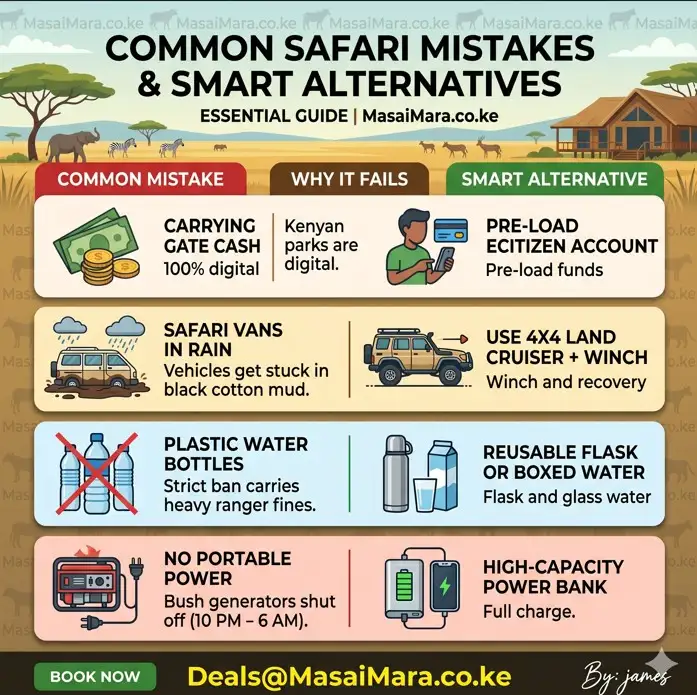
Common Mistake | Why It Fails | Smart Alternative |
Carrying Gate Cash | Kenyan parks went 100% digital | Pre-load funds onto an official eCitizen account. |
Safari Vans in Rain | Vehicles get stuck in deep black cotton mud | Insist on a 4×4 Land Cruiser with a recovery winch. |
Plastic Water Bottles | Strict single-use ban carries heavy ranger fines | Pack a reusable flask or buy boxed/glass water. |
No Portable Power | Bush generators shut off from 10 PM to 6 AM | Carry a fully charged, high-capacity power bank. |
Expecting to pay cash at the gate. Kenya has moved to digital. Park gates use the eCitizen/PesaFlow system. Many tourists get stuck because they expect to hand over cash or swipe a card. Your guide should handle this, but if you’re self-driving, set up an eCitizen account before you arrive.
Bringing plastic water bottles. Kenya has a strict single-use plastic ban. If rangers spot a plastic bottle in your vehicle in the Mara, you can be fined. Bring a reusable bottle or buy water in glass/boxes.
Booking a safari van for rainy season. Don’t. You will get stuck in the black cotton mud. Insist on a 4×4 Land Cruiser, especially April-May or November. The price difference is worth not spending three hours being winched out of a rut.
Forgetting a power bank. Many budget and mid-range Mara camps only run generators from 6 PM to 10 PM. If your phone dies during the day, you’re out of luck until evening. Bring a charged power bank.
Underestimating M-Pesa. International credit cards fail at random moments due to poor signal. Having a local SIM with some M-Pesa float is a lifesaver for paying for drinks, village fees, or unexpected costs. Your guide can help you set this up.
Wrong binoculars for the parks. Nairobi NP is actually a birdwatcher’s paradise – better for birds than the Mara in some ways. If you’re interested, 8×42 magnification is the sweet spot. The Mara has “big” animals you can see with your eyes; NNP rewards people who look at the small stuff.
Questions
Can I do this in 3 days? Technically. Day 1: land, Nairobi NP. Day 2: drive to Mara, afternoon game drive. Day 3: morning drive, drive back, fly out. It’s brutal and I don’t recommend it. Four days minimum.
What if my flight arrives late? If you land after 2:30 PM, skip Nairobi NP that day. Swap the itinerary – do the Mara first, then hit Nairobi NP on your last morning before your evening flight home.
Which park is better? Different experiences. Nairobi NP for the surreal city-wildlife shots and black rhinos. The Mara for everything else – big cats, migration, open landscapes. Do both.
Is Nairobi safe? The park is fenced with KWS rangers. The city has its issues like any major city, but the tourist areas (Karen, Langata, Westlands) are fine. Normal urban awareness applies.
Why is peak season more expensive? Mara park fees double from USD 100 to USD 200 per day. Vehicle rates increase because demand is high. Lodges charge premium rates during migration.
Book This
Tell us your arrival date. We handle airport pickup, vehicle, lodges, park fees – all of it.
David Njunge · Masaimara.co.ke · August 2026
More reading: 3-Day Mara Safari · 5-Day Options · Budget Safaris · Migration Guide · What to Wear · First Timer Tips
Park info: KWS · Mara Conservancies
Welcome to Masaimara.co.ke
Thank you for visiting us! We're excited to help you plan an unforgettable safari adventure across Kenya.