
Mara Intrepids Camp: The Honest 2026 Guide
Mara Intrepids has been on the Talek River since 1984, which makes it one of the oldest camps in the Mara and one of the few where families have been returning across generations. Thirty tents spread along the riverbank inside the national reserve, with hippos grunting below and vervet monkeys working the trees between the tents. The camp is fenced, the airstrip is five minutes away, and the Adventurers’ Club for children is the reason most families choose it over everything else in this part of the reserve.
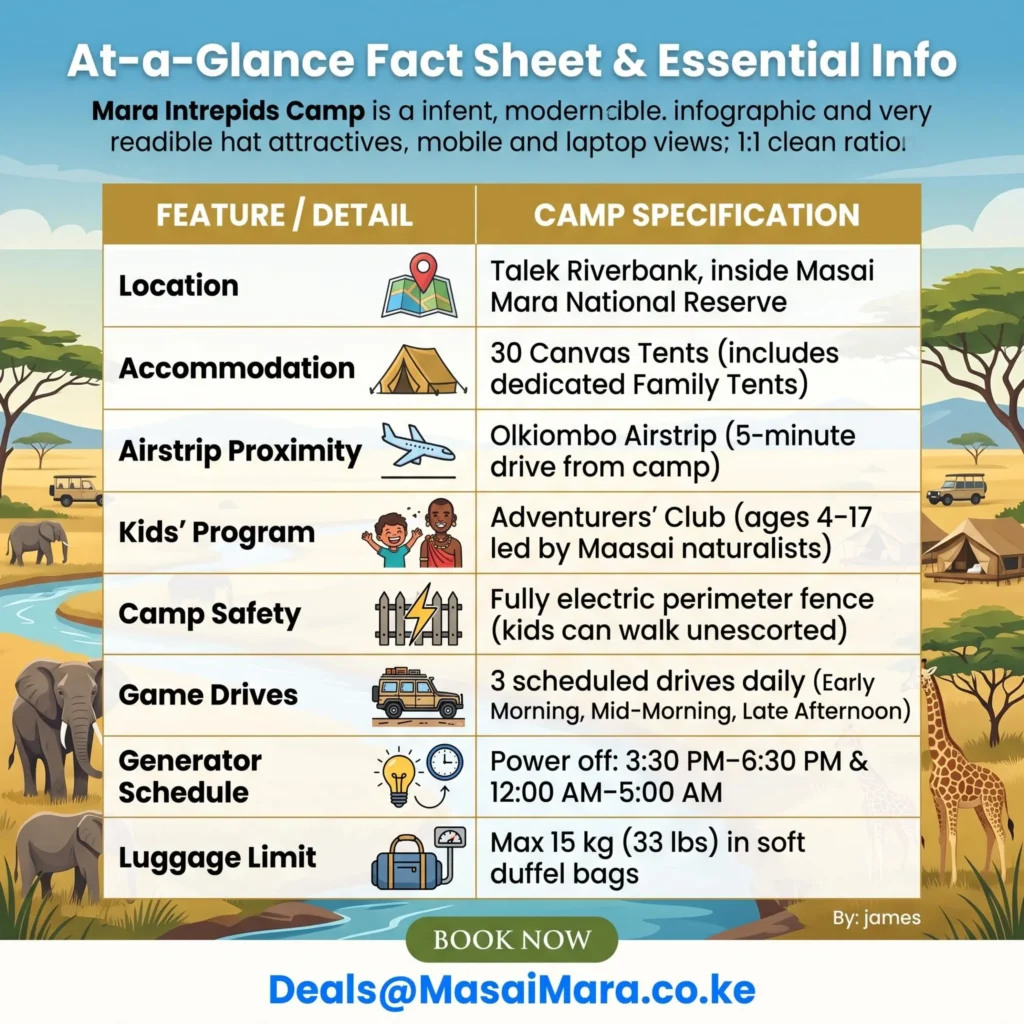
At-a-Glance Fact Sheet & Essential Info
Mara Intrepids Camp offers a distinct, family-friendly safari setup within the Masai Mara National Reserve. Below is a quick breakdown of the core specifications, facilities, and key policies to help you evaluate the camp at a glance.
Feature / Detail | Camp Specification |
Location | Talek Riverbank, inside Masai Mara National Reserve |
Accommodation | 30 Canvas Tents (includes dedicated Family Tents) |
Airstrip Proximity | Olkiombo Airstrip (5-minute drive from camp) |
Kids’ Program | Adventurers’ Club (ages 4–17 led by Maasai naturalists) |
Camp Safety | Fully electric perimeter fence (kids can walk unescorted) |
Game Drives | 3 scheduled drives daily (Early Morning, Mid-Morning, Late Afternoon) |
Generator Schedule | Power off: 3:30 PM–6:30 PM & 12:00 AM–5:00 AM |
Luggage Limit | Max 15 kg (33 lbs) in soft duffel bags |
Five Minutes from the Airstrip
Olkiombo Airstrip is close enough that one guest arrived to find a hippo crossing the runway. The transfer from the strip to camp barely counts as a drive. Flights from Nairobi’s Wilson Airport take 45 to 60 minutes, and flying in saves a full day in each direction. Pack in a soft duffel bag because hard cases don’t fit and the weight limit is 15 kg.
The road from Nairobi takes 5 to 6 hours and enters the reserve through the Talek area.
The Tents and the Talek River
The tents have African mahogany furniture, four-poster beds with mosquito nets, polished wood floors, and verandas overlooking the river. The style hasn’t changed much since the camp opened, and that’s part of its character. It feels established rather than trendy.
Every tent faces the Talek River. From the veranda you hear hippos through the night and watch bush babies moving through the fever trees after dark. Tent 18 is right on the water. The family tents at both ends of the camp (tents 1 and 2, tents 29 and 30) have two bedrooms with en-suite bathrooms and a connecting family room, and they sit at the camp’s edges where the foot traffic is lightest. Request them at booking.
A swinging footbridge crosses the Talek River from the camp, connecting to vehicles parked on the far side for drives into a different section of the reserve. Walking across it with hippos in the water below is one of those things that sticks with you.
The Adventurers’ Club and Why Families Keep Coming Back
The kids’ program runs for ages 4 to 17 and is led by Maasai naturalists who genuinely understand children. Nature walks, bush skills, animal tracking, and educational sessions that keep kids occupied and interested while parents are on game drives. No other camp in this part of the Mara does this as well.
The electric perimeter fence means children can move around the grounds freely between the tents, the pool, and the dining area without an armed escort. That matters more to parents of younger children than almost any other feature. The pool overlooks the Talek River, and swimming while watching hippos surface downstream is one of the camp’s quiet highlights.
Three Drives a Day and Where They Go
Most Mara camps offer two game drives: early morning and late afternoon. Intrepids offers three, adding a mid-morning option. That extra drive gives more flexibility. Guests who want a slow morning can still get two drives in.
The camp’s position on the Talek River puts it at the meeting point of four different game-viewing areas. Morning drives head north toward the Mara River for migration crossings during July to October. Afternoon drives work the central plains for cheetah and lion. The Talek riverine forest itself is prime leopard territory, and four leopard sightings in three days is the kind of number guests have reported from this area.
Because the camp is inside the national reserve rather than a conservancy, there are no night drives, no walking safaris, and no off-road driving. All game drives follow marked tracks with a 6:30 PM curfew. What the camp trades in activities, it gains in location: the migration corridors and the main river crossings are directly accessible without paying the conservancy-to-reserve double fee.
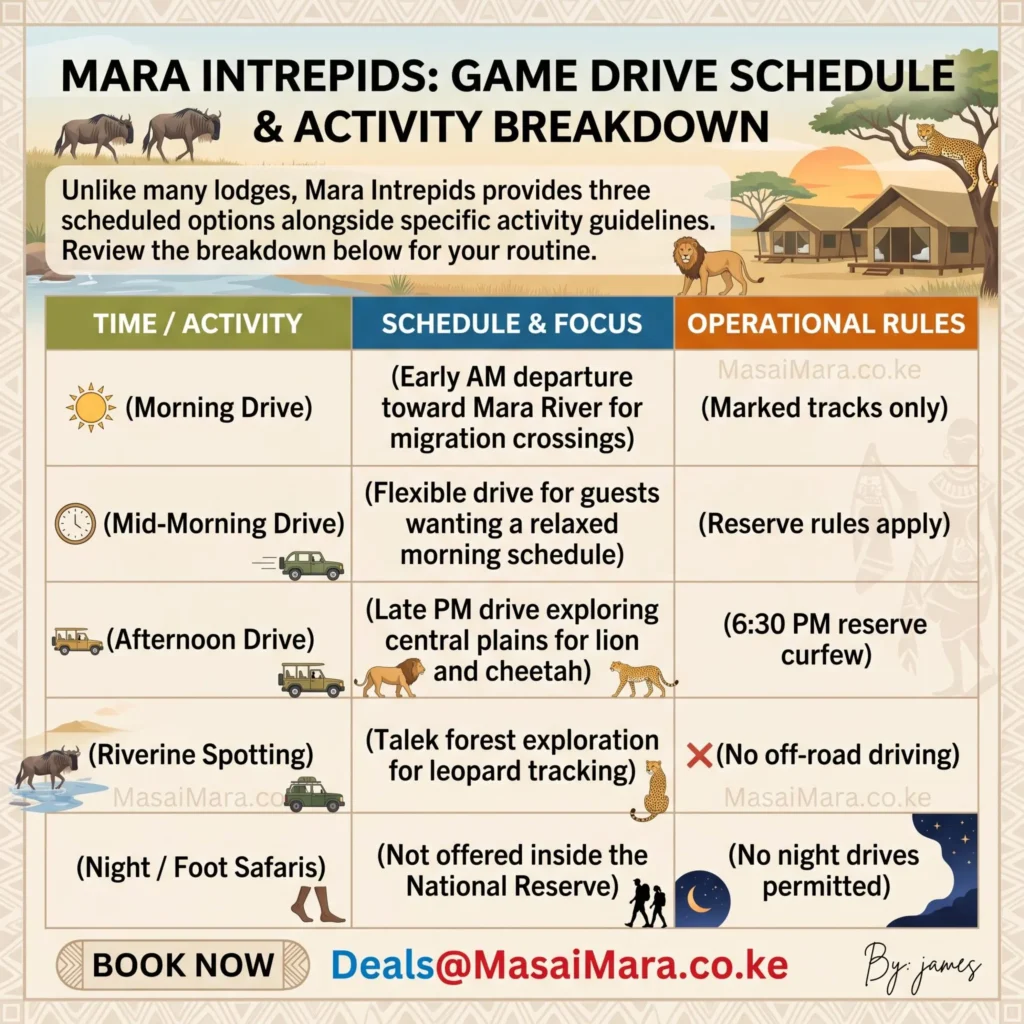
Game Drive Schedule & Activity Breakdown
Unlike many lodges that offer two game drives per day, Mara Intrepids provides three scheduled options alongside specific activity guidelines. Review the breakdown below to see how your game drives and daily routine are organized.
Time / Activity | Schedule & Focus | Operational Rules |
Morning Drive | Early AM departure toward Mara River for migration crossings | Marked tracks only |
Mid-Morning Drive | Flexible drive for guests wanting a relaxed morning schedule | Reserve rules apply |
Afternoon Drive | Late PM drive exploring central plains for lion and cheetah | 6:30 PM reserve curfew |
Riverine Spotting | Talek forest exploration for leopard tracking | No off-road driving |
Night / Foot Safaris | Not offered inside the National Reserve | No night drives permitted |
Three drives daily: 6:30 AM, 10:30 AM, 3:30 PM. This schedule is more structured than smaller camps. You can’t linger indefinitely at a sighting like you might in a private conservancy. But here’s the thing — the guides are genuinely knowledgeable and the location is exceptional.
75% of the BBC’s Big Cat Diary footage was filmed in this area. That’s not marketing. That’s geography.
The Morning Merge Trick
Don’t just do the standard two morning drives. Ask your guide the night before if you can merge the 6:30 and 10:30 drives into one long 6-hour drive with a packed bush breakfast.
Why? While everyone else heads back to camp at 10 AM for the buffet, you stay out. Head toward Double Crossing where the rivers meet — that’s where the leopards hang out. I’ve had clients get cheetah kills entirely to themselves because everyone else was back eating eggs.
Not every day allows this, but it’s worth asking. Best tip in this entire article.
Guides Worth Requesting
Ezekiel — Exceptional for photography tracking. Knows angles and light.
Dominic — Multiple guests have called him “the best guide we’ve ever had.” Calm tracking, good positions in crowds.
Samson — Deep year-round local knowledge. Great for repeat visitors.
Tom — Excellent with families. Adapts drives to children’s attention spans without making it boring for adults.
Joab and Paul — Both praised for getting good viewing positions when multiple vehicles gather.
Simon — Gentle, patient, strong on birds and ecosystem interpretation.
The guides use open-sided Land Rovers. Better visibility than closed vehicles, though you’ll feel the sun more during midday. A quick wardrobe tip: leave the navy blue and black clothes in your suitcase. Tsetse flies in the Talek riverine forest love dark colors. Stick to khaki. Your skin will thank me.
Nature Walks
Available with Maasai guides and armed rangers. They take you onto the plains around camp. Different experience from the vehicle — you notice dung beetles, animal tracks, smaller birds. Not available everywhere in the Mara, but Intrepids offers it.
The Generator Schedule and What It Means
Power runs on a generator that switches off from 3:30 PM to 6:30 PM and again from midnight to 5 AM. During those windows there are no lights, no fans, and no charging. Hot showers are available between 5:30 and 8:30 in the mornings and evenings, which lines up with the game drive schedule if you time it right. Overnight charging can be arranged through reception. UK-style 3-pin plugs in the tents.
WiFi works in the main areas only, not in the tents, and depends on the generator being on. There’s no TV anywhere in the camp.
Honest Assessment of What’s Dated
The camp was built in 1984 and the age shows in some places. Newer tents are well maintained, but some of the older rooms have sagging mattresses, blocked shower heads, and floors that could use attention. The main lounge and pool area feel solid and cared for, but the gap between the best tents and the worst tents is noticeable.
Meals are plated and served at the table by a dedicated waiter assigned to each group, which gives dining a more personal feel than the buffet format at larger lodges. The food changes daily and is good across the board. Pre-dinner talks by the resident naturalist cover wildlife behaviour, conservation, and Maasai culture, and some evenings include Maasai dancing around the fire pit.
Sound carries between tents. The canvas walls don’t block noise the way solid walls do. Tents at the ends of the camp have fewer neighbours and more quiet.
For what this camp does well, nothing else in the central reserve matches it. For guests who want modern luxury or conservancy activities like night drives and walking safaris, a different type of camp is the better fit.
Questions Guests Ask
Is it good for the migration?
Yes. The Talek River position gives direct access to the migration corridors, and the Mara River crossings are a morning drive north. During migration season the camp is ideally placed.
How does it compare to conservancy camps?
Intrepids is inside the reserve, so no night drives, no walking safaris, no off-road. The trade-off is the central location and no double fee for reserve access. Guests wanting both can do a split-stay: two nights at Intrepids for the reserve and the kids’ club, then two nights in a conservancy for the activities.
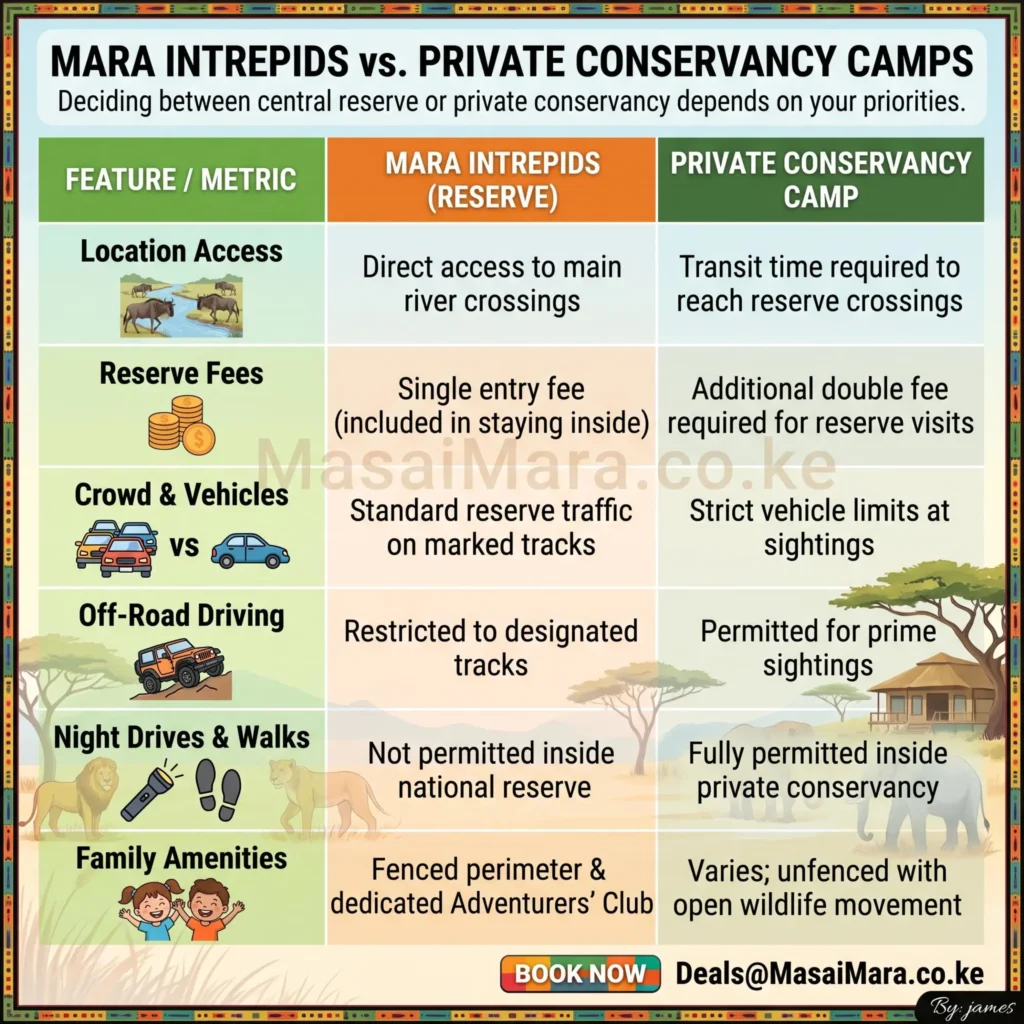
Mara Intrepids vs. Private Conservancy Camps
Deciding whether to stay inside the central reserve or a private conservancy depends on your priority between location access and activity freedom. Here is a direct comparison of how staying at Mara Intrepids compares to a private conservancy camp experience.
Feature / Metric | Mara Intrepids (Reserve) | Private Conservancy Camp |
Location Access | Direct access to main river crossings | Transit time required to reach reserve crossings |
Reserve Fees | Single entry fee (included in staying inside) | Additional double fee required for reserve visits |
Crowd & Vehicles | Standard reserve traffic on marked tracks | Strict vehicle limits at sightings |
Off-Road Driving | Restricted to designated tracks | Permitted for prime sightings |
Night Drives & Walks | Not permitted inside national reserve | Fully permitted inside private conservancy |
Family Amenities | Fenced perimeter & dedicated Adventurers’ Club | Varies; unfenced with open wildlife movement |
How do I start planning?
Send us your dates and we’ll tell you whether Intrepids fits what your family needs. I wouldn’t do fewer than three nights because two feels like you just arrived and you’re already packing, especially with children who need time to settle into the rhythm. Start a booking if dates are fixed, or tell us what matters most and we’ll build the trip around it.
This guide was authored by David Njunge, a TRA-licensed safari guide with over 10 years of experience, and edited by Cecilia Wambui, a travel consultant with a degree in Tourism and Hospitality Management.
Related Reading:
Welcome to Masaimara.co.ke
Thank you for visiting us! We're excited to help you plan an unforgettable safari adventure across Kenya.